Arizona water-users and managers meet and do business at CRWUA

IMG_0681

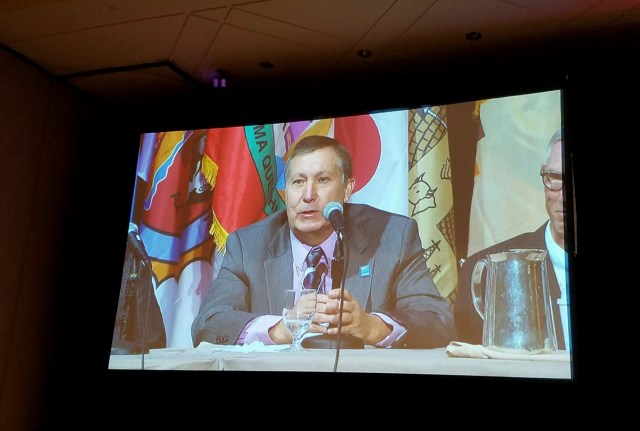
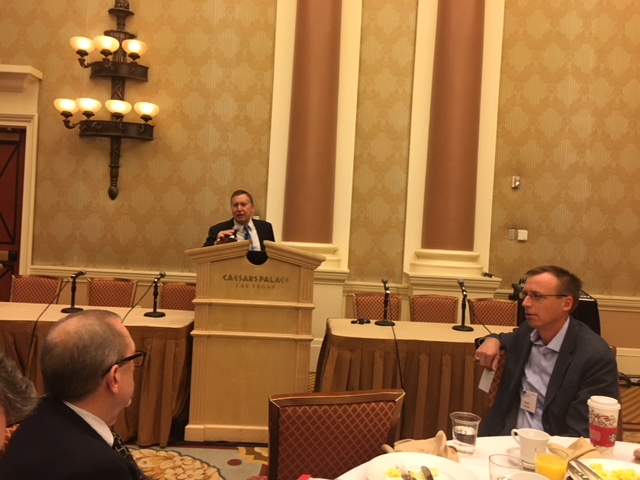
Arizona Department of Water Resources Director Tom Buschatzke briefs the Arizona contingent at CRWUA about Minute 323 developments whil Chuck Podolak, aide to U.S. Sen. Jeff Flake, and Central Arizona Project General Manager Ted Cooke look on

Under the direction of master-of-ceremonies Tom Buschatzke, the Arizona delegation conducted its necessary business work and house-keeping duties related to the Colorado River Water Users Association during the organization’s meetings last week.

The big news coming out of the Thursday breakfast meeting was that the so-called “big four” Arizona water organizations, which rotate Arizona presence on the Board of Trustees, rotated. Three of the four (the Arizona Department of Water Resources, Salt River Project, Yuma Area water users and the Central Arizona Water Conservation District) were in. One was out.

The odd group out this year? The CAWCD. The rotation scheme was set up years ago, noted Wade Noble, a representative of Yuma agriculture.

Buschatzke, Dave Roberts of SRP and Elston Grubaugh of the Wellton-Mohawk Irrigation & Drainage District will take on trustee duties.

Water Resources Director Buschatzke updated the Arizona attendees on 2017 state-related water issues.

Buschatzke briefed attendees on the status of Minute 323, the important water agreement completed this year between the U.S. and Mexico. A big part of the agreement involves progress on desalination efforts, he said.

“Desalination is a long-term project for the State of Arizona,” said Buschatzke. “It’s a long ways away, but at least we’re starting with that project.”

This isn’t confirmed, but Yuma-area ag representative Wade Noble told the substantial Arizona delegation to CRWUA that there is a reason why Arizona attendees must walk farther than anyone else when going to their caucus breakfast meetings.

It’s because Arizona is the largest of all the CRWUA contingents and their breakfast meeting room was the only one capable of holding such a large group.


Arizona Governor’s chief of staff makes surprise appearance at Colorado River water conference

IMG_0674

Ducey administration chief of staff Kirk Adams at a dinner on Wednesday hosted by Salt River Project. From Left: Hunter Moore, the Natural Resources Policy Adviser to Governor Ducey; Peter Hayes, associate SRP GM and chief public affairs executive; Mark Bonsall, general manager and CEO of SRP; Adams; David Rousseau, SRP President; Arizona Department of Water Resources Director Tom Buschatzke

Ducey chief of staff Kirk Adams attended the Colorado River Water Users Association meetings this week in Las Vegas.

Adams told the attendees with whom he met that Governor Ducey is committed to prioritizing a plan that will provide Arizona with a sustainable water future.

“We’re moving full-steam ahead with a broad coalition of stakeholders,” Adams said.

Adams addressed a theme that has become a central focus of the annual three-day CRWUA this year: pushing the long-debated Drought Contingency Plan agreement among Colorado River water users across the finish line.

At a keynote panel discussion involving top water executives organized the next day, all five panelists — including Arizona Water Resources Department Director Tom Buschatzke — emphasized the urgency of completing the multi-state agreement to protect Lake Mead.

“Not to be overly dramatic, but I believe that DCP is fundamental to the survival of how we do business,” said John Entsminger, general manager of the Southern Nevada Water Authority.

Arizona Water Resources Director Buschatzke returned to the DCP theme during nearly all of his speaking engagements at the conference.

“I’ve said it before, we need all hands on deck” to complete Lake Mead-saving water agreements, including both those hands inside Arizona and outside the state.

Chief of Staff Adams met on Wednesday with members.

“I’m gratified we could arrange this,” he said. “Water security is vital to Arizona’s future and it was important, I think, to assure the Colorado River community that Governor Ducey is committed to doing what we need to do to make it all happen.”

Kirk Adams and Mark Bonsal

SRP’s Mark Bonsall with Ducey Chief of Staff Kirk Adams at an event sponsored by SRP at the Colorado River Water Users Association conference in Las Vegas


Intro to CRWUA: noted historian Gregory Hobbs escorts Colorado River conference attendees into the past

IMG_0658

It is difficult to make out, but the map above, from Justice Hobbs’ collection, is a mid-19th century “Map of the Rocky Mountain Region.”

The first event of the annual Colorado River Water Users Association meetings by tradition is a look back. Retired Colorado Supreme Court Justice and senior water judge Gregory Hobbs escorts attendees back to the early, formative days of Colorado River law, which means he examines events in the mid-1800s and beyond.

As Hobbs himself observes, knowledge of the history of the Colorado River and its tributaries is essentially for understanding where things stand now.

“The most basic and fundamental lesson we ought to teach in our schools are these (Colorado River) compacts,” said Hobbs.

“The agreements among the Colorado River states allowed each state to use their allocation as they saw fit.”

An integral part of Justice Hobbs’ presentation each year is his effective use of maps, especially those created in the early days of Western settlement. Most of the maps that Hobbs uses in his CRWUA presentations are from his own extensive collection, which he since has donated to the Colorado Supreme Court. In 2010, Hobbs donated a substantial portion of his carefully archived papers to the Denver Public Library.

Many of the maps he uses at CRWUA are identified as “desecration maps.” Those mostly ancient maps, he said, constitute the “primary source documents that remind us who we are.”


Agenda for annual meeting of Colorado River water users is released

TB at CRWUA 2016

Water Resources Director Buschatzke, speaking during the keynote panel discussion at CRWUA 2016

Editor’s Note: As a service to our readers, the Arizona Department of Water Resources once again is providing a live blog of events as they occur at the Colorado River Water Users Association conferences in Las Vegas, Dec. 12-15.

When they say water is fluid, they’re not kidding. Even convocations assembled to  discuss water policy must remain fluid, especially when those discussions involve Colorado River water policy. Such is the rapidly evolving nature of the complex issues facing Colorado River water users.

Organizers of the Colorado River Water Users Association (CRWUA) annual conference have released the event’s agenda. But even as late as early December, the agenda is identified as “tentative” in order to accommodate potential changes in meeting planning.

Each year, water leaders from the Colorado River system states and the federal Bureau of Reclamation — as well as the system’s major water users, such as cities and agriculture — gather at CRWUA, sharing ideas about management of the most complex water system in the country, the Colorado River.

A focus of discussion among Colorado River states for the last several years has been drought contingency planning to protect and stabilize the river system, particularly Lake Mead, where water levels have drifted dangerously low in recent years.

Discussion about a “DCP,” or Drought Contingency Plan, is certain to play a central role this year as well.

It certainly will be one of the underlying themes of the Keynote Panel Discussion scheduled for Thursday, Dec. 14, entitled “A Ballet in the Making: Choreographing Issues Across the Basin.”

Arizona Department of Water Resources Director Tom Buschatzke will take part in that panel discussion, along with four other top Colorado River water-user executives. The panel will be moderated by Eric Kuhn, general manager of the Colorado River District for the State of Colorado.


ADWR Director to U.S. Senate: Tribal water settlement is a “strategic priority” for AZ

ADWR Director at Senate Indian Affairs

 Photo courtesy of U.S. Senate Committee on Indian Affairs

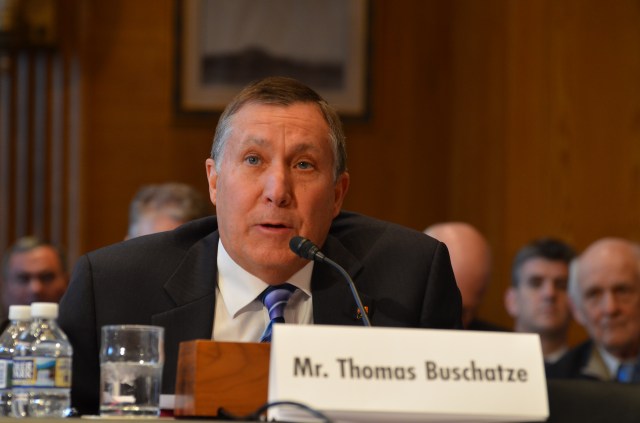
Arizona Department of Water Resources Director Tom Buschatzke on Wednesday told a panel of U.S. senators that an agreement to settle a tribal water-rights claim in northwestern Arizona constitutes a rare resolution that creates positive outcomes for all involved.

In both written and oral testimony, Buschatzke expressed Arizona’s strong support of S. 1770 – the Hualapai Tribe Water Rights Settlement Act of 2017, sponsored by Sens. Jeff Flake and John McCain – to the Senate Committee on Indian Affairs.

In his opening statement, Buschatzke called the agreement “a great step forward.”

He told the panel that the State of Arizona is strongly supportive of S. 1770, which formalizes an agreement reached in 2016 between the Tribe, the State of Arizona and several other major Arizona water users.

The United States participated in the negotiations through a team appointed by the Secretary of the Interior.

The agreement provides 4,000 acre-feet of Colorado River water annually to the Hualapai Tribe. As sponsor, Sen. Flake welcomed Director Buschatzke to the hearing.

In written testimony, Buschatzke told the senators that it represents a major step forward in providing water-certainty to all water users throughout Arizona.

“Half of the 22 federally recognized Indian tribes in Arizona still have unresolved water rights claims,” wrote Buschatzke.

“Resolving these claims through settlement is a strategic priority for the State, not only because it will avoid the cost and uncertainty of litigating the claims, but it will provide certainty to all water users in the state regarding available water supplies in the most expeditious manner possible,” he said.

The United States also will benefit from the reduced risk of costs associated with litigating the Tribe’s water-rights claims, Buschatzke noted.

Director Buschatzke observed that the agreement constitutes an economic opportunity for the Tribe, whose lands enjoy “breathtaking views of the west rim of the Grand Canyon.”

The Tribe operates the famous “Skywalk” tourist attraction at the western edge of the canyon, which attracts an estimated one million visitors annually. The Tribe has announced plans to expand that attraction.

By providing the Tribe with a renewable source of water from the Colorado River, the agreement is consistent with State policy of conserving groundwater supplies for times of drought, the Director wrote.

“Because the aquifer beneath the Tribe’s reservation extends to areas off the reservation, the Tribe’s use of a renewable water supply will help preserve groundwater supplies not just for the Tribe, but for non-tribal water users in the region,” said Buschatzke.

In his written testimony, the Water Resources Director broke down the financial responsibilities that each of the parties agreed to shoulder in 2016.

Those investments included a congressional appropriation of $134.5 million to build a pipeline to deliver the Colorado River water to Peach Springs and to the Tribe’s Grand Canyon West development. In addition, S. 1770 would authorize annual operation, maintenance and replacement costs of $32 million, as well as other federal expenditures.

Under questioning from Sen. Flake during the hearing, Buschatzke assured the committee that the infrastructure and water would “go exclusively to the Hualapai.”

Non-federal contributions to the agreement “are significant,” said Buschatzke.

The State of Arizona agreed to “firm” 557.5 acre-feet of the 4,000 acre-foot annual allocation to the Tribe, at a cost of $3.2 million to Arizona.

“The financial benefits that the United States will receive through the settlement will greatly exceed the costs that the United States will incur in constructing a pipeline to bring water from the Colorado River to the Tribe’s reservation,” Buschatzke wrote to the Senate panel.

Flake, McCain legislation would formalize a tribal-water settlement agreement six years in the making

US-Senate-Committee-on-Indian-Affairs

Arizona Department of Water Resources Director Tom Buschatzke will testify before a Senate Committee on Wednesday in support of a breakthrough agreement settling the Hualapai Tribe’s claim to water rights on the Colorado River as well as other water sources in Arizona.

The agreement is the result of long, complex negotiations that began in 2011.

Buschatzke is one of just five witnesses scheduled to testify on Wednesday before the U.S. Senate Committee on Indian Affairs.

Pending congressional approval of the deal, the Hualapai Tribe will become the 12th of Arizona’s 22 federally recognized Indian tribes to fully resolve its water-rights claims.

According to the terms of the  settlement, the Tribe would receive an annual allocation of 4,000 acre-feet of Colorado River water. The allocation will come from a volume of Colorado River water delivered by the Central Arizona Project that is designated for future Indian water rights settlements in the Arizona Water Settlements Act of 2004.

In addition, the agreement calls for the U.S. Bureau of Reclamation to plan, design and build a pipeline capable of delivering no less than 3,414 acre-feet per year from Diamond Creek on the Colorado River to the Tribe at Peach Springs, as well as to its Grand Canyon West tourist attraction. The legislation authorizes an appropriation of $134.5 million for construction of the pipeline, as well as additional funding for operating expenses.

Director Buschatzke is expected to affirm Arizona’s strong support for the settlement agreement, which constitutes a major step toward resolving the outstanding water-rights claims of Indian tribes throughout the State. The agreement also will provide the Tribe with a renewable source of water that will replace its current groundwater pumping.

The Senate Committee on Indian Affairs hearing is scheduled to begin at 12:30 pm (MST). The legislation, S. 1770, is sponsored by Arizona Sens. Jeff Flake and John McCain. The Hualapai Tribe Water Rights Settlement Act of 2017, as it is known, is one of three items on the Committee’s Wednesday agenda.

Live video of the hearing, as well as written witness testimony,  can be found on the Committee’s website here.


Water Resources Director to testify before Senate committee on Hualapai water settlement legislation

hualapai skywalk

The Hualapai Tribe’s famous “Skywalk” attraction overlooking the Grand Canyon

Arizona Department of Water Resources Director Tom Buschatzke will testify on Wednesday, Dec. 6, before the Senate Indian Affairs Committee on legislation that would provide the Hualapai Tribe of northwestern Arizona with 4,000 acre-feet of Colorado River water annually.

In 2016, the Tribe agreed to a settlement of its long-standing claim to Colorado River water. The legislation – S. 1770, introduced by Arizona Sens. Jeff Flake and John McCain — secures the 2016 agreement.

The agreement ensures that the tribe’s previously outstanding water claims could not potentially displace water used by other customers that also rely on the Colorado and Verde rivers. As a result, the agreement helps provide certainty for water users throughout Arizona.

In addition to its claim to Colorado River water, the Tribe also has a claim to water of the Upper Verde River watershed.

At the time of the settlement agreement, Director Buschatzke noted that the settlement of tribal water-rights claims “has long been a top strategic priority for the State.”

“The resolution of the Hualapai Tribe’s water-rights claims, including its claims to Colorado River water, is a major step to providing long-term certainty to water-users throughout the State,” said  Buschatzke.

“This settlement will allow the Hualapai Tribe to enjoy the assurance of a secure and dependable water supply to its communities. Senator John McCain and Senator Jeff Flake deserve great credit for sponsoring this settlement legislation in the Senate.”

The Senate Indian Affairs Committee hearing on the proposed legislation — known as the Hualapai Tribe Water Rights Settlement Act — is scheduled for 12:30 p.m. (MST).