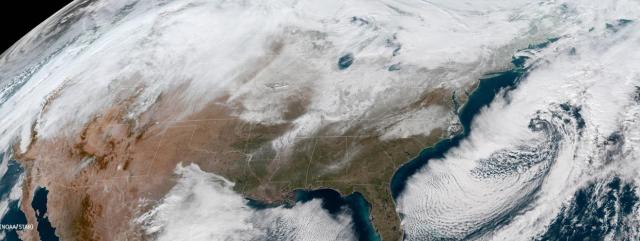
Attack of the Blob: How an enormous, persistent arctic low-pressure system is helping dry out the American Southwest

Article_banner_1

It’s… the blob. It came from above. And it’s got the world in its grip.

And… it’s not going anywhere any time soon.

If that sounds like a trailer line for a low-budget sci-fi movie… well, it could be.

But it also fairly describes the powerful “Strong Hudson Bay Low” – an Arctic-spawned low-pressure systemthat locked in place over much of the Northern Hemisphere in mid-November. The strong, static “blocking” system is showing no sign of releasing its grip any time in the foreseeable future.

“WITH SNOW CONDITIONS IN THE UPPER COLORADO RIVER BASIN TRACKING AT JUST 31 PERCENT OF THE TOTAL AVERAGE SEASONAL ACCUMULATION AS OF MID-JANUARY, THE 2018 SEASON IS LOOKING DRYER THAN THE RECORD-DRY 2002 SEASON.”

And neither is one of the stronger regional effects of the huge low-pressure system:

An equally persistent, equally strong high-pressure ridge has locked into place beneath the blob. It sits in an equally unyielding “blocking” pattern over the eastern Pacific and the southwestern U.S., which is driving the west-east jet stream and its storms well to the north of the parched American Southwest.

That strong high-pressure system is proving to be a virtual mirror image of the Strong Hudson Bay Low, driving temperatures dramatically up and sapping the atmosphere of moisture.

“How strong and permanent it becomes depends on establishment of other high- and low-pressure systems as well as the amplitude of the jet stream around the globe,” explained Greg Smith, a senior hydrologist at the Colorado Basin River Forecast Center, a division of the National Weather Service and the National Oceanic and Atmospheric Administration.

Coming at the time of year when the western slopes of the Rocky Mountains typically build snowpack that, come spring, provides run-off into the Colorado River system, the moisture-robbing effects of this static high-pressure system may prove to be record-setting.

So too might the effects of the Artic blob.

On January 2 in the U.S., at least one location in all 50 states recorded temperatures below freezing. Yes, even in Hawaii.

Water fountains in Florida froze over. Off-shore, sharks swimming near Cape Cod froze to death. And all that occurred before the infamous “bomb cyclone” drove temperatures deeply negative on the entire East Coast for nearly a week.

On the opposite side of the globe, meanwhile, it’s the same deal. The Arctic blob has much of the eastern side of the Northern Hemisphere frozen and snow-bound, too.

In Yakutia, Siberia – 3,300 miles east of Moscow – residents reported their eyelashes freezing as temperatures dropped to an astonishing 88 degrees below zero Fahrenheit. In southwestern Scotland — typically cold and wet in the winter — blizzard conditions shut down highways. And shipping on the normally blue Danube – for now, icy gray – was halted because of ice.

All weather patterns being inter-related with all other weather patterns, the powerful high-pressure ridge sitting over much of the southwestern U.S. built up around the same time as the Strong Hudson Bay Low gathered its global steam – in mid-November.

And like its Hudson Bay “polar” opposite, there it has remained. And remained. Strong. Resolute. And dry.

While neither strong low-pressure systems that sweep down from the Arctic nor high-pressure ridges laying out over the western U.S. are unusual at this time of year, these systems are unique in one important respect: their persistence. They won’t quit.

The high-pressure ridge has proved so persistent – and the conditions it creates so dry – that hydrologists at the Forecast Center now are comparing this season’s snowpack in the Rockies (as well as in the Arizona mountains) to that of the infamously dry winter of 1976-1977, which produced one of the lowest inflows into Lake Powell on the Colorado River system on record.

How low did that inflow go?

The fall-winter “water year” season that ended in 1977 produced an unregulated Colorado River inflow into Lake Powell of roughly 5.8 million acre-feet. That is almost three million acre-feet less than the average river flow into Powell since 2000, a period when much of the Southwest, including Arizona, has been locked in chronic drought.

Measured against the historic average since 1964, the 1977 inflow into Powell was almost five million acre-feet below average. Since 1964, only three seasons have provided less runoff than 1977.

“What drew us to the comparison (with 1977) initially was the snow situation,” said Smith.

The Forecast Center’s highly advanced “SNOTEL” (for “snow telemetry”) network indicated that many of the Colorado River Basin’s snowpack areas, especially in the southern regions, were experiencing the “lowest snow on record,” according to Smith.

To Smith and other hydrologists, the atmospheric patterns prompting the weak snowpack seemed familiar:

“Some of us recall how poor conditions were in 1976-77. Then we noticed these large atmospheric features — strong low in the east and ridge in the west — were similar.”

Added Smith: “These are not uncommon features from year to year. But in both 1976-1977 and this year they were fairly strong, and the jet stream flow in the atmosphere similarly had a high amplitude. These strong low- and high-pressure systems, known as blocking features, or a blocking pattern, can be quite stubborn.”

As it stood in mid-January, the estimate for unregulated inflow into Lake Powell from the western slopes of the Rockies indicated the lake would receive 6.75 million acre-feet of runoff, or 62 percent of the historic, 30-year average. Not good, obviously. But not historically bad.

That estimate may be changing, however. And not for the better.

The lowest Colorado River inflow into Powell ever recorded was about 2.3 million acre-feet in 2002.

With snow conditions in the Upper Colorado River basin tracking at just 31 percent of the total average seasonal accumulation as of mid-January, the 2018 Water Year season – at this point in time — is looking dryer than the record-dry 2002 season.

A “snapshot” chart recently released by the federal Bureau of Reclamation compares the current water-year snow conditions with Water Year 2002. As of January 17, which is 57 percent through the snow-accumulation season, snow conditions were tracking well below conditions in 2001-2002.

Caveats apply, certainly.

Weather changes. The “blocking” low- and high-pressure systems could weaken and dissipate. And we are still relatively early in the snow-accumulation season. The very dry mid-January snapshot of conditions could look very different by mid-February.

As Smith notes, the 1976-1977 pattern finally broke down in March 1977, ushering in a much wetter late-winter period, especially in the northern Colorado and Great Basins.

As our days of unnervingly pleasant sunshine and annoyingly dry, easy breezes drone on – and on – the prospects for matching (or, gulp, “besting”) the Great Colorado River Dribble of 2002 increase.

But, again, as the forecasters well know, weather changes. Even the extraordinarily dry winter of 1977 ended pretty wet.


The prospects for desalination: Experts weigh plusses and minuses of augmenting Arizona’s water supplies

Water Resources director and other experts brief Arizona lawmakers on prospects for large-scale desalination

Buschatzke at desalination conference

Just as the State Legislature began preparing for the 2018 legislative session early in the New Year, Arizona Department of Water Resources Director Tom Buschatzke and other water experts began briefing lawmakers on some of the fundamental issues facing Arizona’s water supplies.

On January 4, State legislators heard from a panel of experts on desalination – potentially one of the most intriguing water-augmentation sources for Arizona – including Water Resources Director Buschatzke.

Following the official commencement of the Second Regular Session of Arizona’s 53rd Legislature on January 8, the Director also briefed the House Energy, Environment and Natural Resources Committee, chaired by Rep. Rusty Bowers, and the Senate Natural Resources, Energy and Water Committee, chaired by Sen. Gail Griffin.

Organized by Rep. Becky Nutt and moderated by Rep. Bowers, the January 4 “Desalination Conference” included participants offering a wide array of perspectives regarding desalination.

Arizona Department of Water Resources depiction of major brackish-groundwater sites around the state. By some estimates, underground deposits of brackish groundwater could exceed 600 million acre-feet.

In addition to Director Buschatzke, they included Clive Lipchin of Israel’s Arava Institute Research Centers; Sandy Fabritz, Director of Water Strategy at Freeport McMoRan; Robert Fowley, an expert on regulatory and permitting challenges that faced New Mexico’s municipal desalination plant in Alamogordo; Scott Reinert of El Paso Water Utilities; Carlos Riva, CEO of Poseidon Water in Boston; and, Chuck Cullom of the Central Arizona Project.

Quoting from the 2012 Bureau of Reclamation Basin Study of anticipated conditions on the Colorado River system, Buschatzke observed to lawmakers at the conference that “seawater desalination may be the most cost-effective and politically viable importation option available to Arizona.”

The Director addressed a wide assortment of desalination issues and opportunities, including desal prospects in partnership with California and Mexico.

Buschatzke recalled for lawmakers recent Southwestern history involving desalination efforts.

Among them: an “augmentation work group” organized by the seven Colorado River Basin States (and, at the time, co-chaired by Buschatzke), as well as the potential for joint Mexico-U.S. desalination projects that have been opened up by the signing of Minute 323 in September. Minute 323 is an extension of the existing, long-term water-related agreements between the two countries.

He also noted Arizona’s prospects for desalinating its enormous underground deposits of brackish water, notably in three areas: the Yuma Brackish Groundwater Mound; the West Salt River Valley; and, the Winslow-Leupp Area in northeastern Arizona.

Buschatzke observed that residents near the locations where the brackish groundwater exists have expressed some concerns that the desalinated water may be transported away from their area:

“I will say that there are communities that are concerned about the local area impacts for treating and transporting away from their area brackish groundwater desalination. We heard those concerns in the desal committee of the Water Augmentation Council.”

Regarding the Yuma brackish-groundwater “mound,” Buschatzke told lawmakers attending the conference that estimates coming out of a recent study indicate that “50,000 acre feet of (potable) water per year” could come out of that mound of saline water at the cost of about $550 per acre foot.

Also, Buschatzke briefed the lawmakers on the activities of the desalination committee of the Governor’s Water Augmentation Council, whose mission is to research and identify potential locations for brackish groundwater desalination projects, and to discuss the potential for implementing those projects.

“Their goal is to identify a project to potentially move forward with,” he said.

Partly because its “total dissolved solids” content often is far lighter than seawater, brackish groundwater is often considered a less expense option than seawater for desalination.

The director noted to lawmakers in his slide presentation that a 2016 study by the Montgomery & Associates consulting firm identified that “an estimated 600 million acre-feet of (brackish) water is obtainable in Arizona” through desalination – an amount 200 times greater than Arizona’s annual delivery of Colorado River water.

Buschatzke’s slide presentation included a map identifying the major brackish groundwater sites around the state – a map that had been prepared in 1973 by an ADWR employee, Debra Daniels. Incredibly, Daniels’ estimates of the location and size of brackish groundwater deposits stand up today, 45 years later.

This week, Buschatzke also briefed the House and Senate natural-resources committees on Arizona’s water-resources opportunities and challenges.

While noting the substantial challenges – including drought-inspired threats to the State’s Colorado River supplies and the increasing strain on groundwater in some regions – he reminded both committees of Arizona’s long legacy of meeting those challenges.


In particular, Buschatzke observed the remarkable fact that Arizonans today use less water than they did in 1957, when the State boasted a sixth of its current population and an economy almost 1,800 percent smaller than Arizona’s economy today.

“That is something we all should be proud of,” he said.


Arizona water-users and managers meet and do business at CRWUA

IMG_0681

Arizona Department of Water Resources Director Tom Buschatzke briefs the Arizona contingent at CRWUA about Minute 323 developments whil Chuck Podolak, aide to U.S. Sen. Jeff Flake, and Central Arizona Project General Manager Ted Cooke look on

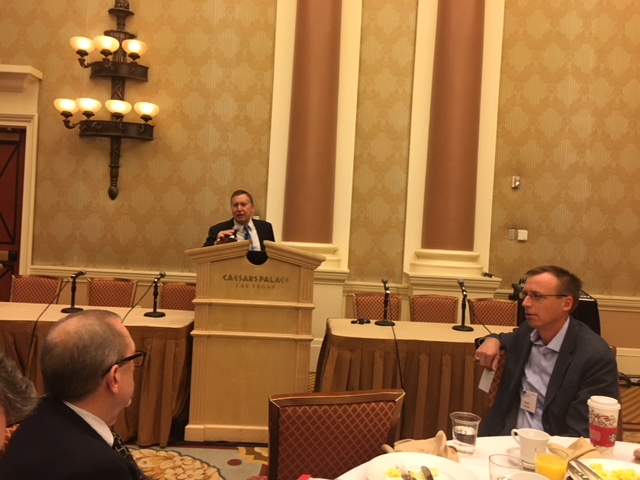
Under the direction of master-of-ceremonies Tom Buschatzke, the Arizona delegation conducted its necessary business work and house-keeping duties related to the Colorado River Water Users Association during the organization’s meetings last week.

The big news coming out of the Thursday breakfast meeting was that the so-called “big four” Arizona water organizations, which rotate Arizona presence on the Board of Trustees, rotated. Three of the four (the Arizona Department of Water Resources, Salt River Project, Yuma Area water users and the Central Arizona Water Conservation District) were in. One was out.

The odd group out this year? The CAWCD. The rotation scheme was set up years ago, noted Wade Noble, a representative of Yuma agriculture.

Buschatzke, Dave Roberts of SRP and Elston Grubaugh of the Wellton-Mohawk Irrigation & Drainage District will take on trustee duties.

Water Resources Director Buschatzke updated the Arizona attendees on 2017 state-related water issues.

Buschatzke briefed attendees on the status of Minute 323, the important water agreement completed this year between the U.S. and Mexico. A big part of the agreement involves progress on desalination efforts, he said.

“Desalination is a long-term project for the State of Arizona,” said Buschatzke. “It’s a long ways away, but at least we’re starting with that project.”

This isn’t confirmed, but Yuma-area ag representative Wade Noble told the substantial Arizona delegation to CRWUA that there is a reason why Arizona attendees must walk farther than anyone else when going to their caucus breakfast meetings.

It’s because Arizona is the largest of all the CRWUA contingents and their breakfast meeting room was the only one capable of holding such a large group.


Arizona Governor’s chief of staff makes surprise appearance at Colorado River water conference

IMG_0674

Ducey administration chief of staff Kirk Adams at a dinner on Wednesday hosted by Salt River Project. From Left: Hunter Moore, the Natural Resources Policy Adviser to Governor Ducey; Peter Hayes, associate SRP GM and chief public affairs executive; Mark Bonsall, general manager and CEO of SRP; Adams; David Rousseau, SRP President; Arizona Department of Water Resources Director Tom Buschatzke

Ducey chief of staff Kirk Adams attended the Colorado River Water Users Association meetings this week in Las Vegas.

Adams told the attendees with whom he met that Governor Ducey is committed to prioritizing a plan that will provide Arizona with a sustainable water future.

“We’re moving full-steam ahead with a broad coalition of stakeholders,” Adams said.

Adams addressed a theme that has become a central focus of the annual three-day CRWUA this year: pushing the long-debated Drought Contingency Plan agreement among Colorado River water users across the finish line.

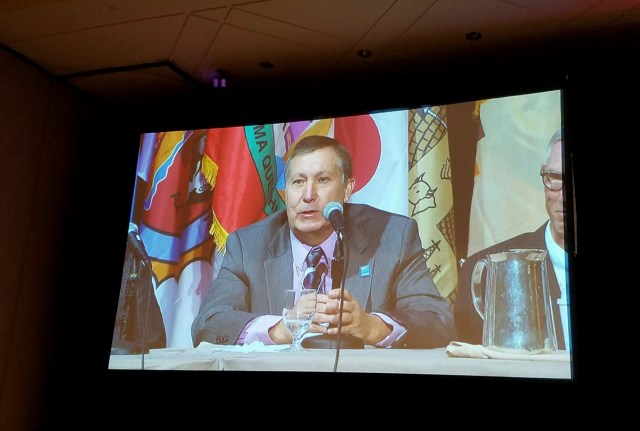
At a keynote panel discussion involving top water executives organized the next day, all five panelists — including Arizona Water Resources Department Director Tom Buschatzke — emphasized the urgency of completing the multi-state agreement to protect Lake Mead.

“Not to be overly dramatic, but I believe that DCP is fundamental to the survival of how we do business,” said John Entsminger, general manager of the Southern Nevada Water Authority.

Arizona Water Resources Director Buschatzke returned to the DCP theme during nearly all of his speaking engagements at the conference.

“I’ve said it before, we need all hands on deck” to complete Lake Mead-saving water agreements, including both those hands inside Arizona and outside the state.

Chief of Staff Adams met on Wednesday with members.

“I’m gratified we could arrange this,” he said. “Water security is vital to Arizona’s future and it was important, I think, to assure the Colorado River community that Governor Ducey is committed to doing what we need to do to make it all happen.”

Kirk Adams and Mark Bonsal

SRP’s Mark Bonsall with Ducey Chief of Staff Kirk Adams at an event sponsored by SRP at the Colorado River Water Users Association conference in Las Vegas


Intro to CRWUA: noted historian Gregory Hobbs escorts Colorado River conference attendees into the past

IMG_0658

It is difficult to make out, but the map above, from Justice Hobbs’ collection, is a mid-19th century “Map of the Rocky Mountain Region.”

The first event of the annual Colorado River Water Users Association meetings by tradition is a look back. Retired Colorado Supreme Court Justice and senior water judge Gregory Hobbs escorts attendees back to the early, formative days of Colorado River law, which means he examines events in the mid-1800s and beyond.

As Hobbs himself observes, knowledge of the history of the Colorado River and its tributaries is essentially for understanding where things stand now.

“The most basic and fundamental lesson we ought to teach in our schools are these (Colorado River) compacts,” said Hobbs.

“The agreements among the Colorado River states allowed each state to use their allocation as they saw fit.”

An integral part of Justice Hobbs’ presentation each year is his effective use of maps, especially those created in the early days of Western settlement. Most of the maps that Hobbs uses in his CRWUA presentations are from his own extensive collection, which he since has donated to the Colorado Supreme Court. In 2010, Hobbs donated a substantial portion of his carefully archived papers to the Denver Public Library.

Many of the maps he uses at CRWUA are identified as “desecration maps.” Those mostly ancient maps, he said, constitute the “primary source documents that remind us who we are.”


Agenda for annual meeting of Colorado River water users is released

TB at CRWUA 2016

Water Resources Director Buschatzke, speaking during the keynote panel discussion at CRWUA 2016

Editor’s Note: As a service to our readers, the Arizona Department of Water Resources once again is providing a live blog of events as they occur at the Colorado River Water Users Association conferences in Las Vegas, Dec. 12-15.

When they say water is fluid, they’re not kidding. Even convocations assembled to  discuss water policy must remain fluid, especially when those discussions involve Colorado River water policy. Such is the rapidly evolving nature of the complex issues facing Colorado River water users.

Organizers of the Colorado River Water Users Association (CRWUA) annual conference have released the event’s agenda. But even as late as early December, the agenda is identified as “tentative” in order to accommodate potential changes in meeting planning.

Each year, water leaders from the Colorado River system states and the federal Bureau of Reclamation — as well as the system’s major water users, such as cities and agriculture — gather at CRWUA, sharing ideas about management of the most complex water system in the country, the Colorado River.

A focus of discussion among Colorado River states for the last several years has been drought contingency planning to protect and stabilize the river system, particularly Lake Mead, where water levels have drifted dangerously low in recent years.

Discussion about a “DCP,” or Drought Contingency Plan, is certain to play a central role this year as well.

It certainly will be one of the underlying themes of the Keynote Panel Discussion scheduled for Thursday, Dec. 14, entitled “A Ballet in the Making: Choreographing Issues Across the Basin.”

Arizona Department of Water Resources Director Tom Buschatzke will take part in that panel discussion, along with four other top Colorado River water-user executives. The panel will be moderated by Eric Kuhn, general manager of the Colorado River District for the State of Colorado.


ADWR Director to U.S. Senate: Tribal water settlement is a “strategic priority” for AZ

ADWR Director at Senate Indian Affairs

 Photo courtesy of U.S. Senate Committee on Indian Affairs

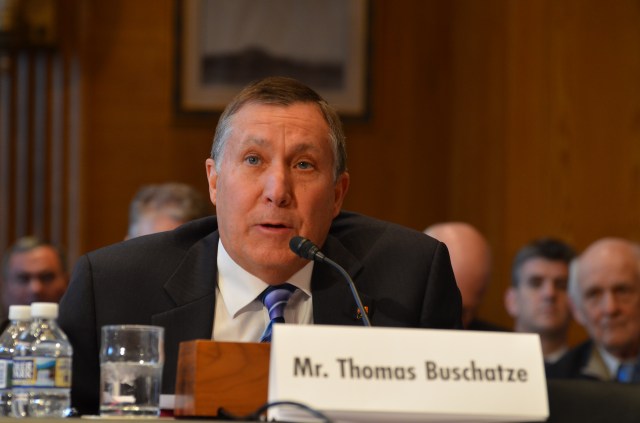
Arizona Department of Water Resources Director Tom Buschatzke on Wednesday told a panel of U.S. senators that an agreement to settle a tribal water-rights claim in northwestern Arizona constitutes a rare resolution that creates positive outcomes for all involved.

In both written and oral testimony, Buschatzke expressed Arizona’s strong support of S. 1770 – the Hualapai Tribe Water Rights Settlement Act of 2017, sponsored by Sens. Jeff Flake and John McCain – to the Senate Committee on Indian Affairs.

In his opening statement, Buschatzke called the agreement “a great step forward.”

He told the panel that the State of Arizona is strongly supportive of S. 1770, which formalizes an agreement reached in 2016 between the Tribe, the State of Arizona and several other major Arizona water users.

The United States participated in the negotiations through a team appointed by the Secretary of the Interior.

The agreement provides 4,000 acre-feet of Colorado River water annually to the Hualapai Tribe. As sponsor, Sen. Flake welcomed Director Buschatzke to the hearing.

In written testimony, Buschatzke told the senators that it represents a major step forward in providing water-certainty to all water users throughout Arizona.

“Half of the 22 federally recognized Indian tribes in Arizona still have unresolved water rights claims,” wrote Buschatzke.

“Resolving these claims through settlement is a strategic priority for the State, not only because it will avoid the cost and uncertainty of litigating the claims, but it will provide certainty to all water users in the state regarding available water supplies in the most expeditious manner possible,” he said.

The United States also will benefit from the reduced risk of costs associated with litigating the Tribe’s water-rights claims, Buschatzke noted.

Director Buschatzke observed that the agreement constitutes an economic opportunity for the Tribe, whose lands enjoy “breathtaking views of the west rim of the Grand Canyon.”

The Tribe operates the famous “Skywalk” tourist attraction at the western edge of the canyon, which attracts an estimated one million visitors annually. The Tribe has announced plans to expand that attraction.

By providing the Tribe with a renewable source of water from the Colorado River, the agreement is consistent with State policy of conserving groundwater supplies for times of drought, the Director wrote.

“Because the aquifer beneath the Tribe’s reservation extends to areas off the reservation, the Tribe’s use of a renewable water supply will help preserve groundwater supplies not just for the Tribe, but for non-tribal water users in the region,” said Buschatzke.

In his written testimony, the Water Resources Director broke down the financial responsibilities that each of the parties agreed to shoulder in 2016.

Those investments included a congressional appropriation of $134.5 million to build a pipeline to deliver the Colorado River water to Peach Springs and to the Tribe’s Grand Canyon West development. In addition, S. 1770 would authorize annual operation, maintenance and replacement costs of $32 million, as well as other federal expenditures.

Under questioning from Sen. Flake during the hearing, Buschatzke assured the committee that the infrastructure and water would “go exclusively to the Hualapai.”

Non-federal contributions to the agreement “are significant,” said Buschatzke.

The State of Arizona agreed to “firm” 557.5 acre-feet of the 4,000 acre-foot annual allocation to the Tribe, at a cost of $3.2 million to Arizona.

“The financial benefits that the United States will receive through the settlement will greatly exceed the costs that the United States will incur in constructing a pipeline to bring water from the Colorado River to the Tribe’s reservation,” Buschatzke wrote to the Senate panel.

Flake, McCain legislation would formalize a tribal-water settlement agreement six years in the making

US-Senate-Committee-on-Indian-Affairs

Arizona Department of Water Resources Director Tom Buschatzke will testify before a Senate Committee on Wednesday in support of a breakthrough agreement settling the Hualapai Tribe’s claim to water rights on the Colorado River as well as other water sources in Arizona.

The agreement is the result of long, complex negotiations that began in 2011.

Buschatzke is one of just five witnesses scheduled to testify on Wednesday before the U.S. Senate Committee on Indian Affairs.

Pending congressional approval of the deal, the Hualapai Tribe will become the 12th of Arizona’s 22 federally recognized Indian tribes to fully resolve its water-rights claims.

According to the terms of the  settlement, the Tribe would receive an annual allocation of 4,000 acre-feet of Colorado River water. The allocation will come from a volume of Colorado River water delivered by the Central Arizona Project that is designated for future Indian water rights settlements in the Arizona Water Settlements Act of 2004.

In addition, the agreement calls for the U.S. Bureau of Reclamation to plan, design and build a pipeline capable of delivering no less than 3,414 acre-feet per year from Diamond Creek on the Colorado River to the Tribe at Peach Springs, as well as to its Grand Canyon West tourist attraction. The legislation authorizes an appropriation of $134.5 million for construction of the pipeline, as well as additional funding for operating expenses.

Director Buschatzke is expected to affirm Arizona’s strong support for the settlement agreement, which constitutes a major step toward resolving the outstanding water-rights claims of Indian tribes throughout the State. The agreement also will provide the Tribe with a renewable source of water that will replace its current groundwater pumping.

The Senate Committee on Indian Affairs hearing is scheduled to begin at 12:30 pm (MST). The legislation, S. 1770, is sponsored by Arizona Sens. Jeff Flake and John McCain. The Hualapai Tribe Water Rights Settlement Act of 2017, as it is known, is one of three items on the Committee’s Wednesday agenda.

Live video of the hearing, as well as written witness testimony,  can be found on the Committee’s website here.


Water Resources Director to testify before Senate committee on Hualapai water settlement legislation

hualapai skywalk

The Hualapai Tribe’s famous “Skywalk” attraction overlooking the Grand Canyon

Arizona Department of Water Resources Director Tom Buschatzke will testify on Wednesday, Dec. 6, before the Senate Indian Affairs Committee on legislation that would provide the Hualapai Tribe of northwestern Arizona with 4,000 acre-feet of Colorado River water annually.

In 2016, the Tribe agreed to a settlement of its long-standing claim to Colorado River water. The legislation – S. 1770, introduced by Arizona Sens. Jeff Flake and John McCain — secures the 2016 agreement.

The agreement ensures that the tribe’s previously outstanding water claims could not potentially displace water used by other customers that also rely on the Colorado and Verde rivers. As a result, the agreement helps provide certainty for water users throughout Arizona.

In addition to its claim to Colorado River water, the Tribe also has a claim to water of the Upper Verde River watershed.

At the time of the settlement agreement, Director Buschatzke noted that the settlement of tribal water-rights claims “has long been a top strategic priority for the State.”

“The resolution of the Hualapai Tribe’s water-rights claims, including its claims to Colorado River water, is a major step to providing long-term certainty to water-users throughout the State,” said  Buschatzke.

“This settlement will allow the Hualapai Tribe to enjoy the assurance of a secure and dependable water supply to its communities. Senator John McCain and Senator Jeff Flake deserve great credit for sponsoring this settlement legislation in the Senate.”

The Senate Indian Affairs Committee hearing on the proposed legislation — known as the Hualapai Tribe Water Rights Settlement Act — is scheduled for 12:30 p.m. (MST).


Decision time for the Salton Sea

Shrinking Salton Sea

In a recent oped, the Audubon Society illustrated the difficult choices facing California at fending off an “ecological disaster” in the area of the Imperial and Coachella Valleys

The state of California has been struggling for years with the consequences of the Salton Sea drying up, including toxic air pollution, loss of bird habitat and myriad health hazards for the thousands of children living in the region.

Audubon’s Salton Sea program director, Frank Ruiz, recently provided a comprehensive update of the issues facing the inland sea, published in several southern California media, including the Riverside Press-Enterprise.

There is some good news to report, noted Ruiz, especially the fact that legislation recently signed by Gov. Jerry Brown would allocate $200 million (out of a statewide package of $4 billion for parks, water, coastal and climate-related projects) to addressing the sea’s ecological crises.

As Ruiz notes, that money is a good start, even though it constitutes about half of the estimated costs ($380 million, in total) for 29,000 acres of air-quality control efforts and habitat projects.

But, he added, money alone “will not avert the looming disaster” at the sea. Political will, he argued, is the difference-maker:

“Ultimately, the question of whether California will act fast enough in 2018 to avoid the worst impacts at the sea depends on leadership from Gov. Brown and California Natural Resources Secretary John Laird,” wrote Ruiz.