ADWR’s Drought Contingency Planning website now live

A web page dedicated to providing up-to-date information on the effort to complete a Drought Contingency Plan in Arizona is now live.

The web page includes the complete agenda from the June 28 briefing co-sponsored by the Arizona Department of Water Resources and the Central Arizona Project, which included presentations by Bureau of Reclamation Commissioner Brenda Burman and Terry Fulp, BOR’s Lower Colorado Regional Director.

In addition, the web page includes the PowerPoint presentations by ADWR Director Tom Buschatzke, CAP General Manager Ted Cooke and BOR’s Fulp.

Also, the web pages include links to statements on the joint commitment to completing an Arizona DCP co-authored by Director Buschatzke and General Manager Cooke. As they are completed, the page will provide a calendar of upcoming DCP planning meetings, including the scheduled July 10 meeting.

Video of the June 28 briefing at the Arizona Historical Society Museum in Tempe will be posted when it becomes available.

The ADWR “Arizona Discussions on Drought Contingency Planning” web page can be found here.


Arizona Moving Forward On Lower Basin Drought Contingency Planning Discussions

Dcxvmj2WkAAomU9
By Thomas Buschatzke, Arizona Department of Water Resources Director and Ted Cooke, Central Arizona Project General Manager

In a joint statement in May, our agencies, the Arizona Department of Water Resources (ADWR) and Central Arizona Water Conservation District (CAWCD) announced that we are committed to bringing the Lower Basin Drought Contingency Plan (LBDCP) to closure in Arizona by addressing a broad range of issues that respect the concerns of all stakeholders across the state.

The discussions between ADWR and CAWCD were only the first step and today, we hosted a public briefing describing the proposed LBDCP, which was developed to address those risks. Colorado River managers were invited to learn about the LBDCP and its importance within Arizona.

We were joined by the U.S. Bureau of Reclamation Commissioner Brenda Burman. The Bureau of Reclamation discussed how the risks to the Colorado River have increased from what was expected when the Interim Guidelines for Lower Basin Shortages were established in 2007.

In fact, the risks of Lake Mead falling below critically low reservoir elevations have tripled in the past decade, increasing the risks of potentially draconian reductions to Arizona’s Colorado River supply.  The tools provided in those guidelines now are insufficient to address the current risks to the system.

In recognition of these increasing risks, Arizona, California, Nevada, and Mexico have worked together in recent years to voluntarily contribute water to Lake Mead.  These efforts include system conservation programs and storage programs, and have served to stave off shortages in the Lower Basin from 2015 through 2018, and very likely in 2019.

We recognize that even these efforts may not be sufficient to reduce the risks posed by a drier future on the Colorado River.

More needs to be done.

Drought Contingency Planning

In today’s briefing, we outlined a framework of additional measures to reduce risks in the Colorado River system, called the Lower Basin Drought Contingency Plan (LBDCP).

The LBDCP is a plan developed by Arizona, California and Nevada and the United States.   It has several major components, including:

  1. Additional contributions to Lake Mead from Arizona and Nevada, along with new contributions from California and the United States.
  2. Incentives for additional storage in Lake Mead by creating flexibility for water users to store water and take delivery of storage even during lower reservoir conditions.
  3. A commitment by parties in the Lower Basin to protect elevation 1020 feet in Lake Mead, implemented through consultation to determine what additional measures would be necessary to protect that elevation.

Implementation of the Lower Basin Drought Contingency Plan will trigger additional contributions from Mexico through the Binational Water Scarcity Contingency Plan as detailed in the Minute 323 agreement, adopted in 2017.

Projections by the U.S. Bureau of Reclamation show that the LBDCP, along with contributions from Mexico and actions by the Upper Basin States, would reduce the risks of falling below critical elevations in Lake Mead.

The LBDCP achieves this reduction of risks by requiring additional incremental water-delivery reductions by Arizona water users.  These reductions will impact Arizona’s junior Colorado River priority holders. The LBDCP has the potential to impact to all CAP priority pools, but the most significant impacts are likely to be to the CAP NIA priority pool.

Arizona Next Steps

This briefing was the beginning of a series of public discussions involving many Colorado River water users, elected officials, and other key stakeholders in Arizona. We recognize that the LBDCP and its impacts are complex issues, and there will be more questions than those addressed today.  Therefore, we have scheduled a meeting on July 10 at the Heard Museum to answer questions, as well as to provide additional details about the LBDCP.

Today’s briefing closed with the announcement that an Arizona Steering Committee will be formed to discuss and recommend how to adopt and implement the LBDCP in a way that is acceptable to Arizona water users. While the delegates to the Steering Committee will be by invitation jointly provided by ADWR and CAWCD, the meetings and discussions will be open, and the public is invited to participate. The Steering Committee is tentatively scheduled to conduct its first public meeting on July 26th.  Additional details will be provided at our websites www.azwater.gov and www.cap-az.com/AZDCP.

We recognize that more must be done to protect Arizona’s Colorado River users from the uncertainty and risks of critically low elevations in Lake Mead.  We are committed to working with Arizona water users and other stakeholders to adopt and implement the LBDCP in a way that is acceptable to Arizona water users.


Attention focusing on planned June 28 Colorado River briefing by ADWR and CAP

New Mexico journalist John Fleck, whose well-informed blog has long served as a sort of news pathfinder regarding Colorado River issues, just posted a lengthy take on the briefing to be co-sponsored by the Arizona Department of Water Resources and the Central Arizona Project in Tempe on June 28.

The briefing, which is to feature Bureau of Reclamation Commissioner Brenda Burman as keynote speaker, will examine the systemic risks posed by potential shortages on the Colorado River.

The event also represents the kick-off of a continuing Arizona discussion on how to adopt and implement the plans of the Lower Basin states of Arizona, California and Nevada for contending with a delivery shortfall, known as the Drought Contingency Plan (see details of the briefing below).

The June 28 event will be livestreamed.

According to Fleck, a shortfall in deliveries of Colorado River water will constitute a lesson in the difference between an “allocation” of water from the river and an “entitlement” to that water. Fleck illustrates the various challenges facing Colorado River water-users with an examination of agriculture in Pinal County, where the river water delivered via the CAP canal system is subject to availability. It’s an interesting analysis and well worth a read.

The June 28 event:

What: An Arizona Discussion of the Risks to Arizona’s Colorado River Supply and the Colorado River Drought Contingency Plan

Who: Panel will include Bureau Commissioner Brenda Burman; ADWR Director Tom Buschatzke; and, CAP General Manager Ted Cooke; the event also will feature presentations from BOR staff on the conditions on the Colorado River and the potential for delivery shortfalls in coming years

Where: Arizona Historical Society Museum at the Arizona Heritage Center at Papago Park – hosted in the auditorium; 1300 N. College Ave, Tempe 85281

When: June 28, 1-4 pm.

How: The briefing will be livestreamed online; visit azwater.gov or CentralArizonaProject.com for details


Public briefing on Colorado River Drought Contingency Planning set for June 28

Arizona Department of Water Resources & Central Arizona Project to co-sponsor

Bureau of Reclamation Commissioner Burman to be keynote speaker

Event to be livestreamed

LakeMead_banner

By clear consensus, the most important issue currently facing the Colorado River system is the as-yet unresolved question of what the states will do to lessen the risks of draconian shortages on the Colorado River.

What, exactly, will the Lower Basin states – Arizona, California and Nevada — do to assure that instability at Lake Mead doesn’t lead toward the perilous state known as “dead pool,” in which water no longer can be drawn from the reservoir?

For several years, all seven Colorado River states, as well as the federal Bureau of Reclamation, have wrestled with the questions surrounding shortage on the Colorado River – how to implement a comprehensive Drought Contingency Plan that will manage the risks of an unstable Lake Mead presented by the on-going regional drought and over-allocation of river water.

In 2007, the seven states and the federal government (joined, in 2017, by the Republic of Mexico) agreed to specific shortage “trigger levels” – that is, specified water levels at the system’s most threatened reservoir, Lake Mead – and the reduced water-delivery volumes that would result from hitting those “triggers.”

Eleven years later, it is clear those triggers – formally, the 2007 Colorado River Interim Guidelines for Lower Basin Shortages and Coordinated Operations for Lake Powell and Lake Mead — are not enough.

Arizona is the only state in the system that requires legislative approval to sign a plan with our out-of-state river partners to deal with the difficult questions surrounding a shortage. The State’s water community is contending with those issues now.

On Thursday, June 28, the Arizona Department of Water Resources and the Central Arizona Project will co-sponsor a panel discussion of the systemic risks posed by potential shortage, as well as announce the kick off of an Arizona discussion on how to adopt and implement the Lower Basin Drought Contingency Plan.

Keynote speaker at the event will be Brenda Burman, Commissioner of the federal Bureau of Reclamation, who plans to discuss the risks to the system.

Burman_BOR Commissioner Hoover Dam

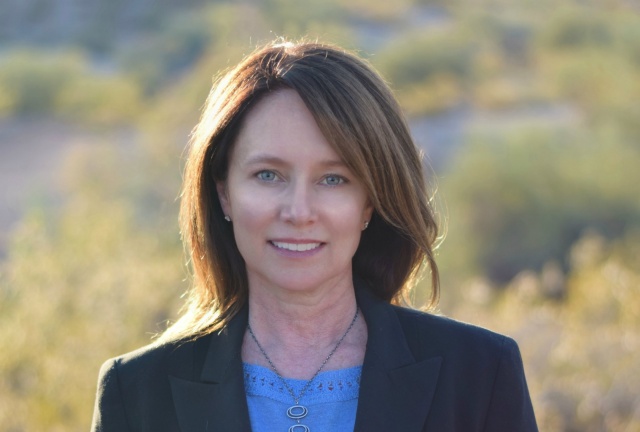
Brenda Burman, Commissioner, Bureau of Reclamation

The event will include presentations from ADWR Director Tom Buschatzke and CAP General Manager Ted Cooke, as well as demonstrations depicting current river conditions from Bureau of Reclamation staff.

There will be a limited question-and-answer session following the presentations. Follow up discussions are scheduled for later in the month.

What: A Joint Briefing by the Arizona Department of Water Resources and the Central Arizona Project on a Lower Basin Drought Contingency Plan

Who: Bureau of Reclamation Commissioner Brenda Burman; ADWR Director Tom Buschatzke; CAP General Manager Ted Cooke, as well as input from Colorado River technical experts from ADWR, CAP and the Bureau of Reclamation

When: June 28, 1-4 pm

Where: The Arizona Historical Society Museum auditorium at the Arizona Heritage Center at Papago Park, 1300 N. College Avenue, Tempe

Special Note: The event will be livestreamed.


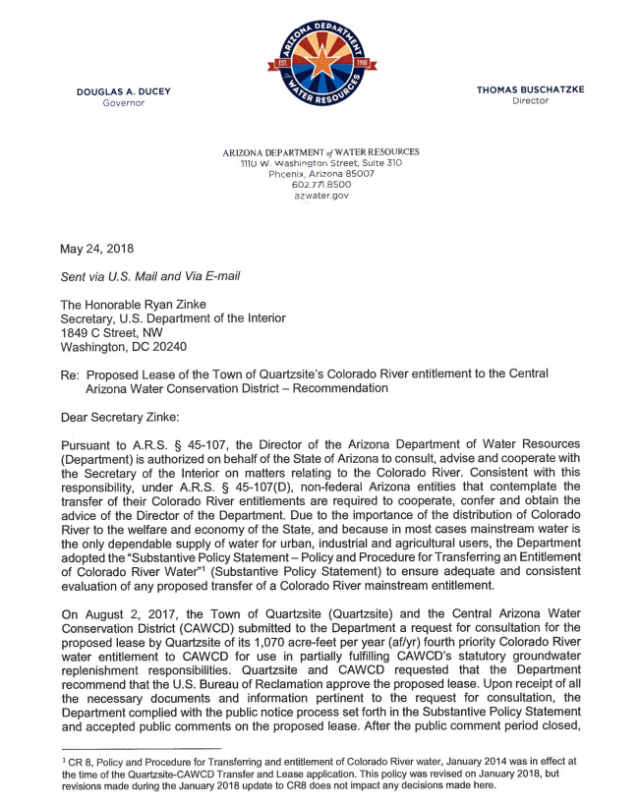
Arizona Water Resources director recommends a denial of lease deal for Quartzsite’s Colorado River water

After nearly ten months of evaluation, the Arizona Department of Water Resources has recommended that the Secretary of the Interior deny a proposed lease of the town of Quartzsite’s Colorado River allocation to the Central Arizona Water Conservation District.

On August 2, 2017, Quartzsite and the CAWCD submitted a request for consultation to the Department for the proposed lease to the District of its 1,070 acre-feet per year allocation. CAWCD is seeking the water to partially fulfill its statutory groundwater-replenishment obligations.

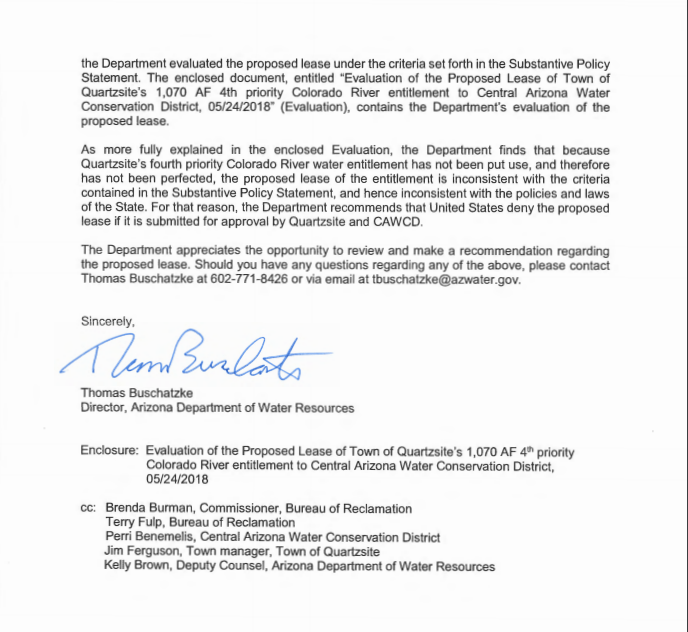
In his May 24 letter to Secretary Zinke, ADWR Director Tom Buschatzke said he recommended that the Interior Department deny the lease based on the fact that the allocation had never been put to a beneficial use, or “perfected” — a fundamental principle governing Arizona’s water law. As a result, the lease would be “inconsistent with the policies and laws of the State.”

“For that reason, the Department recommends that the United States deny the proposed lease if it is submitted for approval by Quartzsite and CAWCD,” wrote Buschatzke.


page 1.PNG

page 2.2


A tough haul: Water woes of north Valley homeowners slowly lumber toward resolution

5.17.2018 New_River water hauling truck

The long, complex effort by federal, municipal and county officials, as well as a private water company, to provide a permanent source of hauled water to residents of New River and Desert Hills in the north Valley appears to be approaching its conclusion, however slowly.

Plans to build a dedicated water station to provide truck-delivered water to the residences by the end of April hit a bump recently when project officials learned that the road-side property selected as the station location carried a federal open-spaces designation.

Releasing the property from its “National Area of Open Space” designation took several weeks.

As a result, the City of Phoenix has extended its deadline for permitting access to its hydrants once again. For months, Phoenix has provided the area’s water-haulers with temporary permits to access its fire hydrants for potable water.

In a letter dated May 1, Phoenix Vice Mayor Thelda Williams informed the Maricopa County Board of Supervisors that the city would extend the permits through August 31.

(The roughly 500 New River/Desert Hills residences in question are built on county land, outside municipal jurisdictions.)

However, noted the vice-mayor, this latest extension will be the last one:

“The City has no intention of again extending this final deadline,” she wrote.

That deadline should not be an obstacle for providing the homeowners with uninterrupted water service, according to the state director for EPCOR, the private water provider that is building the new water station.

“We are committed to have the station up and running for the water haulers by July 20,” said Troy Day, head of EPCOR operations in Arizona, to the Foothills Focus online newspaper.

The predicament facing the New River and Desert Hills residents began for reasons that had little to do with jurisdictions or government policies.

It had a lot to do, on the other hand, with water availability in an extremely water-light region of central Arizona.

Most of the New River and Desert Hills developments actually are a collection of tiny developments that fall outside the jurisdiction of Arizona’s strict “Active Management Area” statutes, which require that the developers of projects that include six or more lots must assure their homebuyers a supply of water for at least 100 years.

Developments with fewer than six lots, on the other hand, had no such requirement to demonstrate water availability.

That legal quirk helped make new homes in a lovely portion of high-desert foothills more affordable. But it also placed the water supplies of those residences outside the regulatory jurisdiction of the Arizona Department of Water Resources.

Rather than tap into a municipal supplier’s assured-water system, the New River/Desert Hills homeowners relied on wells. And as the Southwest’s nearly 20-year drought continued, and still more wells were drilled on behalf of still more homeowners, the area’s extremely shallow aquifer became overtaxed.

And wells began going dry.

A recent analysis of the region’s groundwater conditions by ADWR Chief Hydrologist Frank Corkhill tells much of the story.

Depth to bedrock in the New River, Anthem and Desert Hills area is extremely shallow, ranging from zero to 800 feet. That doesn’t leave much room for groundwater to swell up in an aquifer.

Groundwater flow from that aquifer system in the northern reaches of the Valley, meanwhile, is from north to south and southeast. Away from the region, in other words.

There are numerous other issues with the area’s groundwater reliability.

Drought has reduced the region’s already-small amount of natural groundwater recharge, for example. At the same time, increasing groundwater pumping, both from the area’s numerous domestic and municipal wells has grown rapidly. As a result, water-level declines in some areas have ranged between 80 feet and 200 feet since the late 1990s.

Respected water blogger sees a (barely) hidden message in federal press release on Colorado River management


Burman
Bureau of  Reclamation Commissioner Brenda Burman

Well-respected water journalist and author John Fleck is serving up some intriguing thoughts on his blog about a recent press release issued by the Bureau of Reclamation.

Author of Water is for Fighting Over: and Other Myths about Water in the West, Fleck contends the Bureau’s press release was less of a traditional press announcement than an implicit call to action directed at the Colorado River basin states.

John Fleck at Morelos Dam
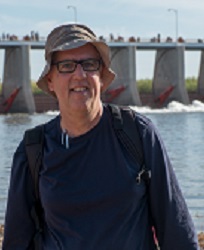
Journalist and author John Fleck

Fleck argues that Bureau of Reclamation Commissioner Brenda Burman used the press statement as an opportunity to kick-start the effort to finalize drought-contingency planning among the seven Colorado River states.It’s hard to argue with Fleck’s point. As quoted in her press release, Commissioner Burman observes that “(w)e need action and we need it now.

“We can’t afford to wait for a crisis before we implement drought contingency plans,” she said.

Fleck noted that the press release also took the unusual step of including messages supportive of drought-contingency planning from representatives of all seven Colorado River basin states. He said his favorite quote was from John Entsminger of Nevada, who observed that “Mother Nature does not care about our politics or our schedules.”

Well spoken, indeed. But the representative from Arizona, we should note, also had interesting points to make:

“The completion of the lower basin states’ Drought Contingency Plan is vitally important to Arizonans,” wrote Tom Buschatzke,  Director of the Arizona Department of  Water Resources.

“The plan reduces the likelihood of Lake Mead declining to critically low levels and incentivizes the use of tools to conserve water in the Lake so that reductions in delivery of Arizona’s Colorado River supplies are avoided or lessened.”

Working out the bugs: Colorado River researchers work to increase bug populations to fatten up fish

Article_banner-chub

From the perspective of humans, the experiment being conducted now on the Colorado River below Glen Canyon Dam may not seem like the best use of a scientist’s time.

If all goes well, for example, the experiment should prompt a noticeable increase in the populations of black flies and midges. Hopefully by as much as 26 percent.

Endangered humpback chub in the Grand Canyon rely on aquatic insects as a primary food source. ©Freshwaters Illustrated 

And, if things go really well, the experiment even might prompt the return of bigger bugs that had all but disappeared from the area –creatures like caddisflies and mayflies. The sort of buzzing, circling, flying annoyances that help make a hot day in the out-of-doors memorable. Although not in the best of ways.

From the perspective of fish living in the region, on the other hand, the “Experimental Macroinvertebrate Production Flow” project – aka, the Glen Canyon “Bug Flow” – may mean life itself.

Beginning this month, a team of scientists from the U.S. Geological Survey is conducting an experiment intended to increase the production of insect eggs and larvae that provide food sources for fish populations on the river below Glen Canyon Dam.

Between May 1 and August 31, this “flow-based” experiment will adjust the planned releases from the dam that creates Lake Powell in order to maximize the conditions favorable to insect eggs.

The flows consist of steady weekend releases and normal fluctuating releases during weekdays.

Grand Canyon Youth river trip participants collect a sample of aquatic insects along the Colorado River. ©Freshwaters IllustratedEnter 

While the patterns of water releases are changed, the amount of water flowing out of Lake Powell and, ultimately, into Lake Mead, remains unchanged. 

The rhythm of the releases is intended to keep insect eggs, which typically lay just below the water’s surface, from drying out when water levels go down and they become stranded above the water level or on sand bars. Increasing bug populations means increasing the health of the creatures that feed on the bugs, like fish, birds and bats.

This will be the first experiment conducted under the Record of Decision for the Glen Canyon Dam Long Term Experimental and Management Plan Final Environmental Impact Statement.

The plan was approved in April when a Leadership Team made up of representatives of the agencies involved in the operation of the Glen Canyon Dam – including the Arizona Department of Water Resources — recommended pursuing the Bug Flow experiment. The plan went live with the approval of Tim Petty, the Department of Interior’s Assistant Secretary for Water & Science.

Researchers from the U.S. Geological Survey had noticed a distinct lack of bugs in that region of the Colorado River, including the once-prized fishery around Lee’s Ferry.

They also noted that fish in the area appeared malnourished.

Researcher Ted Kennedy of the U.S. Geological Survey told an Associated Press reporter recently that scientists studying the Grand Canyon’s ecosystems had noticed a distinct lack of stoneflies, caddisflies and mayflies, as well as other bugs, as far back as 2002.

Concurrently, they also found that the condition of fish was poor – that rainbow trout and native humpback chub appeared longer and thinner than normal and that they lacked energy.

That prompted Kennedy and other researchers to begin examining the bug populations. They saw linkage between the condition of the fish and the lack of a stable food source.

ADWR Director Tom Buschatzke Comments on DCP in Recent Bureau of Reclamation Press Release

Dcxvmj2WkAAomU9

“The completion of the lower basin states’ Drought Contingency Plan is vitally important to Arizonans. The plan reduces the likelihood of Lake Mead declining to critically low levels…” –  Tom Buschatzke, Director of the Arizona Department of Water Resources.

Read More

C.C. Cragin Reservoir: Fire-threatened reservoir a marvel of water-storing technology

Article_banner-Recovered_craigin

Sometimes, events come at you fast.

On Thursday, April 26, a senior water-rights analyst for Salt River Project, Sharon Morris, presented a scheduled tutorial on a unique reservoir in the pine country of northern Gila County for an assembly of Arizona Department of Water Resources employees.


The projected increase in the number of “very large fire weeks”—weeks in which conditions are favorable to the occurrence of very large fires—by mid-century (2041-2070) compared to the recent past (1971-2000). Projections are based on the possible emissions scenario known RCP 8.5, which assumes continued increases in carbon dioxide emissions. NOAA Climate.gov map, based on data from Barbera et al, 2015.


In addition to a great many fascinating details about the reservoir’s history since it was completed in 1965, the analyst offered this sober note of concern:

“It is susceptible to catastrophic forest fire,” she said.

That observation quickly became a premonition.

Scarcely 24 hours later, Arizona media were reporting that the reservoir — the C.C. Cragin Reservoir, a 15,000 acre-foot facility in a densely forested watershed – was near the ignition point of a human-caused wildfire. As of mid-day Thursday, May 3, the “Tinder Fire,” as it became known, had burned through more than 12,000 woodland acres.

The apparent result of careless campers who failed to extinguish an illegal campfire, the Tinder Fire ignited a mere mile and a half northeast of C.C. Cragin. Through mid-week, strong winds were blowing the fire away from the reservoir, but in the path of numerous woodland communities.

This April 29 aerial photo provided by the US Forest Service shows a wildfire burning in north-central Arizona.

(For up-to-date information about the Tinder Fire, as well as other conflagrations around the State, the Arizona Department of Forestry and Fire Management recommends InciWeb, a public website providing information about fire evacuations or road closure notices, fire size and containment numbers, pictures, maps, and other information.)

Though just 21 percent full following a historically dry winter, the reservoir, said Morris to her ADWR audience, typically is considered “very productive” thanks to its position in a moisture-heavy sweet spot atop the Mogollon Rim in Coconino County east of the mountain resort communities of Clints Well and Happy Jack.

This year, however, conditions at Cragin have proved so dry that SRP chose not to run the reservoir at all this summer.

“We can run it,” said Morris. “But we run into operational risks, so we have agreed not to run the reservoir this season.” For a time, the U.S. Forest Service even closed roads leading to the reservoir. While they since have re-opened (pending the outcome of the Tinder Fire), boat ramps on the reservoir have been closed for the season.

SRP acquired C.C. Cragin (formerly Blue Ridge) reservoir from Phelps Dodge Corporation in February 2005 as part of the Gila River Indian Water Rights Settlement approved by the Arizona Water Settlement Act. (Photo Courtesy of Salt River Project)

The town of Payson and nearby communities have invested considerably in recent years on infrastructure necessary to deliver C.C. Cragin water, located 25 miles north of town. By agreement with SRP, Payson has a right to just over 27 percent of the reservoir’s productive capacity, or about 3,000 acre-feet per year.

Originally known as the Blue Ridge Reservoir, the facility was built by Phelps Dodge, which used water from the Black River at its Morenci mining operations in an exchange agreement with SRP for the Blue Ridge Reservoir’s water.

That exchange, which began in 1962, provided for the future transfer of the Blue Ridge Reservoir system to SRP in the event it no longer was needed by the mining company. As the company’s need for water credits decreased, the water exchange eventually ceased in 2002, and Phelps Dodge sold its land holdings in the area to SRP.

The most significant change in the reservoir’s operations began taking shape in 2004 with the passage of the Arizona Water Settlements Act by Congress. In addition to authorizing important tribal water settlements, the Act transferred ownership of the then-Blue Ridge Reservoir to the United States, as part of the Salt River Federal Reclamation Project. As a result, SRP acquired the reservoir in February 2005.


C.C. Cragin Facilities and Town of Payson Delivery Infrastructure (Map Courtesy of Salt River Project)


The Act allowed for changes in the beneficial uses of the water and specified that the reservoir’s water right was transferred to SRP for use within its service area. Up to 3,500 acre-feet per year would be made available for municipal and domestic uses to communities in northern Gila County. That region includes Payson, which secured its deal for Cragin water in 2008.

Including its 147-foot dam, the Cragin reservoir is a marvel of engineering.

A pumping station that houses seven 450 horsepower pumps, as well as one 150 horsepower submersible priming pump, draws water (at 33 cubic-feet per second) from the reservoir uphill into a 2 million gallon priming reservoir.

From there the water drains from the priming reservoir downhill over the Mogollon Rim to a three-megawatt hydropower plant located next to the East Verde River. That power is transmitted back to the pumping plant, providing power to the pumps while the Cragin water is discharged into the East Verde River, eventually flowing into the Verde River and on into the Valley.