On Drought and the “Drought Contingency Plan”: A conversation with Water Resources Director Tom Buschatzke about the on-going, multi-state struggle to save Lake Mead

The negotiations to find an equitable way to stabilize the Colorado River system and, specifically, Lake Mead have been underway for nearly four years now.

In some respects, the parties at the table – including representatives of California, Nevada, the federal government and Arizona – largely have found common ground, in principle.

In other respects — notably achieving agreement among the many stakeholders with longstanding, legal claims to water from the Colorado system, as well as the big service providers — a resolution is far less clear.

Tom Buschatzke, director of the Arizona Department of Water Resources, sat down recently to discuss the current status of the much-debated “Drought Contingency Plan” to stabilize Lake Mead, which continues dropping toward critical water levels each year, despite the occasional wet winter, such as this current one.

He also discussed – and defined – the plan that has become known as “DCP Plus” – a plan to permanently assure that no more water is allocated from Lake Mead than flows into it.

As Buschatzke describes, the health of the Colorado River system is critical to Arizona’s future. The system now supplies 41 percent of the state’s water supplies, providing an economic and societal lifeline to millions of residents.

Just what does it take for everyone to get to “yes” in the debate over a fair and equitable Drought Contingency Plan?

In this podcast, Director Buschatzke shares his thoughts on that and much more involving the state’s water resources.

As the director indicates, he remains hopeful. But, as he also makes plain, “hope” is not the same as having a plan.

To listen to this Water Resources podcast, click here.

West Coast facing another ‘atmospheric river’ of weather-related news

Normally, we here at Water Resources prefer to stay off the topic of “weather” and, instead, stick to longer-term climate-related conditions, particularly drought.

The 2016-2017 “water year” — officially October 2016 to September 2017 — isn’t letting us do that. It’s just been too darned wet out there to avoid observing that current weather conditions are greatly impacting long-term climate conditions.

Two big, unavoidable weather stories are happening right now: The “biggest storm of the winter” that is now hitting southern California, and the more northerly disturbance following it that will push a lot of water where none is needed right now, the area of the Oroville Dam.

While the extremely wet Western winter has driven drought off the map in much of northern California, SoCal has been much drier. The sole remaining sliver of “extreme drought” in the Golden State, according to the U.S. Drought Monitor, is in the south.

That status may be changing right now. Greater Los Angeles could get between five and seven inches of rain before the weekend is out. Hundreds of flights out of LAX are being cancelled. And the weekend rush hour commencing in less than two hours is guaranteed to be every traffic cop’s worst nightmare.

The bigger drama, however, remains to the north at the Oroville Dam, where a rain-and-runoff-damaged spillway has caused grave concerns for residents as far downstream as Sacramento.

The latest “atmospheric river” poised to hit northern California is expected late Sunday into Monday and perhaps five inches of rain could fall in the Oroville Dam region. Nevertheless, California Department of Water Resources officials are feeling much better about the dam’s condition than they were just a few days ago.

“The threat level – it is much, much, much lower than what it was on Sunday,” said CDWR Acting Director Bill Croyle to reporters on Thursday.

The Oroville crisis prompted some considerable interest among local media about the condition of Arizona dams.

As ADWR Director Tom Buschatzke explained to ABC News 15 earlier this week, Arizona’s biggest dams — including the two mega-dams on the Colorado River and the Salt River Project dams — are inspected by the federal Bureau of Reclamation.

The ADWR dam-safety program regularly inspects 106 dams designated as “high-hazard potential” dams around the state, but none of which approaches the size of the 770-foot Oroville Dam, or the 3.5 million acre feet of water held behind it.

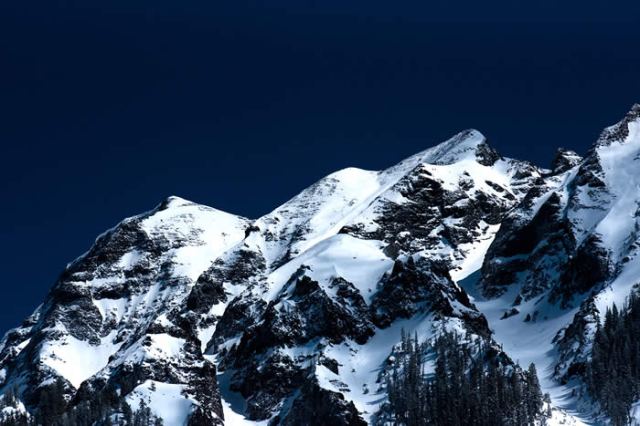
SNOWPACK IN THE ROCKIES: Hey, it’s not ALL about California!

It’s still early, but much of Arizona’s watershed, as well as the western face of the Rockies, is experiencing higher-than-normal precipitation, too


rocky-mountains-in-winter

Nothing against California, you understand. We’re all delighted to hear about this winter’s bounty of rain and snow, especially as it piles high in the Sierra Nevada.

Love all those “atmospheric rivers.”

It is great to hear of expert-level debates over whether the Golden State’s drought designations should be eased — or even lifted entirely — especially in the north of the state.

There are parts of the mountains immediately east of Sacramento and San Francisco that have experienced well over 200 percent of the official average precipitation. As they say in southern Cal: Whoa!

But, well… it’s not all about California, you know.

According to data compiled and analyzed by the National Water and Climate Center, precipitation thus far in the “water year” – that is, the period beginning October 1, 2016 – has been predominately “near to well above average” almost everywhere in the West, except Alaska.

Meanwhile, the snowpack in the southern regions of the Western U.S. – the areas of the West most seriously impacted by record and near-record drought – is being judged “well above average,” according to the results reported in the Water and Climate Center’s Snow Telemetry (SNOTEL) summaries.

That snowpack translates, ultimately, into the statistics that matter most to the 35 million-odd people living in the Colorado River basin: the streamflow forecasts and the expectations for reservoir storage levels. And those are looking better than they have in a long time too:

The SNOTEL measurements depict “well above average streamflow in the middle and southern parts of the West,” and reservoir storage amounts that should be “above average in Montana and Wyoming, near average in Colorado and Nevada.”

As of February 1, the Center is forecasting inflows into Lake Powell at 147 percent of the 30-year average for April through July, a critical streamflow period.

Almost… California-esque.

For Arizona specifically, the precipitation picture has brightened considerably this winter.

“We have to go all the way back to 2010 the last time we filled the reservoirs,” said Salt River Project water operations manager Charlie Ester to 12News on February 2.

“In the seven years since then, we have progressively lowered the reservoirs to the current conditions.”

With much of Arizona’s water supply beginning its annual journey on the western slopes of the Colorado Rockies, the Water and Climate Center’s early February report is promising. January produced 217 percent of normal precipitation in Colorado, and the February 1 snowpack is at 156 percent of normal, up 43 percent from January.

As a result, streamflow forecasts “are nearly all above normal with the western basin projections providing the highest forecasts,” according to the Water and Climate Center report.

Even in the best of times, precipitation never distributes evenly.

As of February 1, the “snow-water equivalent levels” – that is, the amount of liquid, flowing water expected to be produced from a region’s snowpack – range from 88 percent of median in the San Francisco-Upper Gila River Basin to 166 percent of median in the Verde River Basin.

Still: “Cumulative precipitation since October 1 is now well above normal in all major river basins for the water year.”

Precipitation disclaimers in the arid Southwest are always lit bright, however. The remarkable measurements of the winter to date are entirely capable of petering out to nil. Which is a pretty good summary of how last winter went.

A winter’s precipitation is the result of weather. And while drought is a function of weather over time, it isn’t something that disappears in a single, wet season.

The effects of drought, for example, can be cumulative. The volume of Southwestern desert dust that blows east onto the western slopes of the Rockies has been shown to have a cumulative effect on the duration of the winter season.

NOAA’s Cooperative Institute for Research and Environmental Sciences at the University of Colorado Boulder, for example, reported in late 2013 that the snowpack of the Rockies “is melting out as many as six weeks earlier than it did in the 1800s,” as a result of a thick layer of desert dust.

It’s not just drought that impacts Colorado River streamflow, in other words.

Moisture at these levels in the West can make people forget quickly the long-term issues the region faces. Already, Californians are in a fierce debate over whether to extend Gov. Jerry Brown’s emergency drought declaration and whether or not to ease up on other water-conservation efforts.

“Most water agencies have yet to adjust to this ‘new normal’ and are operating on outmoded assumptions and practices that place the state at risk of water shortages and worse,” argued climate-change expert Alex Hall of UCLA in a commentary that appeared February 5 in the Los Angeles Times.

Hall’s concern – that the recent snow and rain will blunt efforts to improve water-use efficiencies in southern California – is a concern for the entire Southwest.

Could this one year’s abundance blunt efforts to resolve the systemic over-allocation of Colorado River water, for example?

If there is a downside to the current – and literal – flood of moisture into the region, it is that.

“While I’m happy about all the snow,” said Water Resources Director Tom Buschatzke, “we don’t have enough certainty about what Mother Nature is going to send us.

“We have to focus on what we have control of.”


Water Resources director hails agreement to expand uses of CAP canal system

“System-use agreement” between Central Arizona Project and the federal Bureau of Reclamation a major milestone for vital water-delivery system

Central Arizona Project photo by Philip A. Fortnam
Central Arizona Project board President Lisa Atkins and board member Sharon Megdal signing the CAP System Use Agreement on Feb. 2


Central Arizona Project and the federal Bureau of Reclamation reached an historic agreement on Thursday that allows for “new and innovative” uses of the CAP’s 336-mile system of canals, including transporting new water supplies, exchanging supplies among users and efficiently accessing water stored underground by the Arizona Water Banking Authority and others.

The agreement creates a legal framework for a variety of water supplies to be moved through the system, including many dedicated to addressing possible future shortfalls in Arizona’s Colorado River water allocations.

“It allows for flexibility in managing our Colorado River water supplies,” said Tom Buschatzke, director of the Arizona Department of Water Resources.

Until now, so-called “non-CAP water” – that is, water controlled by users other than the Central Arizona Project – flowed through the elaborate delivery system only on an ad hoc basis.  In 2014, for example, the cities of Phoenix and Tucson reached an agreement allowing Phoenix to store some of its unused Colorado River allocation in Tucson-area aquifers.

Thursday’s agreement provides a legal framework for such water exchanges, thus opening the door for further innovation, as well as for future agreements on water quality and financial issues.

CAP General Manager Ted Cooke also noted the additional flexibility that the agreement provides his agency. Cooke thanked the agencies involved in helping make it happen for their collaborative efforts:

“This agreement provides us with the flexibility for cost-effective recovery of stored water, including more than four million acre-feet of CAP water stored in the aquifers of central and southern Arizona,” said Cooke.

“I would like to thank the negotiators from the Department of the Interior and the Bureau of Reclamation, along with the significant contributions from the Arizona Department of Water Resources and the Arizona Water Banking Authority.”

Water Resources Director Buschatzke joined Cooke in extending thanks to the Arizona congressional delegation – especially noting the efforts of Arizona Senator Jeff Flake – for helping make the system use agreement happen.

“Our role was to support efforts to complete the system use agreement for the benefit of Arizona water users,” added Buschatzke.

“We sought to support the maximum flexibility of this important asset.”

Gov. Doug Ducey expressed thanks to former Interior Secretary Sally Jewell for her efforts in support of the system-use agreement.

The CAP canal system was built by the federal Bureau of Reclamation for the state of Arizona and is managed and operated by the Central Arizona Project.

The deal is especially valuable to the Water Bank, which pays to bring Colorado River water through the CAP system into central and southern Arizona. The Water Bank stores that water in underground aquifers, or directly recharges it into underground storage facilities. It also arranges for water deliveries to irrigation districts, which use the water in lieu of mined groundwater.

Water Bank officials helped review the agreement.

The deal creates a legal framework allowing the Water Bank to use the CAP system to make recovered water available during potential periods of shortage of Colorado River water deliveries to Arizona. Until now, the Water Bank’s capacity to make use of the water it stores has been extremely limited.

 (A Central Arizona Project statement released Thursday contributed to this blog post)


Arizona Senator Jeff Flake tabbed to head drought-crucial Water & Power subcommittee

New chairman cites leadership on protecting Lake Mead as key duty

flake-at-az-national-league-of-cities-event-last-year
Arizona Senator Flake at an Arizona League of Cities event


Arizona Senator Jeff Flake, who in July won assurances that water stored in Lake Mead would be retained by Arizona, has been named chairman of the Senate Energy and Natural Resources Subcommittee on Water and Power.

The new chairman’s subcommittee is responsible for overseeing federal involvement in a wide swath of water matters of substantial importance to Arizona and the Southwest.

 The jurisdiction of the panel includes agricultural irrigation, reclamation projects, power marketing administrations, energy development impacts on water resources, groundwater resources and management, hydroelectric power and other energy-and-water related concerns.

The senator, moreover, said in a statement that he would use his chairmanship to safeguard his home state’s water supplies

 “I look forward to using this chairmanship to improve stewardship of Arizona’s water and energy resources,” said Flake.

“Whether it’s strengthening oversight at (the Western Area Power Administration), protecting Arizona’s voluntary water contributions to Lake Mead, or taking proactive steps to prevent a drought declaration in Arizona, I will actively work with my colleagues on the Water and Power Subcommittee to hold federal agencies accountable.”

Last summer, Flake received a written assurance from the US Department of the Interior that Colorado River water stored by Arizona users in Lake Mead to maintain higher levels would not subsequently be released to other states, notably California.

Flake said at the time that his lengthy negotiations with California Senator Dianne Feinstein to improve inter-state cooperation on protecting Lake Mead was successful. Among other considerations, California water officials had become “more receptive” to Arizona’s water concerns as a result of his negotiations with Senator Feinstein.

Senator Flake at Lake Mead
 An amendment package submitted by Flake and Arizona Sen. John McCain to the Feinstein legislation in September also figured in the legislation, which passed in the fall.

The Flake/McCain amendment directed that a study be performed by the National Academy of Sciences on how to best control water-intensive invasive species like tamarisk, also known as salt cedar. It also required that the Interior Department create an implementation to put the study’s recommendations into action.

A federal report issued last August indicating a probable 2018 shortfall declaration affecting Colorado River water users also helped prompt negotiations.

“They’re more receptive than ever now that there is a potential shortage to be declared,” Flake said. “It’s something that draws people together.”

Flake is a fifth-generation Arizonan who was first elected to the U.S. Senate in 2013. Prior to that he served in the U.S. House of Representatives from 2003 to 2013.

Massive earth fissure found near Picacho Peak…and you heard about if first from Arizona Water News!

fissure1

Spectacular drone video shot by Arizona Geological Survey of new fissure sparks wave of media attention

Arizona news media are buzzing suddenly with the release of some spectacular video of a new, expanding earth fissure in the desert near Picacho Peak.

Shot by geoscientist Brian Gootee of the Arizona Geological Survey (AZGS), the drone video depicts a classic aerial shot of the 1.8-mile long fissure before zooming down below the ground-level rim, providing some sensational inside views of the earthly phenomenon.

The video can be viewed here, here, here, here and here. And, notably, here.

The fissure, located about ten miles southwest of Picacho Peak State Park in southern Pinal County, is the latest fissure discovered in an area of the desert where they are becoming plentiful. In places, the nearly two-mile-long fissure is up to ten feet wide and 30 feet deep.


Sending in a drone to examine the earth fissure

Fissures can pose a hazard to hikers and people riding off-road vehicles in the area. Cattle grazing in the area also are in jeopardy of falling into some of the larger fissures.

Fissures also tend to erode quickly, especially during torrential rains, and can act as a conduit for storm runoff into the area’s underground aquifers.

The Arizona Department of Water Resources Land Subsidence Monitoring Report No. 3, which the department featured in the January 12 issue of Arizona Water News, identified numerous fissures in southern Pinal County, including one north of the Picacho Mountains.

The large earth-crack depicted in the video is oriented roughly north and south. It appears to have begun forming between March 2013 and December 2014, according to the AZGS geoscientists who first examined the fissure.

The newer part of the Picacho fissure — much of which the drone traverses at below-the-rim levels — appears to have formed within the last six months, judging by the lack of erosion around its rims, as well as a lack of vegetation.

“The earth fissures are a result of land subsidence which is caused by excessive groundwater use,” said Brian Conway, supervisor for the Water Resources Geophysics/Surveying Unit. Conway worked closely with the AZGS geoscientists in preparing the department’s subsidence report.

An uprooted tree

“This earth fissure was an extension of an earth fissure that was discovered using 2014 imagery by Joe Cook at the AZGS,” said Conway.

“This was Joe Cook’s first chance to visit the earth fissure and discover the newer extension of the earth fissure.”

According to Conway, AZGS researchers never before have used drone-video technology while mapping out an earth fissure.

Water Resources cooperates closely with AZGS in investigating and monitoring earth fissures and land subsidence. Much of their work is mapped out using a revolutionary satellite-based radar technology known as InSAR.

Modern technology clearly changes our understanding of earth-bound phenomena like fissures by giving us perspectives we didn’t have previously.

Camera-carrying drones, for example, allow us to examine the fresh walls of earth fissures as if we were hiking through a Colorado Plateau slot canyon.

“Perspective” works in both directions. Just as a drone can descend below the rim of a new fissure, satellite-based photo technology literally can lift a viewer’s perspective off the planet’s surface. Click on this satellite image

“Perspective” works in both directions. Just as a drone can descend below the rim of a new fissure, satellite-based photo technology literally can lift a viewer’s perspective off the planet’s surface. Click on this satellite image of the Picacho fissure, in an image created circa 2014, and roll your mouse wheel as far back as it will go. Talk about a unique, out-of-this-world perspective!


The Great California Drought: Is it over? Well, yes. And no.

california-rainstorm

In California, the weather is being described in words and phrases that are foreign to many of us.

“Atmospheric rivers?” Really? Whatever those are, they sound really… wet.

And they are. The moisture-laden atmospheric phenomena are delivering snowfall in the Sierra Nevada mountains that around the New Year came down in double-digit feet. Areas north of San Francisco that only months ago sweated out the danger of widespread wildfire – breathe deep, Sonoma County! – now are drenched and enduring widespread… floods. It’s wet out there.

But is it really the end of the “D” word? Is the Great California Drought really done?

In fact, it is. And… it is not. California is a big state. Some regions in northern California that seemed to be tip-toing toward the wetter edge of drought last winter now have raced free.

But it is still weather we are discussing. However breath-taking their accumulations, rain and snow are still just that. Rain and snow, coming down over the course of days and weeks.

Drought, on the other hand, is more a function of climate. It is a condition afflicting California for the last five years, overall, and Arizona for the last 16 plus years. It takes more than precipitation – even enormous atmospheric rivers of precipitation – to break free of drought. It takes time.

Still, according to the National Oceanic and Atmospheric Administration (or, NOAA), northern California now is officially drought-free for the first time in over four years, thanks to the astonishing – and on-going – drenching that began there in October.

For the first time since early 2013, less than 60 percent of the Golden State is locked in drought. At this time last year, according to NOAA’s weekly drought monitor, 97 percent of California was in a state of drought.

For southern California (and, ahem, their neighbors to the east), the news is less celebratory. The drought continues.

In a statement released in late December, for example, the Coachella Valley Water District — water provider for urban and agricultural users covering 1,000 square miles, from the San Gorgonio Pass to the Salton Sea – said water agencies could expect deliveries that were 45 percent of their full allocation from the State Water Project. The district did acknowledge, however, that if precipitation continued to fall in the north, deliveries could be bolstered.

Arizona Department of Water Resources climate analyst Don Gross said he expects the California Department of Water Resources will increase that allocation even further, given the continuing levels of precipitation.

As Arizonans well know (there are Arizona teenagers driving cars now who have never known their home state to be out of drought) there is drought. And, then, there is drought. Even though southern California remains drought-plagued, conditions are improving there, too.

As reported by NOAA, just two percent of southern California – mostly in Ventura County – remains in “exceptional” drought. But almost half the state, including the Coachella Valley, remains in “severe drought,” which is the third-worst stage of drought.

“I would expect that the next Drought Monitor will show additional lessening of the drought intensity classifications,” added Water Resources’ Don Gross.

The paradox of experiencing record precipitation in some regions combined with official reports of continuing “exceptional” and “severe” drought is causing real confusion on the West Coast.

The Marin County Independent Journal, for example, reported recently that the area was experiencing record rains, but that the drought was continuing. The newspaper’s headline: “Marin on pace for record rains, but state says drought still on.”

That paradox flustered the general manager of the North Marin Water District, who told the Independent Journal: “Our region is not in a drought, and if the (state) regulation remains in effect, it is the wettest drought ever.”


Ebbing Away: Latest land “subsidence” monitoring report finds lower ground levels and fissures in some regions of Arizona

earth-fissures-pic

The problem of land subsidence in Arizona – the lowering in elevation of land-surface levels, largely the result of groundwater extraction – is a decidedly mixed bag, the Arizona Department of Water Resources is discovering.

Thanks to decreased groundwater pumping in the Phoenix and Tucson Active Management Areas, for example, subsidence rates in many areas of those AMAs have decreased between 25 and 90 percent compared to rates in the 1990s.

That is just one of the major findings of the department’s recent “Land Subsidence Monitoring Report No. 3,” released earlier this month.

And it’s the news from the happy side of the bag.

On the opposite side, land subsidence statewide is proving to be an increasingly serious challenge that is causing problems for infrastructure in some areas. And it is proving to be a headache even in certain parts of active-management areas.


Monitoring for subsidence


As the report describes, Water Resources first began monitoring for subsidence in the eastern areas of the Valley and around Luke Air Force Base in the west after numerous “non-exempt” wells – that is, wells that draw up groundwater at rates faster than 35 gallons per minute – were installed starting in 1997.

Historically, land levels in those areas have dropped at significant rates, the recent report finds.

The problems caused by land subsidence do not go away simply by fixing cracked foundations, reconnecting broken pipelines or repairing roadways.

Subsidence is caused by the collapse of open-pore spaces in subsurface aquifers, an unseen water-storage catastrophe in the making. When the open-pore spaces of aquifers fully collapse, they collapse permanently, in most cases.

“Land subsidence is a regional problem for some groundwater basins in the state and may continue to be an ongoing problem,” said Brian Conway, who prepared the report on behalf of Water Resources.


Arizona Department of Water Resources’s Brian Conway, Supervisor for the Geophysics/Surveying Unit

“Even if sustainable, safe-yield groundwater withdrawal occurred, residual land subsidence would continue until the groundwater levels recover — and/or the open pore-spaces in the sub-surface fully collapse.

As one would expect, the Water Resources report finds that subsidence is most active in regions outside the active-management areas – that is, in areas where groundwater pumping is unregulated.

Land subsidence has resulted in more than 160 miles of earth fissures. The Arizona Geological Survey maps all the earth fissures throughout the state. The Geological Survey analysts provide Water Resources with the data from their research.

The Geological Survey and Water Resources analysts have found that the Willcox Groundwater Basin in southeastern Arizona is the most active area for forming new earth fissures.

Southeastern Arizona is one of the regions most severely impacted by drought. The area also has seen substantial increases in farming operations that rely on mined groundwater.


Earth Fissure


The Willcox Basin is outside the reach of the state’s Groundwater Management Act of 1980, which regulates groundwater extraction in active-management areas. According to the report, new earth fissures in the area are impacting roads, highways, power lines and a pipeline.

The report observes that other non-AMA regions of the state also have seen considerable increases in their rates of earth subsidence, notably parts of the McMullen Valley Basin and the San Simon Valley Sub-basin. Both of those regions have seen increased agriculture activity in recent years that is reliant on mined groundwater

The subsidence mapping process employs the latest radar technology — known as “InSAR,” or satellite-based synthetic aperture radar.

The introduction of the InSAR technology has proved to be a game-changer in terms of the state’s ability to accurately track the development of subsidence over time.

Water Resources was awarded a $1.3 million grant from NASA in 2002 that kicked off a three-year effort to integrate the InSAR system into Arizona’s subsidence-monitoring programs.

The program now has 14 different partners in the effort whose financial support allows the department to fund the InSAR data collection.

The side-looking, self-illuminating, radar-imaging system has helped Water Resources develop an extensive library of scenes, covering an area greater than 150,000 square miles.

With the InSAR data, Water Resources has identified more than 26 individual land subsidence features around the state, collectively covering more than 3,400 square miles.

“The InSAR data is a huge part of our monitoring efforts now,” said Conway.

“We are able to cover large areas with the data and are able to see millimeter changes of deformation at a very high resolution.”

Busy water author explains water “collaboration” in the Southwest

fleck-at-asu

And just who is the busiest water writer out there?

Not much argument that it’s John Fleck, longtime author of an authoritative blog on water in the Southwest ( http://www.inkstain.net/fleck/ ), former water reporter for the Albuquerque Journal, and author of an influential new book on water in the arid West, Water is for Fighting Over and Other Myths about Water in the West.

None of those credentials, however, are evidence of Fleck’s breakneck schedule in recent months.

In August, Fleck was named director of the University of New Mexico’s Water Resources program. He already had served at UNM as a professor of Practice in Water Policy and Governance.

In December, Fleck served on a panel titled “communicating the drought” at the Colorado River Water Users Association meetings in Las Vegas.

Now, he’s in Tempe, where he spoke at an event organized by a trio of Arizona State University-affiliated organizations about the need to nurture collaborative water governance in response to increasing drought-driven scarcity.

“We have this ‘myth’ of water being anchored in conflict, wealth and power (in the West),” said Fleck to an audience of about 35 at the Brickyard Orchid House near ASU’s Tempe campus.

“And that myth just hasn’t played out in the last century.” Rather, he said, regional collaboration, combined with unanticipated adaptations to water scarcity (think: low-flow showerheads and toilets), have effectively “decoupled” growth in regional population from growth in water usage.

“Water use is declining (in the West) overall and on a per-capita basis,” noted Fleck. “This is a phenomenon the economists call ‘decoupling.’”

Fleck spoke at the invitation of ASU’s Future H2O, the Kyl Center at the Morrison Institute and Decision Center for a Desert City.

In the course of a question-and-answer period, Fleck acknowledged in response to an audience-member’s question that there are water-related events that are counter-factual to his thesis about rampant water collaboration.

One of those contradictory issues is the on-going question in California about what to do about the Salton Sea – the ‘accidental’ lake that is fed largely by runoff from the vast Imperial Valley farmlands. With drought and water conservation limiting flows into the Salton Sea, the potential for catastrophic wind-borne chemical pollutants filling the air in the region grows daily.

“The Salton Sea is one of those unsolved problems,” he said.


An end-of-year report: Why Water Resources is putting more resources into informing the public about what we do

graph-6

It is a safe bet that at one time or another nearly every member of the Water Resources team has needed to explain to an acquaintance what we are not.

No, we’re not the people primarily responsible for assuring the quality of the state’s water supply. Those are our valued colleagues over at the Arizona Department of Environmental Quality.

ADEQ is just across the hall. Come on over some day. We’ll introduce you.

Water Resources protects the state’s water supplies. It is our complex duty to help assure the taps keep flowing.

But, no, we’re not your water provider. Not exactly. In most cases, that would be your community’s water department, like the city of Phoenix. Or – in big-picture terms – our friends over at the Central Arizona Project. Or the Salt River Project.

All of them literally deliver water. We help assure the supply. For the entire state.

And we do more. Lots more. At which point, your casual conversation with that acquaintance gets really complicated.

“It is the mission of the Water Resources communications team to express to the public – to those millions of “acquaintances” out there – what it is that this small-but-vital division of Arizona’s government does. As you can see, there’s a lot to it.”

We administer and enforce the most far-sighted groundwater-management laws in the nation. And, not to brag, but we’ve done that job so well that water demand in many of our communities – despite skyrocketing population and economic growth – has remained flat.

In fact, since 1986, we’ve stored over three and a half trillion gallons of water underground for future use.

Other states and localities have been forced to resort to emergency water-saving measures to combat drought conditions that seem to have caught them by surprise. Through Water Resources, Arizona has been vigilantly preparing for drought for decades.

We negotiate with external political entities – including other states and the federal government – over Arizona’s rights to the Colorado River, a mind-bendingly complex mix of salesmanship, diplomacy and a raw determination to protect the vital interests of Arizonans.

We assure the safety of non-federal dams. We collect and analyze data on groundwater levels. We research the complex intersections of weather and climate and create modelling that attempts to accurately assess Arizona’s water future.

“Other states and localities have been forced to resort to emergency water-saving measures to combat drought conditions that seem to have caught them by surprise. Through Water Resources, Arizona has been vigilantly preparing for drought for decades.”

And we are actively – indeed, urgently – working with Governor Ducey to seek out ways to augment Arizona’s water supplies while taking steps to further conserve what we already have.

That’s not the end of it. Not by a long shot. But you get the picture.

It is the mission of the Water Resources communications team to express to the public – to those millions of “acquaintances” out there – what it is that this small-but-vital division of Arizona’s government does. As you can see, there’s a lot to it.

Gov. Ducey has asked each division of state government to report on their efforts to put into practice efficiencies and best-management practices taught by his “Arizona Management System” instructors. It is part of the governor’s commitment to assure the public gets the most bang for its tax-paying buck.

From time to time in the coming months, this Arizona Water News newsletter will report on the progress that our teams here at Water Resources are making at implementing those AMS efficiencies.

We’ll describe how our strategic-planning team is doing. And report on the efficiency efforts of our team coordinating the Assured and Adequate Water Supply program. We’ll describe how the work of our hydrologists, geologists, engineers, modelers and surveyors is progressing.

This week? Well, it’s all about us. The Water Resources communications team. To paraphrase the late, indefatigable mayor of New York, Ed Koch, “How are we doin’?”

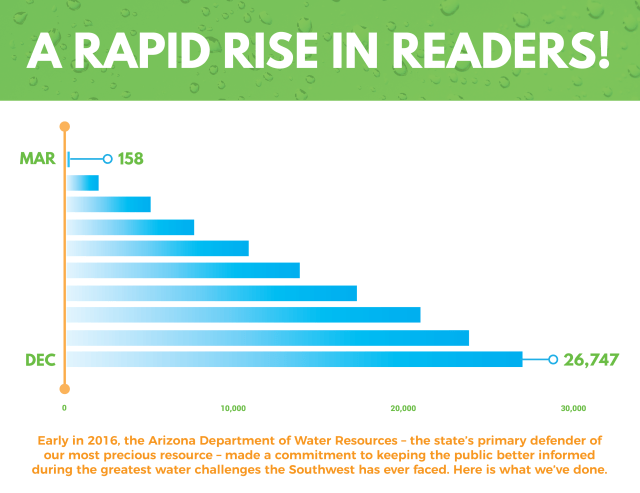
Our Arizona Water News newsletter – the “flagship” of the Arizona Department of Water Resources media empire – increased its subscriber listings from 134 in March to over 2,000 by the end of the year.

Since the early months of 2016, the Water Resources communications team has taken steps to accomplish two primary goals: 1) to enhance public awareness of the condition of the state’s water supply during an epochal period of drought; and, 2) to ensure the transparency of the records and data to which the department has been entrusted.

To accomplish that first goal, we have done a simple thing. It is the same thing that communications teams large and small in our fragmented, decentralized, mostly-online media world are attempting to do: We are expanding our viewing audience by providing useful, timely information and by carefully tracking what our analytics tell us interests that audience.

So, how’s that doin’?

In March 2016, the Water Resources news site attracted 158 page-views. We made a commitment to increase website viewers to 11,000 by year’s end. We blew past that figure in mid-summer and re-set our goal at 20,000. In December, we tallied 3,114 page views, and we logged a total of 26,747 page views for the year. Speaking technically, we crushed it.

How? Well, we gave our audience valuable water-related news to consume, of course, including a multi-media supply of written features, audio podcasts and YouTube video, all of which we made more easily accessible.

But we also dramatically diversified how our audience finds us.

Our Arizona Water News newsletter – the “flagship” of the Arizona Department of Water Resources media empire – increased its subscriber listings from 134 in March to over 2,000 by the end of the year.

Our presence on Twitter and Facebook has increased exponentially. In March, we counted 480 profile visits and 4,272 impressions. In December, those figures stood at 3,914 and 77,100, respectively.

“The advancing news cycle, obviously, played the dominant role in the growth of media interest in water issues involving Arizona and the Southwest. There is that matter of descending water levels at Lake Mead, after all. Still…”

Not all those readers are local readers, either. Our analytics show readers coming to our pages from Canada, India, the United Kingdom, Mexico and at least eight other countries.

In mid-December, meanwhile, we launched our Arizona Water News blog, a regularly updated news feature that began as a special “live news” report on Colorado River negotiations among Upper and Lower Basin Colorado River water users. One recent blog post between Christmas and New Year’s Eve attracted over 700 readers.

Small potatoes by New York Times standards? Well… OK. Sure. But the growth curve is up. Not all “media centers” can say that.

Precious few of them, for that matter, can say they have increased their audiences without having spent a penny on promotion or advertising – or on anything outside their own doors. At Water Resources, all the media magic happens here.

What’s more, our effort to problem-solve our way to better public outreach is bearing fruit in another important respect: It appears to be improving the factual awareness about Arizona’s water story among news media in and outside the state.

Our (admittedly subjective) log of accurate news-media reports on water issues in Arizona tracked an average of one or two reports a month in early 2016 that in our judgment related a factually accurate story.

 In November, we recorded 39 such reports, including news accounts published by Politico, International Business Times, the Denver Post, the Los Angeles Times and the Wall Street Journal.

The advancing news cycle, obviously, played the dominant role in the growth of media interest in water issues involving Arizona and the Southwest. There is that whole matter of descending water levels at Lake Mead, after all.

But we’re also confident the steps we have taken to assertively tell Arizona’s water story ourselves have had an impact. Many, if not most, of the media writing about drought in the Southwest now come to the Arizona Department of Water Resources for accurate and timely water data and analysis.