Water Awareness Month Festival Scheduled for April 5 is Canceled

Color Logo Transparent- For Web

PRESS RELEASE

FOR IMMEDIATE RELEASE                                                         March 26, 2025

Water Awareness Month Festival Scheduled for April 5 is Canceled

PHOENIX (March 26, 2025) – The annual Water Awareness Month Festival sponsored jointly by the Arizona Department of Water Resources (ADWR) and the Arizona Department of Environmental Quality (ADEQ) and scheduled this year at Wesley Bolin Plaza in Phoenix on Saturday, April 5, has been canceled.

Organizers of a nationwide protest event planned for that same day at the State Capitol have informed our agencies that they anticipate substantial attendance that may overflow onto the Plaza area. Out of an abundance of caution, ADWR and ADEQ have opted to cancel this year’s festival.

_

For further information, contact:

ADWR: Shauna Evans, Public Information Officer | 602-771-8079 | smevans@azwater.gov

ADEQ: Alma Suarez, Deputy Public Information Officer for Water Quality | 480-670-0568 | suarez.alma@azdeq.gov

###

ADWR Director expresses support for reintroduction of historic tribal water rights settlement

Color Logo Transparent- For Web

PRESS RELEASE

FOR IMMEDIATE RELEASE                                                         March 12, 2025

CONTACT: Doug MacEachern

PHONE: 602.771.8507

ADWR Director expresses support for reintroduction of historic tribal water rights settlement

Phoenix, AZ — Members of Arizona’s Congressional delegation from both sides of the aisle have led the way in reintroducing legislation to ratify and fund the historic Northeastern Arizona Indian Water Rights Settlement Agreement.

Arizona Senators Mark Kelly and Ruben Gallego, alongside Representatives Juan Ciscomani (R-AZ-06), Greg Stanton (D-AZ-04), David Schweikert (R-AZ-01), Raúl Grijalva (D-AZ-07) and Yassamin Ansari (D-AZ-03) announced on Tuesday the reintroduction of the vital legislation.

The bill was originally introduced in Congress last year to ratify and fund the settlement agreement entered into between the State of Arizona, the Navajo Nation, the Hopi Tribe, the San Juan Southern Paiute Tribe, and numerous other Arizona parties.

Arizona Governor Katie Hobbs signed the settlement agreement on November 19, 2024.

“Arizona’s congressional delegation is to be commended for leading the way in moving this legislation forward,” said Arizona Department of Water Resources Director Tom Buschatzke.

“Finalizing this crucial agreement, following decades of negotiation in some cases, constitutes a monumental ‘win’ for both the State of Arizona and the tribes,” said Buschatzke. “So, it is extremely gratifying to see our representatives from both sides of the political divide uniting behind this legislation.”

Congressional approval of the Act is vital to assuring clean and safe water supplies for the three Native American tribes.  Although estimates vary across the Navajo Nation, Hopi Tribe, and San Juan Southern Paiute Tribe reservations, approximately one-third of homes on the three reservations lack access to running water.

The legislation creates a reservation for the San Juan Southern Paiute Tribe, settles the Arizona water rights claims for all three Tribes, and authorizes $5.1 billion to acquire, build, and maintain much needed delivery infrastructure and water development projects, including the iiná bá – paa tuwaqat’si pipeline that will bring Colorado River water to the three reservations. Settlement water supplies include both Upper and Lower Basin Colorado River water, groundwater, and other surface water supplies.

The settlement also allows the Navajo Nation and the Hopi Tribe to lease a portion of their Colorado River supplies off-reservation, creating economic opportunities until on-reservation demand is met through new infrastructure.

The leasing authorization includes authorization to lease the Tribes’ Upper Basin Colorado River water for system conservation, which will provide a benefit to the Colorado River System.  The water has historically been used for system conservation.

For further information, contact ADWR communications administrator Doug MacEachern at dmaceachern@azwater.gov or 602.771.8507.

###

Public Comment Period for Arizona Water Protection Fund Fiscal Year 2025 Grant Applications Now Open

FOR IMMEDIATE RELEASE

September 16, 2024

Press Release

CONTACT: Doug MacEachern

(602) 771-8507

dmaceachern@azwater.gov

Public Comment Period for Arizona Water Protection Fund Fiscal Year 2025 Grant Applications Now Open

PHOENIX – The Arizona Water Protection Fund* has received grant applications for its fiscal year 2025 funding cycle.

Grant applications are now available for public review at the Arizona Water Protection Fund website at https://www.azwpf.gov/grant-information/fy-2025-grant-cycle or at the Arizona Department of Water Resources physical address described below.

Written comments regarding grant applications may be submitted during the 45-day public comment period, which begins September 17, 2024 and ends November 1, 2024 at 5:00 p.m. Written public comments must be received no later than 5:00 p.m., November 1, 2024. Written comments can be mailed, sent via email, or sent by fax. If mailed, written comments must be postmarked no later than November 1, 2024. Please include application numbers and project titles. For additional information, please contact Reuben Teran, Executive Director at (602) 771-8528.

Mailing AddressPhysical Address           
Arizona Department of Water Resources Arizona Water Protection Fund Attn: Reuben Teran 1802 W Jackson St. Box #79 Phoenix, Arizona 85007Arizona Department of Water Resources Arizona Water Protection Fund 1110 West Washington, Suite 310 Phoenix, Arizona 85007
FaxEmail
(602) 771-8687rteran@azwater.gov

*The Arizona Water Protection Fund supports projects that develop or implement on the ground measures that maintain, enhance and restore Arizona’s river and riparian resources.

Arizona Water Protection Fund Accepting Applications for Fiscal Year 2025 Grant Cycle

FOR IMMEDIATE RELEASE

June 24, 2024

Press Release

CONTACT: Doug MacEachern

(602) 771-8507

dmaceachern@azwater.gov

Arizona Water Protection Fund Accepting Applications for Fiscal Year 2025 Grant Cycle

PHOENIX- The Arizona Water Protection Fund (AWPF) supports projects that develop or implement on- the-ground measures that directly maintain, enhance and restore Arizona’s river and riparian resources.

The AWPF Commission will be accepting applications for the Fiscal Year 2025 grant cycle and will award grants under three categories: capital projects, research, and water conservation. The deadline to submit applications is August 30, 2024, at 11:59 p.m. Arizona time. Applications will only be accepted electronically via the eCivis Grants Management System. The eCivis grant application portal link, grant cycle schedule, grant application manual, and electronic forms are available on the AWPF website at https://www.azwpf.gov/grant-information/fy-2025-grant-cycle

AWPF staff will be hosting one grant application workshop:

LocationDateTime
Online Webinar*Wednesday, July 10, 2024 1:30 p.m. – 2:30 p.m.
Webinar Information
Link: https://adwr.info/3VT5boM
Webinar Number (Access Code): 2530 916 1357
Webinar Password: NgsDFvaU837
Join by Phone: 1-415-655-0001 US Toll (Access Code is same as above)

*Staff will be providing the grant application workshop via online webinar only, but a recording will also be available on the AWPF website at https://www.azwpf.gov/grant-information/fy-2025-grant-cycle.   Please contact the Arizona Water Protection Fund at 602-771-8528 or rteran@azwater.gov with any questions.

The Arizona Legislature established the AWPF in 1994 (A.R.S. § 45-2101, et seq.). The Arizona Department of Water Resources provides administrative, technical, and legal support to the AWPF Commission. The legislation establishing the AWPF provides that it is the declared policy of the Legislature to provide for a coordinated effort between state funding and locally led solutions for the restoration and conservation of the water resources of the state. A.R.S. § 45-2101(A). The primary purpose of the AWPF is to provide monies through a competitive public grant process for implementation of measures to protect water of sufficient quality and quantity to maintain, enhance, and restore rivers and streams and associated riparian resources consistent with existing water law and water rights, and measures to increase water availability. A.R.S. § 45-2101(B).

For additional information, please contact Reuben Teran at rteran@azwater.gov.

Arizona, California and Nevada commit to record-setting conservation to protect the Colorado River

PRESS RELEASE

FOR IMMEDIATE RELEASE OCTOBER 19, 2023

CALIFORNIA
Jessica Neuwerth
Colorado River Board of California
818-254-3202
jneuwerth@crb.ca.gov

NEVADA
Bronson Mack
Southern Nevada Water Authority
702-822-8543
bronson.mack@snwa.com

Arizona, California and Nevada commit to record-setting conservation
to protect the Colorado River

Record-setting volumes of Colorado River water are being saved in Lake Mead

The Bureau of Reclamation is moving the process forward to develop new operating guidelines for the Colorado River that will be in effect after 2026. Simultaneously, states, tribes and water users across the Colorado River Basin continue to collaborate on a long-term sustainable plan for the stability of the river.

To that end, the Lower Colorado River Basin states – water users in Arizona, California and Nevada – are contributing record volumes of water to Lake Mead. By the end of 2023, cumulatively, the Lower Basin will have voluntarily conserved more than 1 million acre-feet  – water that is being held back in Lake Mead for the benefit of the entire system over and above shortage reductions agreed to in 2007 and those of the 2019 Drought Contingency Plan.

In 2023, consumptive use in the Lower Basin States is expected to be around 5.8 million acre-feet, the lowest consumptive use since 1984.

Arizona

Arizona users are conserving nearly 345,000 acre-feet of water in 2023 through the Central Arizona Water Conservation District/Arizona Department of Water Resources ICS Preservation program as well as federally funded CAP subcontractor, tribal contractor and on-river conservation agreements. This is in addition to the 592,000 acre-foot Tier 2a shortage reduction taken by Arizona.

“Arizona is conserving more water than ever to stabilize the Colorado River Basin and protect our collective water future,” said Tom Buschatzke, Director of the Arizona Department of Water Resources.

“The commitment of our state’s tribes, cities, industries and agricultural districts to Colorado River conservation efforts is substantial, and builds upon Arizona’s long history of water conservation in support of a robust economy. I’m confident we will continue this tradition well into the future as we all adapt to a changing Colorado River.”

California

Colorado River water deliveries to California in 2023 are on track to be the lowest since 1949 – 700,000 acre-feet lower than the state’s 4.4 million acre-foot apportionment. In urban Southern California, Colorado River use this year is projected to be the third lowest in 60 years, thanks in part to recent broad efforts to reduce outdoor water use on grass. Last week, Gov. Gavin Newsom signed legislation prohibiting the use of potable water to irrigate grass that serves no functional purpose at businesses and other institutions.

“Twenty years ago this year, California permanently reduced its Colorado River water use by 800,000 acre-feet overnight — enough to serve 2.4 million households every year. This year, in addition to that unparalleled and ongoing effort, we’ve cut our use even further thanks to investments in conservation and partnerships forged between our agricultural, urban, and tribal water users,” said JB Hamby, California’s Colorado River Commissioner and Chairman of the Colorado River Board of California. “California is committed to leading with our water users, Basin States, and Basin Tribes to ensure sustainability on the Colorado River now and into the future.”

Nevada

Nevada implemented a series of new water efficiency measures to further enhance the community’s progressive and comprehensive conservation program, which has reduced Nevada’s consumption of Colorado River by 41 percent since 2002. The new water efficiency measures include pool size limits, state laws requiring decorative grass replacement, prohibitions on new evaporative cooling, and innovative tools to align economic development opportunities with water efficiency.

“With a population of 2.3 million residents, Southern Nevada will use less than 200,000 acre-feet this year – our lowest annual water use since 1993 when our population was about 900,000 people,” said John Entsminger, SNWA General Manager. “As a river community, we can all maintain diverse, robust economies while using less water, and the reductions in municipal and agricultural water use across the Lower Basin demonstrates that.” 

Arizona, California, and Nevada water users continue to conserve and leave roughly 3 million acre-feet of water in Lake Mead by the end of 2026, ensuring Colorado River system stability. Collectively, ongoing commitments may exceed the volumes in the Lower Basin consensus proposal offered to the federal government earlier this year as part of the Supplemental Environmental Impact Statement process to revise the 2007 Interim Guidelines that operate the Colorado River system.

These contributions provide much-needed stability through 2026 while new operating guidelines are being developed for the Colorado River system.

###
Comment Period for Arizona Water Protection Fund Fiscal Year 2024 Grant Applications Now Open

FOR IMMEDIATE RELEASE

September 11, 2023

Press Release

CONTACT: Shauna Evans

(602) 771-8079

smevans@azwater.gov

Comment Period for Arizona Water Protection Fund Fiscal Year 2024 Grant Applications Now Open

PHOENIX – The Arizona Water Protection Fund* has received grant applications for its fiscal year 2024 funding cycle.


Grant applications are now available for public review at the Arizona Water Protection Fund website at https://www.azwpf.gov/grant-information/fy-2024-grant-cycle or at the Arizona Department of Water Resources physical address described below.


Written comments regarding grant applications may be submitted during the 45-day public comment period, which begins September 12, 2023 and ends October 27, 2023 at 5:00 p.m. Written public comments must be received no later than 5:00 p.m., October 27, 2023. Written comments can be mailed, sent via email, or sent by fax. If mailed, written comments must be postmarked no later than October 27, 2023. Please include application numbers and project titles. For additional information, please contact Reuben Teran, Executive Director at (602) 771-8528.

Mailing AddressPhysical Address   
Arizona Department of Water Resources Arizona Water Protection Fund Attn: Reuben Teran 1802 W Jackson St. Box #79 Phoenix, Arizona 85007Arizona Department of Water Resources Arizona Water Protection Fund 1110 West Washington, Suite 310 Phoenix, Arizona 85007
FaxEmail
(602) 771-8687rteran@azwater.gov

_

* The Arizona Water Protection Fund supports projects that develop or implement on the ground measures that directly maintain, enhance and restore Arizona’s river and riparian resources.

###

Arizona Water Protection Fund Accepting Applications for Fiscal Year 2024 Grant Cycle

FOR IMMEDIATE RELEASE

July 5, 2023

Press Release

CONTACT: Doug MacEachern

(602) 771-8507

dmaceachern@azwater.gov

Arizona Water Protection Fund Accepting Applications for Fiscal Year 2024 Grant Cycle

PHOENIX- The Arizona Water Protection Fund (AWPF) supports projects that develop or implement on-the-ground measures that directly maintain, enhance and restore Arizona’s river and riparian resources.

The AWPF Commission will be accepting applications for the Fiscal Year 2024 grant cycle and will award grants under three categories: capital projects, research, and water conservation. The deadline to submit applications is August 25, 2023, at 11:59 p.m. Arizona time. Applications will only be accepted electronically via the eCivis Grants Management System. The eCivis grant application portal link, grant cycle schedule, grant application manual, and electronic forms are available on the AWPF website at https://www.azwpf.gov/grant-information/fy-2024-grant-cycle.

AWPF staff will be hosting one grant application workshop:

LocationDateTime
Online Webinar*Wednesday, July 12, 2023 1:30 p.m. – 2:30 p.m.
Webinar Information
Link: https://adwr.info/AWPF_W
Webinar Number (Access Code): 2595 334 6863
Webinar Password: 3ZKcjn3WW97
Join by Phone: 1-415-655-0001 US Toll (Access Code is same as above)

*Staff will be providing the grant application workshop via online webinar only, but a recording will also be available on the AWPF website at https://www.azwpf.gov/grant-information/fy-2024-grant-cycle.   Please contact the Arizona Water Protection Fund at 602-771-8528 or rteran@azwater.gov with any questions.

The Arizona Legislature established the AWPF in 1994 (A.R.S. § 45-2101, et seq.). The Arizona Department of Water Resources provides administrative, technical, and legal support to the AWPF Commission. The legislation establishing the AWPF provides that it is the declared policy of the Legislature to provide for a coordinated effort between state funding and locally led solutions for the restoration and conservation of the water resources of the state. A.R.S. § 45-2101(A). The primary purpose of the AWPF is to provide monies through a competitive public grant process for implementation of measures to protect water of sufficient quality and quantity to maintain, enhance, and restore rivers and streams and associated riparian resources consistent with existing water law and water rights, and measures to increase water availability. A.R.S. § 45-2101(B).

For additional information, please contact Reuben Teran at rteran@azwater.gov.

Arizona Department of Water Resources field hydrologists conducting “basin sweep” to collect water level measurements in the Phoenix AMA

Color Logo Transparent- For Web

PRESS RELEASE

FOR IMMEDIATE RELEASE                                                         December 1, 2022

Arizona Department of Water Resources field hydrologists conducting “basin sweep” to collect water level measurements in the Phoenix AMA

PHOENIX- Beginning the week of December 12, 2022, and continuing through January 2023, Arizona Department of Water Resources (ADWR) field services staff will make an extensive effort to measure water levels in wells in the Phoenix Active Management Area (AMA). This survey of wells – or basin “sweep,” as it is known – was last conducted during the winter of 2016/2017. 

The data collected will be analyzed and used to obtain a comprehensive overview of the groundwater conditions and used to support scientific and water management planning efforts. Among others, data uses will include:

  • Analysis of water-level trends
  • Groundwater modeling
  • Water-level change maps
  • Hydrologic reports
  • Water resource planning and management

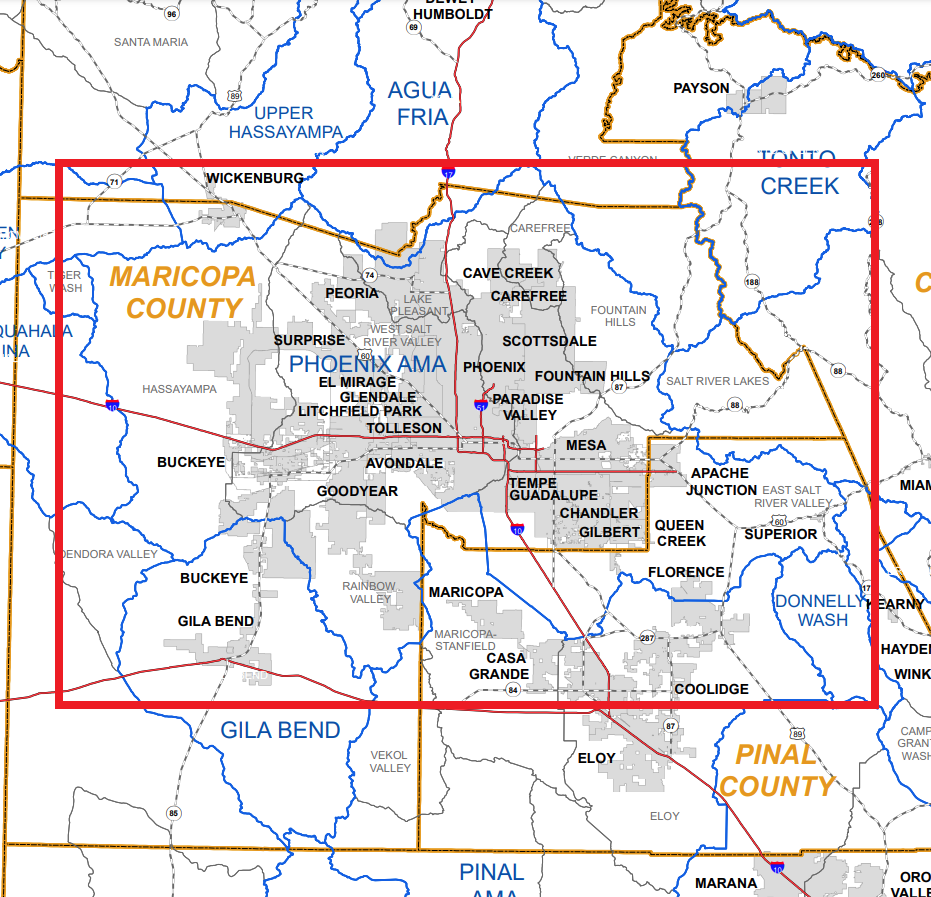
This basin sweep covers an area generally in the central portion of the state and extends west of the Phoenix Metro area past Tonopah, east near the Superstition Mountain and Globe, AZ, north of New River, AZ and south to Sacaton. The Phoenix AMA consists of the following subbasins; Hassayampa, West Salt River Valley, Lake Pleasant, East Salt River Valley, Rainbow Valley, Carefree and Fountain Hills.

Map of the Phoenix AMA

For more information regarding this matter, please contact Public Information Officer Shauna Evans at smevans@azwater.gov or (602) 771-8079. Details about the nature of basin sweeps and groundwater modeling can be found here.

###

Arizona Department of Water Resources field hydrologists conducting “basin sweep” to collect water level measurements in the Western Planning Area: Butler Valley, Harquahala, McMullen Valley, Ranegras Plain, and Tiger Wash Basins

Color Logo Transparent- For Web

PRESS RELEASE

FOR IMMEDIATE RELEASE                                                         January 5, 2022

Arizona Department of Water Resources field hydrologists conducting “basin sweep” to collect water level measurements in the Western Planning Area: Butler Valley, Harquahala, McMullen Valley, Ranegras Plain, and Tiger Wash Basins

PHOENIX – Beginning the week of January 1st, 2022, and scheduled to continue for multiple months, Arizona Department of Water Resources (ADWR) field services staff will be making an extensive effort to measure water levels in wells in the Western Planning Area (WPA): Butler Valley, Harquahala, McMullen Valley, Ranegras Plain, and Tiger Wash Basins.  ADWR’s objective is to measure water levels at hundreds of wells in these groundwater basins. This survey of wells – or basin “sweep,” as it is known – was last conducted in winter 2016 for the WPA.  The Harquahala Irrigation Non-Expansion Area (INA) will also be included in the basin sweep as it is contained within the Harquahala Basin. 

The data collected will be analyzed and used to obtain a comprehensive overview of the groundwater conditions and used to support scientific and water management planning efforts. Data collected will be used for several purposes, including:

  • Analysis of water-level trends
  • Groundwater modeling
  • Water-level change maps
  • Hydrologic reports
  • Water resource planning and management.

This basin sweep covers an area generally in the western to southwestern portion of the State and extends east of Plomosa and Kofa Mountains, west of Big Horn, Vulture and Harquahala Mountains, north of Eagle Tail Mountains and south of Bouse Hills, Buckskin and Harcuvar Mountains. 

For more information regarding this matter, please contact Public Information Officer Shauna Evans at smevans@azwater.gov or (602) 771-8079. Details about the nature of basin sweeps and groundwater modeling can be found here.

###

At the Inauguration: Governor Ducey’s comments on securing Arizona’s water future

inauguration day 2019

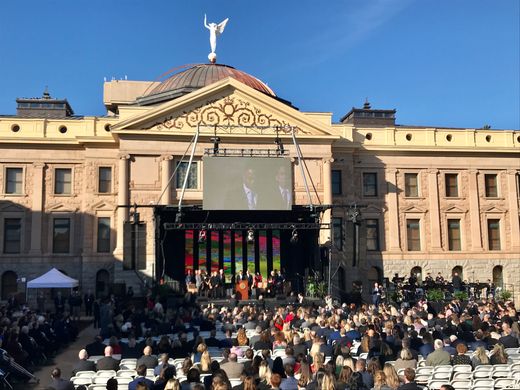
In delivering his second Inaugural Address, Arizona Governor Doug Ducey told the audience at the State Capitol that the time has come to “press forward on some of the biggest challenges facing us.”

“Because none of us came here to do little things — we came here to do the things that matter, big things — and we can do them together.”

Among those big things the Governor identified was securing the State’s water future. Specifically, Governor Ducey called on lawmakers and stakeholders to take action on protecting the State’s Colorado River water supplies.

“We cannot kick the can any further,” he said.

Governor Ducey’s comments on Arizona water security, in full:

Our duty is to leave this state in far better shape than we found it — and we are well on our way.

These are the tasks before us. And if there’s any question of how Arizonans expect us to solve these problems, I’d say, look around. Taking the oath with me today are Republicans and Democrats – all hired by the same electorate.

When conversations stall, as they sometimes do during difficult discussions, we let history be our guide and the hand that lifts us back up.

Nearly four decades ago, in 1980, Arizona’s accelerated water consumption forced a sobering ultimatum from the federal government: reform or suffer severe water cutbacks.

The can could not be kicked any further.

But Arizona’s history is not one of missed opportunities or efforts that came up short. Rather we find, that in the darkest times, Arizona’s pioneering spirit shines the brightest.

Democrats and Republicans rose above party labels. They brought skeptical and reluctant stakeholders to the table. And they acted – and they did it with good faith and honest intentions.

For the people in this crowd and many across our state, I don’t have to spell out the parallel circumstances in which we find ourselves today.

It’s simple. Arizona and our neighboring states draw more water from the Colorado River than mother nature puts back. And with a critical shortfall imminent, we cannot kick the can any further.

It’s going to mean rising above self-interest, and doing the right thing. It means taking the action our past and future generations demand.