The current status of Colorado River negotiations: A statement from the seven Colorado River Basin States, the Department of the Interior and the Bureau of Reclamation

PRESS STATEMENT

The current status of Colorado River negotiations: A statement from the seven Colorado River Basin States, the Department of the Interior and the Bureau of Reclamation

The seven Colorado River Basin states together with the Department of the Interior and the Bureau of Reclamation recognize the serious and ongoing challenges facing the Colorado River. Prolonged drought and low reservoir conditions have placed extraordinary pressure on this critical water resource that supports 40 million people, tribal nations, agriculture, and industry.  

While more work needs to be done, collective progress has been made that warrants continued efforts to define and approve details for a finalized agreement. Through continued cooperation and coordinated action, there is a shared commitment to ensuring the long-term sustainability and resilience of the Colorado River system.

###

ADWR statement in response to Department of Interior’s new Draft Supplemental Environmental Impact Statement

PRESS STATEMENT

ADWR statement in response to Department of Interior’s new Draft Supplemental Environmental Impact Statement

By the end of 2023, the Lower Basin will have voluntarily conserved more than 1 million acre-feet in the Colorado River system. This volume is on top of reductions in use mandated by the 2007 Guidelines and the 2019 Drought Contingency Plan, which resulted in a cumulative 617,000 acre-feet being stored in Lake Mead this year by the three states.

As a result of the conservation and the reductions in use, Arizona, California and Nevada this year have put just 5.8 million acre-feet to consumptive use – the lowest consumptive use since 1984.

Arizona’s conservation efforts alone have been substantial.

Including voluntary contributions and reductions mandated by the ‘07 Guidelines and the DCP, Arizona has conserved over 3.7 million acre-feet of water in Lake Mead since 2014. In 2023 alone, Arizona is on track to conserve 907,000 acre-feet:

  • Tier 2a shortage reduction stipulated by ‘07 Guidelines – 400 KAF
  • Tier 2a DCP contribution – 192 KAF
  • System Conservation funded by Bureau of Reclamation – ~272 KAF
  • ADWR-CAWCD ICS Preservation – ~43 KAF
  • Total – ~907 KAF

Taken together, the ongoing voluntary commitments are on track to achieve the volumes in the Lower Basin consensus proposal offered to the federal government earlier this year. Combined with the past year’s above-average hydrology, the system is stable through 2026.

As a result, the states will continue focusing their efforts on post-2026 operational guidelines in order to stabilize the Colorado River system for the long-term.

###

A Joint ADWR/CAP Statement On CO River Shortage Preparedness

Stronger Together

As the drought in the Colorado River Basin extends beyond its 20th year, we anticipate the first-ever shortage declaration on the Colorado River. The shortage will result in a substantial cut to Arizona’s share of the river, with reductions falling largely to central Arizona agricultural users.  These reductions are painful, but we are prepared. We have long understood the risks to Arizona’s Colorado River supplies and have been planning for decades, including the successful efforts to create a Drought Contingency Plan for the Colorado River system in 2019. 

It’s important to note that a shortage means a reduction in the Colorado River supply available to Arizona. While we may have less water coming to Arizona from the Colorado River in 2022, the river will continue to be a vital source of water for generations to come.

In 2021, the river is currently operating in a “Tier Zero” status, requiring the state to contribute 192,000 acre-feet of Arizona’s 2.8 million acre-foot annual entitlement to Lake Mead. This contribution is coming entirely from the Central Arizona Project (CAP) system. 

Based on the current hydrology, it is likely that the U.S. Bureau of Reclamation will elevate the shortage level to a “Tier 1” in 2022. This would require Arizona to reduce uses by a total of 512,000 acre-feet, again, borne almost entirely by the CAP system. While significant, the high priority CAP water supply for cities and tribes is not affected due to the implementation of agreements among Arizona water users.

We are prepared for Tier 1 reductions because Arizona water users have been working collaboratively for many years to protect our Colorado River water supply.

Specifically, the seven states in the Colorado River Basin and the U.S., and the Republic of Mexico, developed plans for managing the Colorado River, known in the U.S. as the Drought Contingency Plan (DCP), which lasts until 2026. Arizona prepared a unique and innovative way to implement the plan in Arizona through its DCP Steering Committee. 

The DCP Steering Committee, which included more than 40 representatives of tribes, cities, agriculture, developers, environmental organizations, and elected officials, worked collectively to share the risks and benefits of the DCP.  Arizona’s DCP implementation plan represents the best of Arizona water management: collaboration, cooperation, and innovation. 

The plan shares resources and mitigates the impacts of shortage reductions.  In the plan, some are committing to leaving extra water in Lake Mead to reduce future risks, while others are sharing water with the most severely impacted of the state’s water users, central Arizona agriculture Together these efforts reduce the pain of the near-term reductions while addressing risks of future shortages.  The result is the Arizona water community is prepared, even in the midst of a decades-long drought.

The actions taken by Arizona’s water-community stakeholders, legislature and by Governor Ducey manage the immediate risk to supplies on the Colorado River, providing time while we develop new rules and programs to sustain the river after 2026.

As we face the prospect of a hotter and drier future, we are confident that with our long history of successful collaboration among our diverse stakeholders – agriculture, tribes, cities, environment, and industry, we will continue to find innovative and effective solutions to sustain Arizona’s Colorado River supply.

How do we sustain the Colorado River past 2026? Here’s how Arizona intends to find out.

The Opinion piece below was initially published on AZCentral.com on Friday, Sept. 13, 2019.

By Tom Buschatzke, Director, Arizona Department of Water Resources, and Ted Cooke, General Manager, Central Arizona Project


It didn’t take long for the completion of the Drought Contingency Plan to create value to Arizona and the Colorado River Basin.

Its focus on stabilizing Lake Mead and creating incentives to “bank” water in the reservoir already are paying dividends.

We can say with confidence that DCP is already a success.

DCP is providing a safe harbor while we work on important issues leading up to 2026, when the existing guidelines for the operation of the Colorado River system expire.

We now have an opportunity to build on the successful Arizona process that led to the DCP signing. Arizona is Stronger Together. And that will serve us well as we work toward the next step – maintaining a stable, healthy Colorado River system as we face a hotter and drier future.

Lake Mead is 22 feet higher than expected

A year ago, many of us were immersed in the details of Arizona’s Drought Contingency Implementation Plan, which benefited from the cooperative spirit of its participants, including elected leaders and representatives from every sector of the state’s water-using community.

ADWR Director Buschatzke
Tom Buschatzke

In 2020 and likely 2021, we will be operating under DCP’s Tier Zero, a reduction of 192,000 acre-feet to Arizona. The estimated impact of contributing this water is more than $40 million, but the investment is worth it to protect the Colorado River system.

Aerial View of the Colorado River
Ted Cooke

DCP’s incentives allowed for greater storage in Lake Mead this year. That, coupled with a lot of snow from the Rocky Mountains and additional tributary flow, increased storage in Lake Mead by more than 22 feet from what was initially projected.

An excellent winter snowpack in the Rockies helped Lake Mead a lot. But here is the kicker: Almost half of that 22-foot rise in Lake Mead was due to storage and contributions to system conservation.

But DCP won’t hold us forever

The term used for the coming negotiations on the system’s new guidelines is “reconsultation” of the “Colorado River Interim Guidelines for Lower Basin Shortages and the Coordinated Operations for Lake Powell and Lake Mead.”

The emphasis is on “interim.” The 2007 Guidelines expire in 2026. So, when people ask “what’s next?” for Colorado River management, that’s it – the difficult challenge of assessing the effectiveness of the current Guidelines, with the DCP overlay, and exploring new approaches for the next iteration of the Guidelines.

As we learned on January 31 when the State Legislature passed, and Governor Doug Ducey signed Arizona’s DCP, we achieved success because we worked together. We intend to bring the steering committee process back to life, reviving that spirit of cooperation that so infused negotiations.

To that end, we are embarking on a listening and data-collecting effort. It is our plan to meet first with the elected leaders who contributed so much time and effort to the successful steering committee process. Then, we plan to sit down with other delegates, including those representing Arizona tribes, cities, agriculture, mining, development and the nonprofit community.

Our goal: To develop a shared vision

Our new goal? Gather our stakeholders’ thoughts and develop a shared vision as we plan for Arizona’s Colorado River water supply.

This will ensure Arizona is a strong voice among the Colorado River Basin states and the federal government as we hammer out the next set of agreements for management of the Colorado River Basin beyond 2026.

That is our “Next Step.” It’s a big one and we must be prepared. And we will be, because Arizona truly is Stronger Together.
 

ADWR Director to present on potential impacts of DCP at Colo River conference

GWC_Conference 2019

Arizona Department of Water Resources Director Tom Buschatzke will participate Thursday in a panel discussion on “Charting a Better Course for the Colorado River” at the annual Getches-Wilkinson Center Summer Conference in Boulder, Colo.

Buschatzke’s panel discussion will delve into expectations for the new management guidelines on the Colorado River system, including the new Drought Contingency Plans that were signed on May 20 at an event at Hoover Dam. The panel also will discuss expectations for the new Guidelines for river management that must be worked out before the existing Guidelines expire in 2026.

Panelists will consider how (or, whether) the  DCPs may provide a “roadmap” for reaching agreement on those post-2026 Guidelines.

As noted in the GWC Summer Conference schedule of events, “(n)owhere was the DCP road more turbulent, and the upcoming implementation more salient, than in Arizona.”

The discussion, which begins at 9:00 a.m. (MST) will be recorded and livestreamed. It will be available for viewing here.


Effort to win Congressional support for the Colorado River Drought Contingency Plans begins in earnest on Wednesday

DCP Signing-19
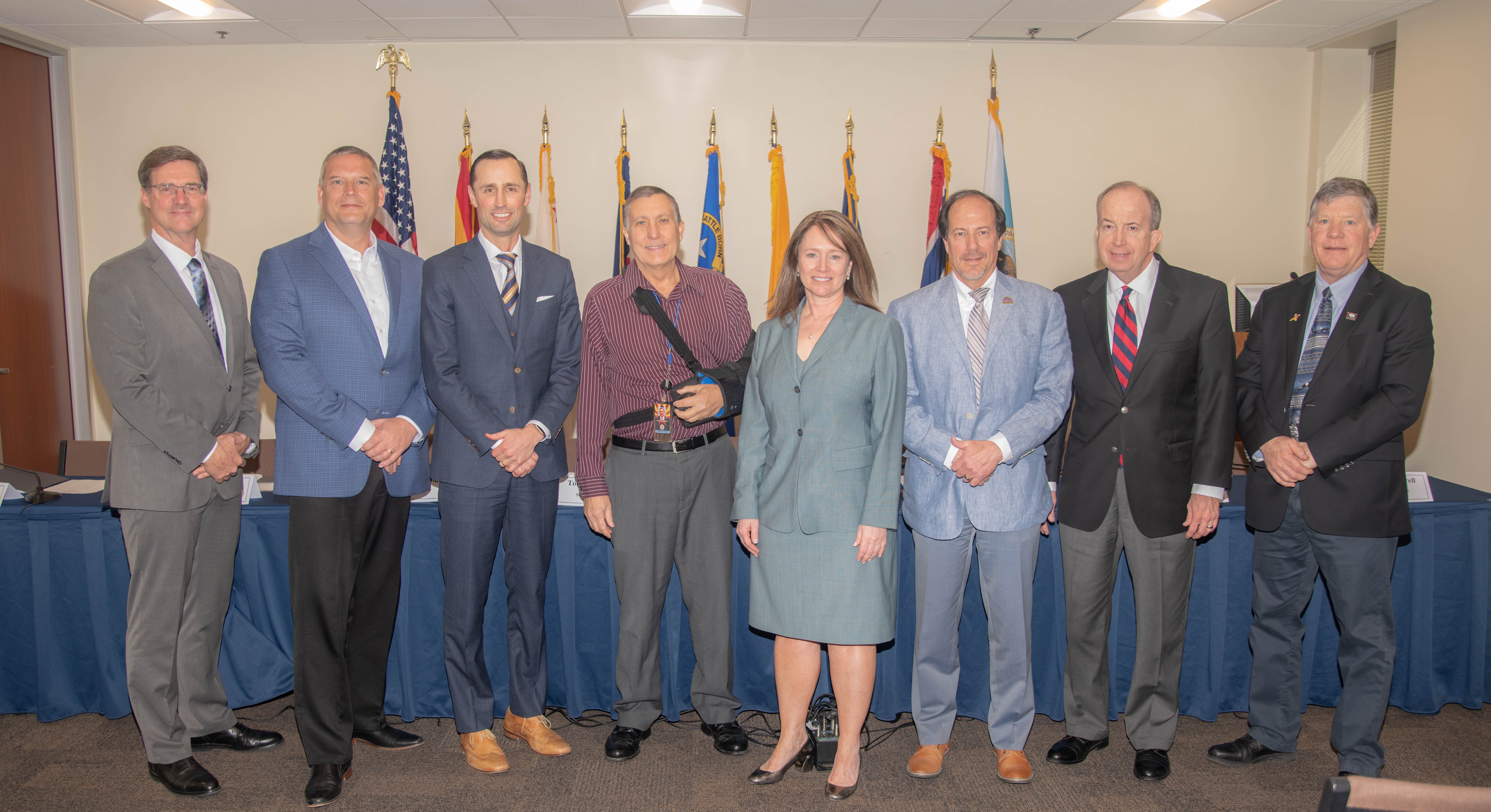
Signers of the March 19 Letter to Congress urging federal support for the Drought Contingency Plans, with Bureau of Reclamation Commissioner Brenda Burman. From left: Peter Nelson, California; John Entsminger, Nevada; James Eklund, Colorado; Tom Buschatzke, Arizona; Commissioner Burman; John D’Antonio, Jr., New Mexico; Norm Johnson, Utah; and, Pat Tyrrell, Wyoming. Buschatzke, Entsminger and Tyrrell will join the Commissioner before the Senate Subcommittee on Water and Power on March 27.

Advocates for the Colorado River Drought Contingency Plans will begin making their case to Congress on Wednesday, March 27, when four officials deeply involved in the effort to stabilize the system are scheduled to address the U.S. Senate Committee on Energy & Natural Resources’ Subcommittee on Water and Power.

The witness panel includes Brenda Burman, Commissioner of the U.S. Bureau of Reclamation; Tom Buschatzke, Director of the Arizona Department of Water Resources; John Entsminger, general manager of the Southern Nevada Water Authority; and, Patrick Tyrrell, State Engineer for the State of Wyoming.

Like other witnesses, ADWR Director Buschatzke will provide oral and written testimony to the panel about the DCP.

Chaired by Sen. Martha McSally of Arizona, the subcommittee will examine the drought plans of the Upper and Lower Basins of the river system. Before the plans can be finalized, Congress must first authorize the Department of the Interior to implement them.

Set to convene at 2:30 p.m. EDT (11:30 a.m. Arizona time), The hearing will be webcast live on the committee’s website, and an archived video will be available shortly after the hearing is complete.

Witness testimony will be available on the website at the start of the hearing.


Drought Contingency Plan focus now turns to Congress: ADWR Director to testify at U.S. House and Senate

DCP Signing-19
Signatories to the Letter to Congress, gathered for a post-signing photo with Bureau of Reclamation Commissioner Brenda Burman (left to right): Peter Nelson of California; John J. Entsminger of Nevada; L. James Eklund of Colorado; Tom Buschatzke of Arizona; ; John R. D’Antonio, Jr. of New Mexico; Norm Johnson of Utah; and, Pat Tyrrell of Wyoming

Following the agreement reached on Tuesday to jointly pursue completion of their Drought Contingency Plans, the seven Colorado River Basin states now turn attention to Washington, D.C., where congressional action is necessary to complete the plans.

That congressional action commences next week.

On Tuesday, March 19, representatives of the seven States, including Arizona Department of Water Resources Director Tom Buschatzke, signed a Letter to Members of Congress, requesting that they support the Drought Contingency Plans. Congress first must approve legislation directing the Secretary of Interior to sign and implement the plans.

With that mission in mind, Director Buschatzke will testify next week before relevant subcommittees in the both the U.S. Senate and the House of Representatives.

The Director has been asked to testify regarding the drought plans on Wednesday, March 27, before the Senate Committee on Energy and Natural Resources’ Subcommittee on Water & Power.

In addition to  Director Buschatzke, Bureau of Reclamation Commissioner Brenda Burman; John Entsminger, the general manager for Southern Nevada Water Authority; and, Pat Tyrrell, the Wyoming state engineer, are scheduled to testify before the subcommittee, which is chaired by Sen. Martha McSally of Arizona.

On Thursday, March 28, Buschatzke is scheduled to testify on the DCP before the House Subcommittee on Water, Oceans, and Wildlife. The Director will provide lawmakers five minutes of oral testimony and will submit a lengthier statement in writing.

Water, Oceans, and Wildlife is a subcommittee of the House Natural Resources Committee. Arizona Rep. Raul M.  Grijalva chairs the Committee.


Final DCP Steering Committee meeting scheduled for February 19

Homepage_Thumbnail_New_DCP

A final wrap-up meeting of the 40-plus member Steering Committee – the stakeholder group that over the last 8 months debated and negotiated the Intra-Arizona DCP Implementation Plan – is scheduled for Tuesday, February 19 at the Central Arizona Project headquarters.

The agenda for the meeting is available at the Lower Basin Drought Contingency Planning websites at both the Arizona Department of Water Resources and the CAP.

The agenda includes:

  • A recap of the Arizona DCP legislation
  • A status summary of the Intra-Arizona Implementation Plan
  • An outline of actions needed to achieve Congressional approval
  • Delegate comments
  • A Steering Committee resolution

Details:

Who: Lower Basin Drought Contingency Plan Arizona Implementation Steering Committee

What: Wrap-up, recap, status reports, delegate observations and Steering Committee resolution

Where: CAP headquarters, 23636 N. Seventh St., Phoenix

When: February 19, 2019; 9 a.m. – 11 a.m.


Arizona Governor puts saving Lake Mead onto center stage on social media platforms

Arizona Governor Doug Ducey is giving over much of his social media platform to  getting a Drought Contingency Plan completed in Arizona.

governor ducey facebook page lake mead 1.23.2019

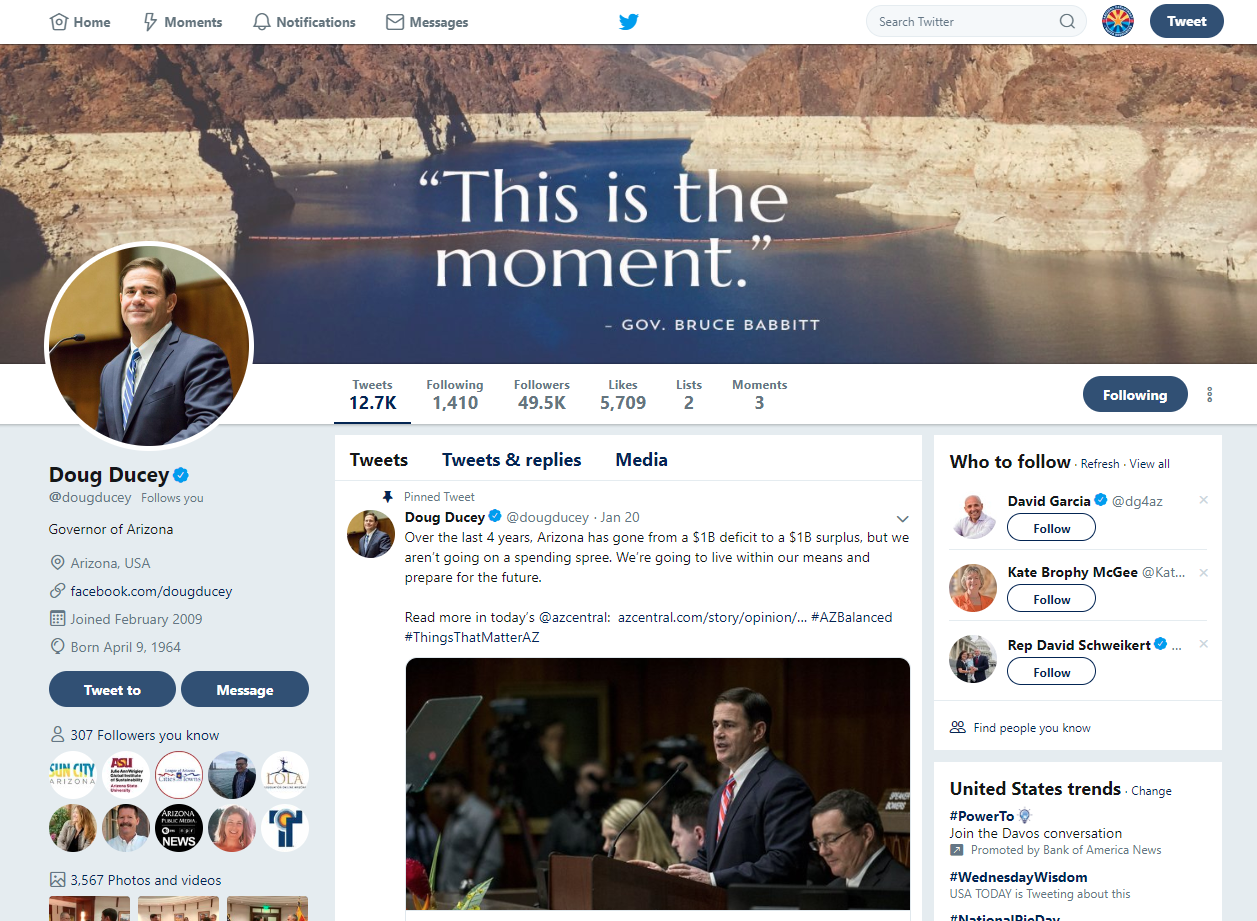
The art on the Governor’s Twitter feed home page is one of those startling “bathtub ring” photos of Lake Mead, which depict the reservoir’s dramatic decline in recent years.

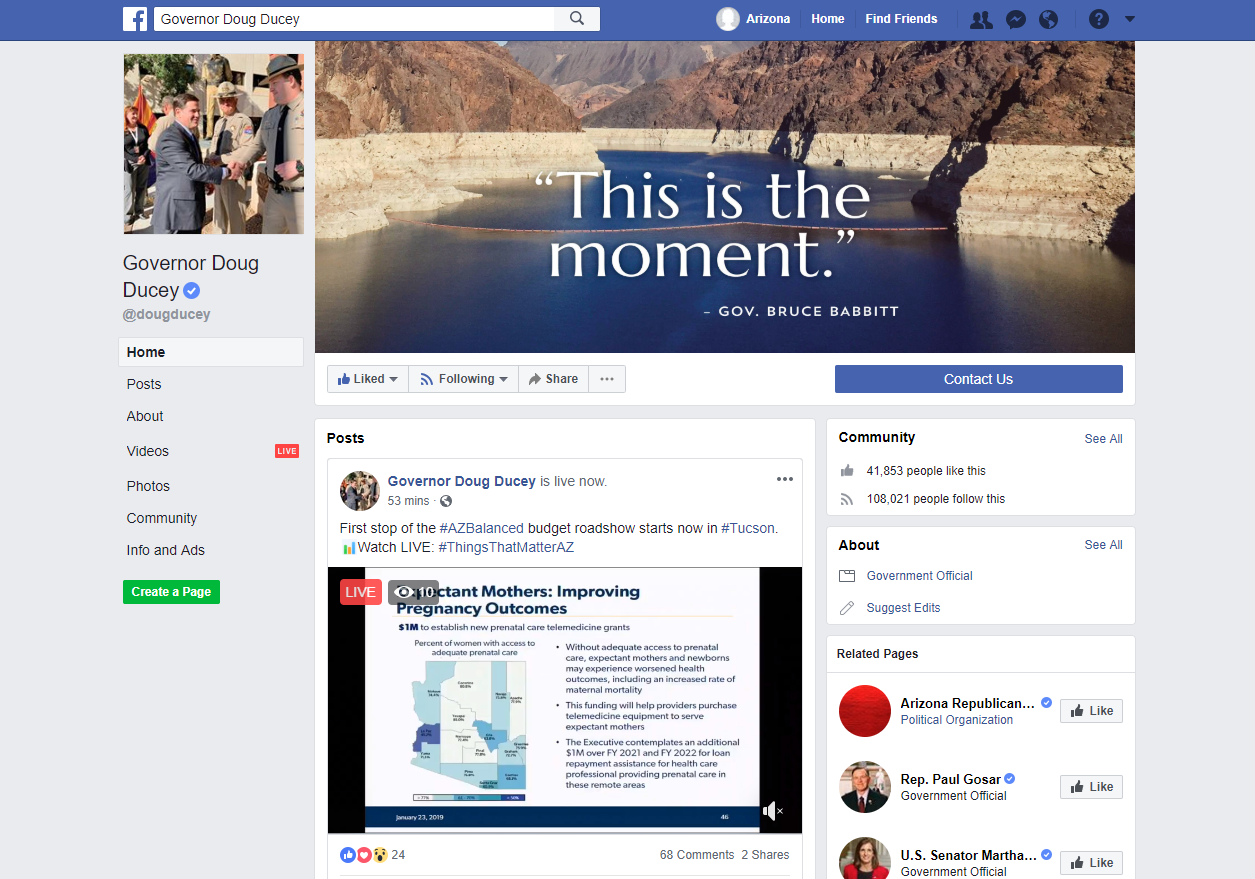
His official Facebook page includes the same image.

The Governor’s Office has emblazoned the Lake Mead photo with a quote from former Arizona Governor Bruce Babbitt, who observed recently that “this is the moment” to get an Arizona DCP agreement through the State Legislature.

governor ducey twitter feed 1.23.2019

Ducey has asked lawmakers to act quickly to approve proposed legislation that would give the Director of the Arizona Department of Water Resources authority to enter into a drought plan with the other Colorado River states, as well as the federal government.

In December, the Commissioner of the Bureau of Reclamation, Brenda Burman, set a January 31 deadline for states to complete work on their Drought Contingency plans. The Bureau, a division of the Interior Department, is overall manager of the river system.

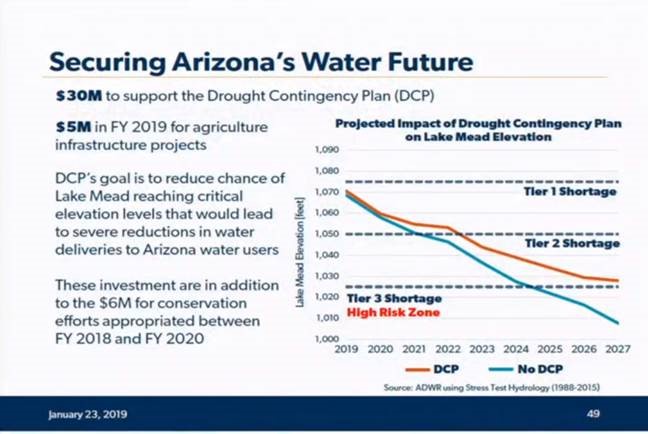
In addition, the Governor’s Office has published  video on Twitter of a briefing of Ducey’s proposed budget, which includes funding for the DCP. The briefing, held today in Tucson, includes the graphic copied below, which demonstrates why the drought plan is so vital. Discussion of the DCP funding begins after the 59-minute mark.

As depicted in the “Securing Arizona’s Water Future” graphic below, Lake Mead is in jeopardy of falling into a high-risk zone within five years if a system-wide DCP is not in effect. Implementing the DCP, on the other hand, flattens out the curve and gives the Colorado River states time to enact additional drought-fighting measures.

securing arizona water future graphic 1.23.2019


At the Inauguration: Governor Ducey’s comments on securing Arizona’s water future

inauguration day 2019

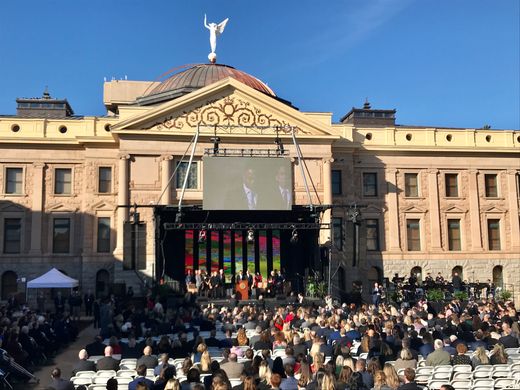
In delivering his second Inaugural Address, Arizona Governor Doug Ducey told the audience at the State Capitol that the time has come to “press forward on some of the biggest challenges facing us.”

“Because none of us came here to do little things — we came here to do the things that matter, big things — and we can do them together.”

Among those big things the Governor identified was securing the State’s water future. Specifically, Governor Ducey called on lawmakers and stakeholders to take action on protecting the State’s Colorado River water supplies.

“We cannot kick the can any further,” he said.

Governor Ducey’s comments on Arizona water security, in full:

Our duty is to leave this state in far better shape than we found it — and we are well on our way.

These are the tasks before us. And if there’s any question of how Arizonans expect us to solve these problems, I’d say, look around. Taking the oath with me today are Republicans and Democrats – all hired by the same electorate.

When conversations stall, as they sometimes do during difficult discussions, we let history be our guide and the hand that lifts us back up.

Nearly four decades ago, in 1980, Arizona’s accelerated water consumption forced a sobering ultimatum from the federal government: reform or suffer severe water cutbacks.

The can could not be kicked any further.

But Arizona’s history is not one of missed opportunities or efforts that came up short. Rather we find, that in the darkest times, Arizona’s pioneering spirit shines the brightest.

Democrats and Republicans rose above party labels. They brought skeptical and reluctant stakeholders to the table. And they acted – and they did it with good faith and honest intentions.

For the people in this crowd and many across our state, I don’t have to spell out the parallel circumstances in which we find ourselves today.

It’s simple. Arizona and our neighboring states draw more water from the Colorado River than mother nature puts back. And with a critical shortfall imminent, we cannot kick the can any further.

It’s going to mean rising above self-interest, and doing the right thing. It means taking the action our past and future generations demand.