ADWR statement on Reclamation’s Final Environmental Impact Statement for Future Colorado River Operations

PRESS STATEMENT

ADWR statement on Reclamation’s Final Environmental Impact Statement for Future Colorado River Operations

FOR IMMEDIATE RELEASE: July 31, 2026                                             

For many months it has been clear that the direction of Colorado River negotiations has been an exercise in lowering expectations, particularly for a long-term, seven-state agreement on operating this vital river system. It was that increasingly bleak scenario that prompted the three Lower Basin states of Arizona, California and Nevada to step forward with our proposal to help stabilize Lake Powell and Lake Mead with more than three million acre-feet of water savings over a two-year period.

While the FEIS just released by the Department of the Interior does nothing to elevate expectations around a coherent seven-state plan for shared sacrifice, it includes an analysis that allows the adoption of many of the core elements of the Lower Basin proposal. We will continue to work with the federal government, as well as with our tribal, agricultural and municipal partners in Arizona, and the other Colorado River Basin states, to make river operations work for the betterment of all.

The FEIS contains a framework that includes sideboards that are unacceptable for the state of Arizona including reductions in the Lower Basin of up to 3 million acre-feet per year, in priority. Such reductions would devastate Arizona’s water users and its economy. The FEIS framework also fails to include any Upper Basin reductions or sufficient use of water stored in the Upper Initial Units (reservoirs above Lake Powell).

A forthcoming Record of Decision and operating guidelines will provide the details for operations through 2028 and a framework for an additional eight years of operations. We hope to see those documents provide for operations in 2027 and 2028 consistent with the May 1 Lower Basin Proposal, including sharing reductions among the three Lower Basin states (Arizona, California, and Nevada) of 1.25 million acre-feet in each year, as well as an additional commitment of 700,000 acre-feet of system conservation water.

ADWR will continue to work to complete the agreements necessary to implement the Lower Basin Proposal while preserving Arizona’s legal rights.

We will provide additional statements and opportunities for interviews when Interior releases the Record of Decision and the operating guidelines.

PDF version linked here.

###

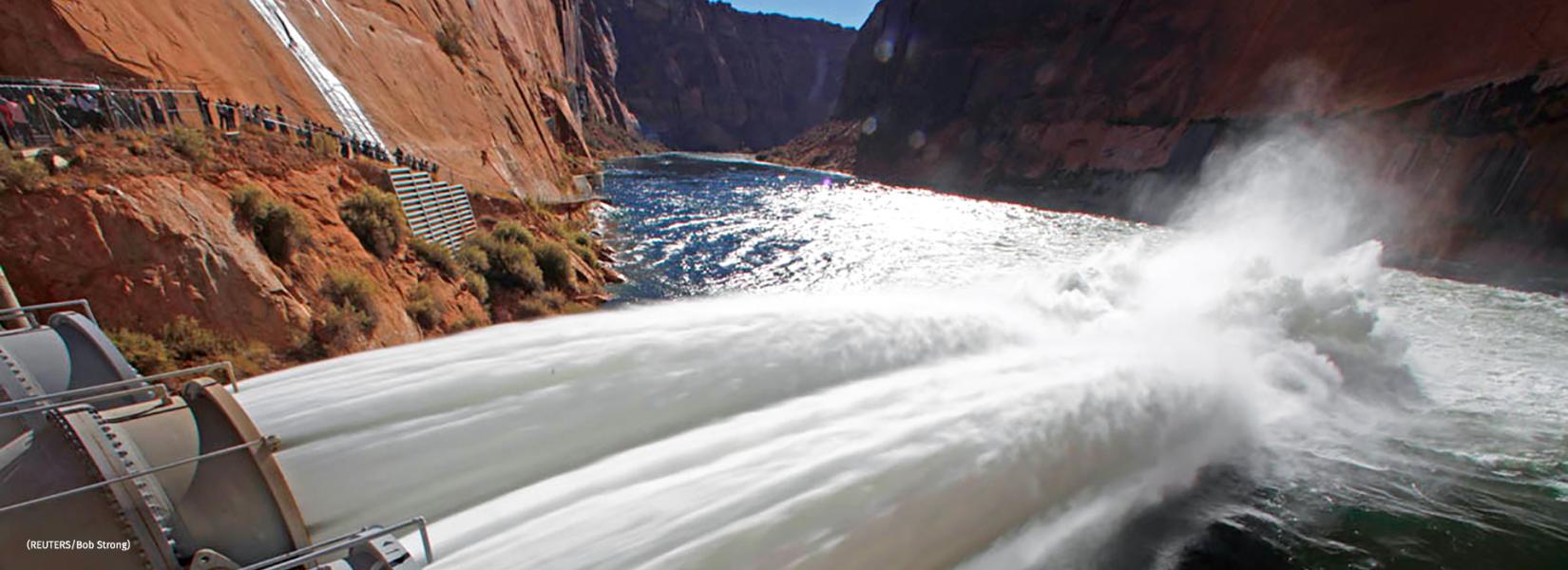
On-Going Experiment In High-Volume CO River Releases From Glen Canyon Dam Set for November 5

Glen Canyon Dam high flow release photo

Science is all about experimentation, and one of the more spectacular experiments in the movement of Colorado River sediment is set to begin in a matter of days.

Beginning November 5, the Department of Interior will begin a High-Flow Experiment (HFE) release of water out of Glen Canyon Dam, slowly ramping up the volume to 38,100 cubic feet per second, which it will maintain for 60 hours over three days.

The forceful water release is intended to mimic the floods that once drove enormous volumes of sand through the river canyons prior to the construction of Glen Canyon Dam, which rebuilt eroded sandbars downstream.

Those reconstituted, enlarged beaches serve a number of valuable purposes – from providing camping space for river-rafters to creating backwater habitat for native fish populations. The enlarged eddies and pools enhanced by those bigger sandbars also encourage the growth of riparian vegetation that provides habitat for birds and other wildlife.

The upcoming “HFE” release is the first under the newly minted 2016 Record of Decision for the Glen Canyon Dam, which provides a framework for adaptively managing Glen Canyon Dam over the next 20 years. The goal of the “ROD” is to create certainty and predictability for water and power users while protecting environmental and cultural resources in Grand Canyon National Park and the Colorado River ecosystem.

The high-volume water release experiment, meanwhile, is a component of the 1992 Grand Canyon Protection Act, which mandated that Glen Canyon Dam be operated in a manner that protects the values for which Grand Canyon National Park and Glen Canyon Recreational Area were established. The first-ever release was conducted in 1996. Known as the Beach Habitat Building Flow, it was designed to mimic the dynamics of a natural system, including building high-elevation sandbars, depositing nutrients, and restoring backwater channels.

Given its unprecedented mission – imitating the sediment-rich flood conditions of a pre-Glen Canyon Dam river – the HFE releases have been genuinely experimental, adapting and changing as more data were accumulated about their impact.

Release times are scheduled to coincide with the periods that its tributaries – the Paria and Little Colorado rivers – have deposited their largest volumes of sand into the Colorado River.

A lot of concerns factor into the timing of HFE releases. One of the primary concerns is avoiding spreading the seeds of non-native vegetation, such as tamarisk, whose seed production generally occurs between April and September.

The effort to improve habitat for native fish species is a work in progress, too. Early on, researchers found that the intensity of the releases actually worked to expand habitat for non-native trout, which fed on rare native species like the humpback chub.

These discoveries have been the cornerstone of the “adaptive management” strategies adopted by the Department of Interior for the Glen Canyon Dam. The USGS researchers – considered the architects of the HFE — have had to change their strategies of making maximum use of the HFE releases by changing and adapting as new scientific findings improved their understanding of how HFE releases affect the Colorado River ecosystem.

The releases by the Department of Interior are conducted in consultation with the Colorado River Basin States, including Arizona, as well as with Native American tribes, federal and state agencies and with input from Glen Canyon Adaptive Management Program stakeholders.

The Department reports that the HFE releases will not impact the total annual amount of water released from Lake Powell to Lake Mead in water year 2019.