ADWR CELEBRATES NEW, “ALTERNATIVE” ASSURED WATER SUPPLY PATHWAY

PHOENIX – Today Governor Katie Hobbs signed a proclamation celebrating the first implementation of the new “Alternative Designation of Assured Water Supply Program,” commemorating a new pathway for increasing Arizona’s housing supply while at the same time maintaining the vital consumer protections of the State’s landmark Groundwater Management Act.

“This program, dubbed ADAWS, represents the culmination of a challenging public stakeholder process that kept protection of Arizona’s groundwater supplies as a top priority,” said Arizona Department of Water Resources Director Tom Buschatzke.

“I commend Governor Hobbs for her leadership in this effort, and I further commend my hard-working staff for the countless hours they have contributed to making this alternative pathway to an Assured Water Supply a reality for participating providers.”

“The many stakeholders involved in this process have been intensely engaged and determined to find that next adaptation of water policy that allowed incremental, sustainable growth while protecting groundwater. I heartily commend them as well.”

__

See: EPCOR Water Arizona-West Valley System AWS Designation

###

ARIZONA DEPARTMENT OF WATER RESOURCES FIELD HYDROLOGISTS CONDUCTING “BASIN SWEEP” TO COLLECT WATER LEVEL MEASUREMENTS IN TUCSON/SANTA CRUZ AMAS

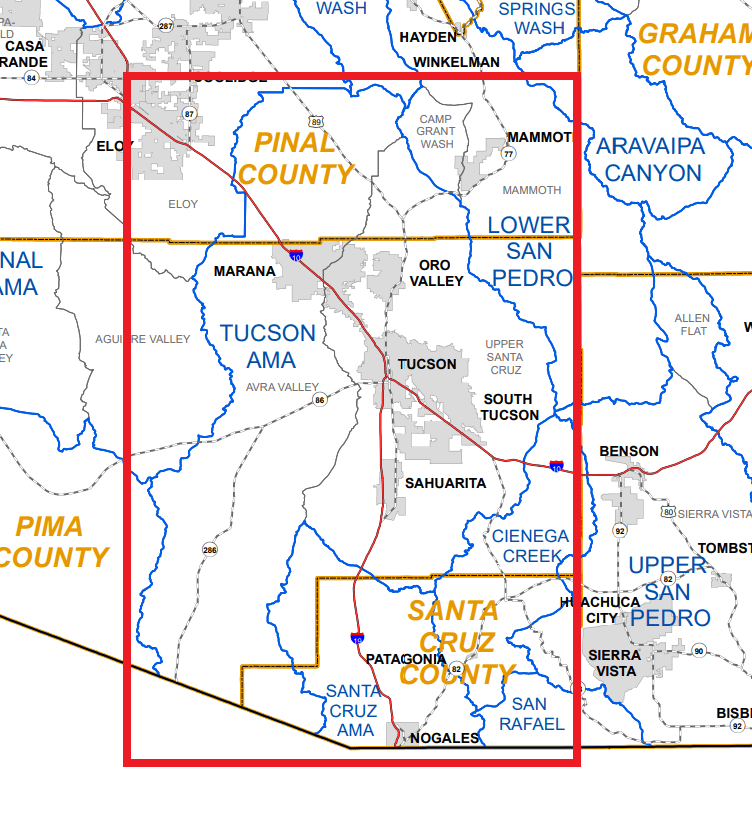
PHOENIX- Beginning the week of March 3, 2025, and continuing through April 2025, Arizona Department of Water Resources (ADWR) field services staff will make an extensive effort to measure water levels in wells within several groundwater basins in Southern Arizona. This survey of wells – or basin “sweep”, as it is known, was last conducted during the Spring of 2020.

The data collected will be analyzed and used to obtain a comprehensive overview of the groundwater conditions and used to support scientific and water management planning efforts. Among others, data uses will include:

  • Analysis of water-level trends
  • Groundwater modeling
  • Water-level change maps
  • Hydrologic reports
  • Water resource planning and management

The groundwater subbasins that will be targeted are as follows; Avra Valley, Cienega Creek, San Rafael, Santa Cruz AMA and Upper Santa Cruz. These subbasins cover several thousand square miles of Tucson Metro, farmland, riparian areas, Santa Cruz River and rugged terrain in Southern Arizona along the border of Mexico. Additional coverage areas include the cities and towns of Green Valley, Tubac, Nogales, Patagonia and Sonoita.

For more information regarding this matter, please contact Public Information Officer Shauna Evans at smevans@azwater.gov or (602) 771-8079.

Details about the nature of basin sweeps and groundwater modeling can be found here. If you would like to volunteer your well for participation in this groundwater survey please contact the Hydrology Division at (602) 771-8535.

###

Arizona Department of Water Resources field hydrologists conducting “basin sweep” to collect water level measurements in Eastern Arizona

PHOENIX- Beginning the week of December 30, 2024, and continuing through February 2025, Arizona Department of Water Resources (ADWR) field services staff will make an extensive effort to measure water levels in wells within several groundwater basins in Eastern Arizona. This survey of wells – or basin “sweep”, as it is known, was last conducted during the winter 1987.

The data collected will be analyzed and used to obtain a comprehensive overview of the groundwater conditions and used to support scientific and water management planning efforts. Among others, data uses will include:

  • Analysis of water-level trends
  • Groundwater modeling
  • Water-level change maps
  • Hydrologic reports
  • Water resource planning and management

The groundwater subbasins that will be targeted are as follows; Bonita Creek, Duncan Valley, Gila Valley, Morenci and San Carlos Valley. These basins cover several thousand square miles of farmland, riparian areas and rugged terrain in East/Central Arizona along the border of New Mexico, through the Gila Mountains and includes the Town of Safford following the path of the Gila River.

For more information regarding this matter, please contact Communications Administrator Doug MacEachern at dmaceachern@azwater.gov or (602) 771-8507.

Details about the nature of basin sweeps and groundwater modeling can be found here. If you would like to volunteer your well for participation in this groundwater survey please contact the Hydrology Division at (602) 771-8535.

###

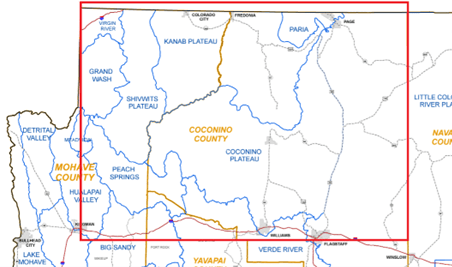
Arizona Department of Water Resources field hydrologists conducting “basin sweep” to collect water level measurements in the NW Groundwater Basins: Virgin River, Grand Wash, Shivwits Plateau, Kanab Plateau, Paria, and Coconino Plateau Basins (known mostly as the Arizona Strip region, not including Peach Springs Basin)

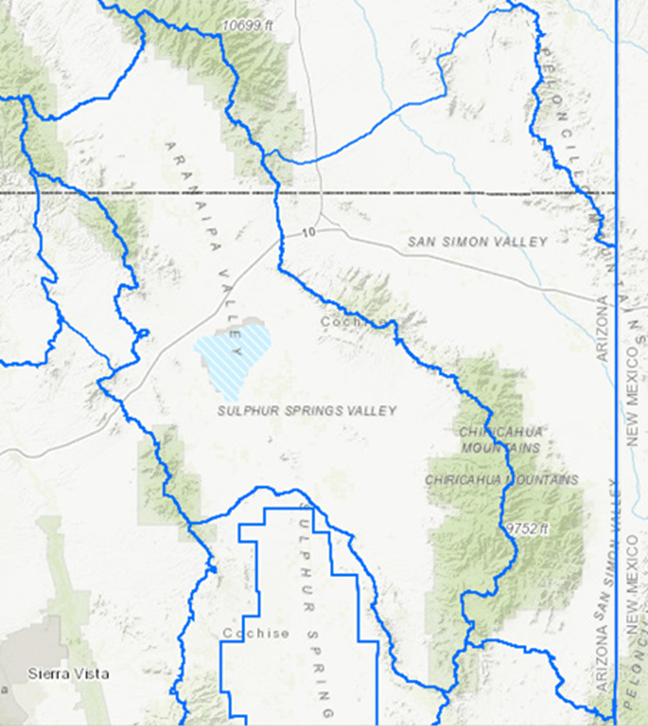
PHOENIX – Beginning the week of March 11, 2024, and scheduled to continue for multiple months, Arizona Department of Water Resources (ADWR) field services staff will be making an extensive effort to measure water levels in wells in the NW Groundwater Basins: Virgin River, Grand Wash, Shivwits Plateau, Kanab Plateau, Paria, and Coconino Plateau Basins.  ADWR’s objective is to measure water levels at hundreds of wells in these groundwater basins. This survey of wells – or basin “sweep,” as it is known – was last conducted by the USGS in 1976 for the Grand Wash, Shivwits Plateau, Kanab Plateau, Paria Basins.  ADWR last conducted a sweep in the Virgin River Basin in 1991 and Coconino Plateau Basin in 2004.

The Arizona Strip area has been identified as a critical area that has not had a basin sweep conducted recently (see ADWR publication, Hydrologic Map Series (HMS), Water Level Change Map Series (WLCMS), and Basin Sweep Assessment Report ADWR Basins and Sub-Basins, (2009)

The data collected will be analyzed and used to obtain a comprehensive overview of the groundwater conditions and used to support scientific and water management planning efforts. Data collected will be used for several purposes, including:

  • Analysis of water-level trends
  • Groundwater modeling
  • Water-level change maps
  • Hydrologic reports
  • Water resource planning and management

This basin sweep covers an area generally in the northwestern portion of the state from the Virgin River and Virgin River Mountains, including the Grand Canyon – Parashant NM, north and south rims of the Grand Canyon NP, extending east to Paria Canyon and southeast to the Colorado River west of Page, south to the San Francisco Mountains just northwest of Flagstaff, including Williams..

For more information regarding this matter, please contact Public Information Officer Shauna Evans at smevans@azwater.gov or (602) 771-8079. Details about the nature of basin sweeps and groundwater modeling can be found here.

###

Arizona Department of Water Resources field hydrologists conducting “basin sweep” to collect water level measurements in the Pinal Active Management Area

PHOENIX- Beginning the week of December 18th, 2023, and continuing through February 2024, Arizona Department of Water Resources (ADWR) field services staff will make an extensive effort to measure water levels in wells in the Pinal Active Management Area (AMA). This survey of wells – or basin “sweep,” as it is known – was last conducted during the Winter of 2018.

The data collected will be analyzed and used to obtain a comprehensive overview of the groundwater conditions and used to support scientific and water management planning efforts. Among others, data uses will include:

  • Analysis of water-level trends
  • Groundwater modeling
  • Water-level change maps
  • Hydrologic reports
  • Water resource planning and management

The Pinal AMA is located in the central part of the State of Arizona. The Pinal AMA covers approximately 4,000 square miles in central Arizona. The topography consists of gently sloping alluvial basins separated by north to northwest trending fault-block mountains. The AMA consists of five sub-basins with unique groundwater underflow, storage, and surface water characteristics. These sub-basins are Maricopa-Stanfield, Eloy, Vekol Valley, Santa Rosa Valley, and Aguirre Valley.

For more information regarding this matter, please contact Public Information Officer Shauna Evans at smevans@azwater.gov or (602) 771-8079. Details about the nature of basin sweeps and groundwater modeling can be found here. If you would like to volunteer your well for participation in this groundwater survey, please contact the Hydrology Division at (602) 771-8535.

###

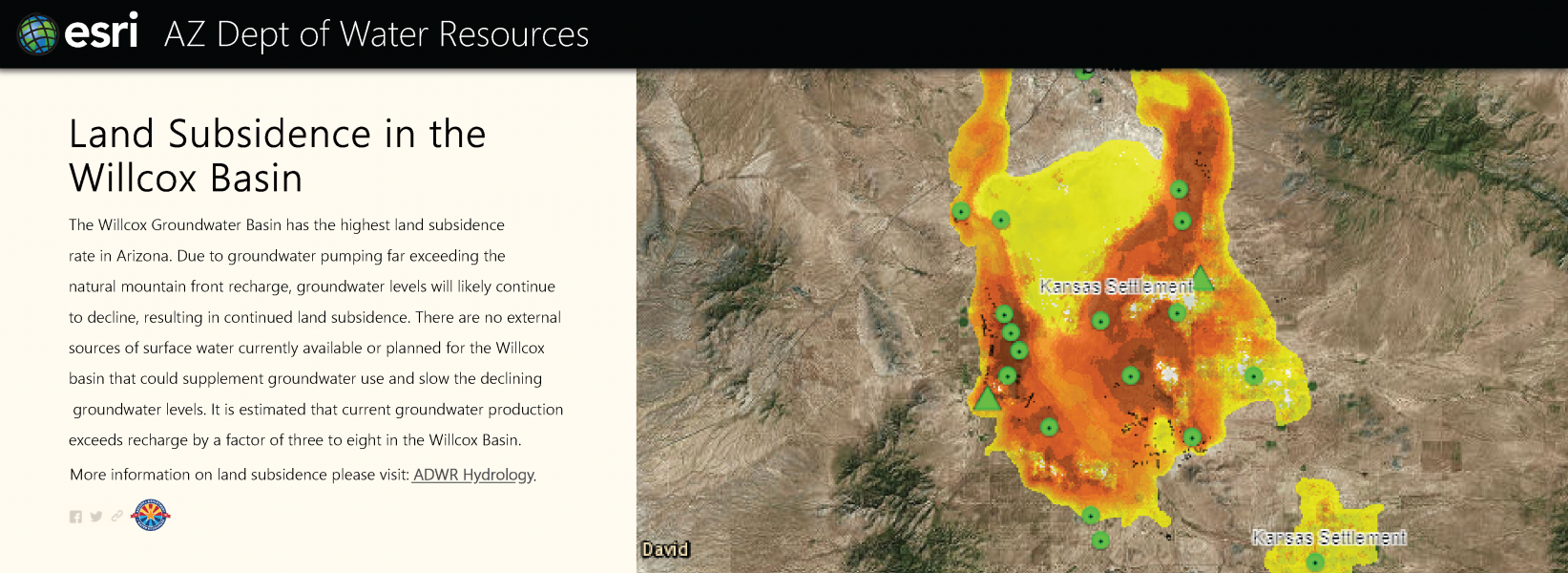
New ADWR “Story Map” Uses High-Tech Imagery To Tell Story Of Willcox Area Land Subsidence

ADWR Story Map image

Since the dawn of modern science – since Copernicus struggled to bring around 16th century skeptics to his evidence of a heliocentric solar system – illustrating complex science to a general audience has proved challenging.

A century or so after Copernicus, Galileo and his famous telescope would (eventually, at least) help illustrate the Polish astronomer’s claim that the earth revolved around the sun, as opposed to the other way around.

Proving, in other words, that images matter. Text is good. Text and way-cool images? Even better.

Following in Galileo’s footsteps, researchers in the Arizona Department of Water Resources’ Hydrology Division have developed one of the department’s most visually appealing presentations ever:

A “story map” depicting land subsidence in the Willcox Groundwater Basin, where ADWR recently completed work on a comprehensive groundwater-flow model.

Focusing on the prevalence of land subsidence in the Willcox Basin, the story map uses interactive imagery as a compliment to textual descriptions of the area’s subsidence issues. Together, they paint (quite literally) a clear picture of the dramatic subsidence issues facing the region.

Produced for ADWR by GIS Application Developer Karen Fisher and Brian Conway, supervisor of the Geophysics/Surveying Unit, the “story map” brings together into a single, user-friendly package a wide assortment of the tools that hydrologists employ to analyze groundwater conditions.

“This story map is the first of hopefully other story maps that combine (geographic information system, or “GIS”) maps, data analysis, images/multimedia content, and a summary of various Water Resources topics in an easy to read format to tell a story,” said Conway.

Fisher said they selected the Willcox Basin as the subject of the story map due to the area “having the highest annual magnitude of land subsidence in Arizona,” as well as “a number of active earth fissures.”

Fisher designed the story map using ArcGIS mapping and analytics software, a product of Esri, a global market leader in GIS.

“Esri has story-map templates that they have been encouraging their users to use,” said Fisher.

“Brian and I both thought of the idea and wanted to highlight land subsidence in hope that it would inspire other groups at ADWR to put their projects into a story map.”

As described by Esri, story maps “are a simple yet powerful way to inform, engage, and inspire people with any story you want to tell that involves maps, places, locations, or geography.”

The web applications, the firm notes, “let authors combine beautiful maps with narrative text, striking images, and multimedia, including video.”

The narrative text is the other beauty of the ADWR land-subsidence story map.

Its text is general-audience friendly – scientifically precise while, at the same time, expressing the complex land-subsidence issues the map depicts clearly enough for a high-school age, would-be hydrologist to appreciate.

In addition to the direct link found above, the story map is available at the ADWR Hydrology eLibrary, which can be found here: https://new.azwater.gov/hydrology/e-library

A tough haul: Water woes of north Valley homeowners slowly lumber toward resolution

5.17.2018 New_River water hauling truck

The long, complex effort by federal, municipal and county officials, as well as a private water company, to provide a permanent source of hauled water to residents of New River and Desert Hills in the north Valley appears to be approaching its conclusion, however slowly.

Plans to build a dedicated water station to provide truck-delivered water to the residences by the end of April hit a bump recently when project officials learned that the road-side property selected as the station location carried a federal open-spaces designation.

Releasing the property from its “National Area of Open Space” designation took several weeks.

As a result, the City of Phoenix has extended its deadline for permitting access to its hydrants once again. For months, Phoenix has provided the area’s water-haulers with temporary permits to access its fire hydrants for potable water.

In a letter dated May 1, Phoenix Vice Mayor Thelda Williams informed the Maricopa County Board of Supervisors that the city would extend the permits through August 31.

(The roughly 500 New River/Desert Hills residences in question are built on county land, outside municipal jurisdictions.)

However, noted the vice-mayor, this latest extension will be the last one:

“The City has no intention of again extending this final deadline,” she wrote.

That deadline should not be an obstacle for providing the homeowners with uninterrupted water service, according to the state director for EPCOR, the private water provider that is building the new water station.

“We are committed to have the station up and running for the water haulers by July 20,” said Troy Day, head of EPCOR operations in Arizona, to the Foothills Focus online newspaper.

The predicament facing the New River and Desert Hills residents began for reasons that had little to do with jurisdictions or government policies.

It had a lot to do, on the other hand, with water availability in an extremely water-light region of central Arizona.

Most of the New River and Desert Hills developments actually are a collection of tiny developments that fall outside the jurisdiction of Arizona’s strict “Active Management Area” statutes, which require that the developers of projects that include six or more lots must assure their homebuyers a supply of water for at least 100 years.

Developments with fewer than six lots, on the other hand, had no such requirement to demonstrate water availability.

That legal quirk helped make new homes in a lovely portion of high-desert foothills more affordable. But it also placed the water supplies of those residences outside the regulatory jurisdiction of the Arizona Department of Water Resources.

Rather than tap into a municipal supplier’s assured-water system, the New River/Desert Hills homeowners relied on wells. And as the Southwest’s nearly 20-year drought continued, and still more wells were drilled on behalf of still more homeowners, the area’s extremely shallow aquifer became overtaxed.

And wells began going dry.

A recent analysis of the region’s groundwater conditions by ADWR Chief Hydrologist Frank Corkhill tells much of the story.

Depth to bedrock in the New River, Anthem and Desert Hills area is extremely shallow, ranging from zero to 800 feet. That doesn’t leave much room for groundwater to swell up in an aquifer.

Groundwater flow from that aquifer system in the northern reaches of the Valley, meanwhile, is from north to south and southeast. Away from the region, in other words.

There are numerous other issues with the area’s groundwater reliability.

Drought has reduced the region’s already-small amount of natural groundwater recharge, for example. At the same time, increasing groundwater pumping, both from the area’s numerous domestic and municipal wells has grown rapidly. As a result, water-level declines in some areas have ranged between 80 feet and 200 feet since the late 1990s.