The current status of Colorado River negotiations: A statement from the seven Colorado River Basin States, the Department of the Interior and the Bureau of Reclamation

PRESS STATEMENT

The current status of Colorado River negotiations: A statement from the seven Colorado River Basin States, the Department of the Interior and the Bureau of Reclamation

The seven Colorado River Basin states together with the Department of the Interior and the Bureau of Reclamation recognize the serious and ongoing challenges facing the Colorado River. Prolonged drought and low reservoir conditions have placed extraordinary pressure on this critical water resource that supports 40 million people, tribal nations, agriculture, and industry.  

While more work needs to be done, collective progress has been made that warrants continued efforts to define and approve details for a finalized agreement. Through continued cooperation and coordinated action, there is a shared commitment to ensuring the long-term sustainability and resilience of the Colorado River system.

###

Governor’s Executive Budget Proposal Includes Funding for Key ADWR Initiatives

Color Logo Transparent- For Web

PRESS RELEASE

FOR IMMEDIATE RELEASE                                                         January 17, 2025

CONTACT: Doug MacEachern

PHONE: 602.771.8507

GOVERNOR’S EXECUTIVE BUDGET PROPOSAL INCLUDES FUNDING FOR KEY ADWR INITIATIVES

Funding for Arizona’s on-going efforts to protect groundwater resources and to prepare for possible litigation over management of the Colorado River

Phoenix, AZ — Today Governor Hobbs released her FY2026 Executive Budget, which funds critical ADWR programs and efforts, including our expanding efforts to actively manage groundwater resources in previously unregulated areas of rural Arizona and to prepare for the possibility of litigation to defend the State’s Colorado River allocation.

While managing current endeavors, ADWR has taken on the State’s next generation of water challenges.

Those new challenges include:

  • Assisting an increasing number of Arizonans in rural communities who now have groundwater protections for the first time ever.
  • Helping builders to find a new path to build more homes in Arizona’s urban centers while reducing reliance on groundwater.
  • Partnering with Tribes whose efforts to reach agreement on water rights are now bearing fruit as a result of successful negotiations with the State and local parties.

Decades of drought in the Southwest, as well as significant increases in groundwater mining in recent years in rural areas, have prompted the ADWR Director to take action, including designating earlier this year Arizona’s seventh Active Management Area (AMA) in the Willcox Basin region.

The new Willcox AMA, along with the Douglas AMA established in 2022 in southern Arizona, together represent the first-ever expansions of groundwater basins actively managed by the Department since the enactment of Arizona’s landmark Groundwater Management Act of 1980.

As a result, ADWR is preparing to advance its efforts to monitor commercial groundwater extraction, assist local communities in establishing groundwater-protection goals and assure that new-home construction in the new Willcox AMA conforms to the requirements of the Groundwater Management Act, including assuring new-home buyers of at least a 100-year water supply.

To keep up with this work on behalf of Arizonans, ADWR must strengthen its team of highly skilled, technical professionals. The Executive Budget includes an ongoing General Fund appropriation of $741,300 to add 6.0 FTE positions across the agency to meet the demanding water policy challenges facing Arizona.

Governor Hobbs’ budget proposal also includes funding to protect the State’s vital Colorado River supplies in the event negotiations on new operating rules for the river falter, prompting legal action.

The Executive Budget creates a Colorado River Litigation Fund with a $1 million General Fund deposit and a transfer of $2 million from prior non-lapsing special line items for Colorado River legal expenses, for a total investment of $3 million.

“If the collaborative and cooperative partnership we have fostered in these negotiations does not bear fruit, Arizona may need to take legal action to protect its current 2.8 million acre feet of Colorado River entitlement,” said Director Tom Buschatzke.

“Litigation is not a path we wish to go down. It can be a very lengthy and expensive process.”

“Nevertheless, this proposed budget demonstrates a significant commitment by Governor Hobbs to support Arizona’s commitment to protecting its entitlement from the Colorado River,” he said.

The current guidelines for the operation and management of the Colorado River system expire at the end of calendar year 2026. Arizona and the six other Basin States are negotiating the post-2026 guidelines with the federal Bureau of Reclamation in order to develop a framework that more sustainably manages the Colorado River system.

The Director of ADWR serves as Arizona’s lead negotiator and is charged with protecting the State’s 2.8 million acre-feet entitlement of Colorado River water, representing as much as 40 percent of the State’s water supply.

While Arizona is committed to collaboration and cooperation with its Basin States partners, it is possible that new guidelines or the absence of a negotiated outcome could result in litigation among the Basin States.

Arizona continues to pursue good-faith negotiations that hopefully will result in a consensus outcome for more sustainable Colorado River management. At the same time, this appropriation ensures that ADWR has the resources to defend Arizona’s interests and water users who depend on the State’s precious Colorado River entitlement.

Major ADWR initiatives funded in the Governor’s budget proposal include:

  • $741,300 ongoing from the General Fund to add 6.0 FTE positions across the agency.
  • $1 million General Fund deposit and a transfer of $2 million from prior non-lapsing special line items for Colorado River legal expenses, for a total investment of $3 million.

###

ADWR statement in response to Department of Interior’s new Draft Supplemental Environmental Impact Statement

PRESS STATEMENT

ADWR statement in response to Department of Interior’s new Draft Supplemental Environmental Impact Statement

By the end of 2023, the Lower Basin will have voluntarily conserved more than 1 million acre-feet in the Colorado River system. This volume is on top of reductions in use mandated by the 2007 Guidelines and the 2019 Drought Contingency Plan, which resulted in a cumulative 617,000 acre-feet being stored in Lake Mead this year by the three states.

As a result of the conservation and the reductions in use, Arizona, California and Nevada this year have put just 5.8 million acre-feet to consumptive use – the lowest consumptive use since 1984.

Arizona’s conservation efforts alone have been substantial.

Including voluntary contributions and reductions mandated by the ‘07 Guidelines and the DCP, Arizona has conserved over 3.7 million acre-feet of water in Lake Mead since 2014. In 2023 alone, Arizona is on track to conserve 907,000 acre-feet:

  • Tier 2a shortage reduction stipulated by ‘07 Guidelines – 400 KAF
  • Tier 2a DCP contribution – 192 KAF
  • System Conservation funded by Bureau of Reclamation – ~272 KAF
  • ADWR-CAWCD ICS Preservation – ~43 KAF
  • Total – ~907 KAF

Taken together, the ongoing voluntary commitments are on track to achieve the volumes in the Lower Basin consensus proposal offered to the federal government earlier this year. Combined with the past year’s above-average hydrology, the system is stable through 2026.

As a result, the states will continue focusing their efforts on post-2026 operational guidelines in order to stabilize the Colorado River system for the long-term.

###

Turning the tables: reporters covering the Colorado River explain their challenges to Colorado River water users

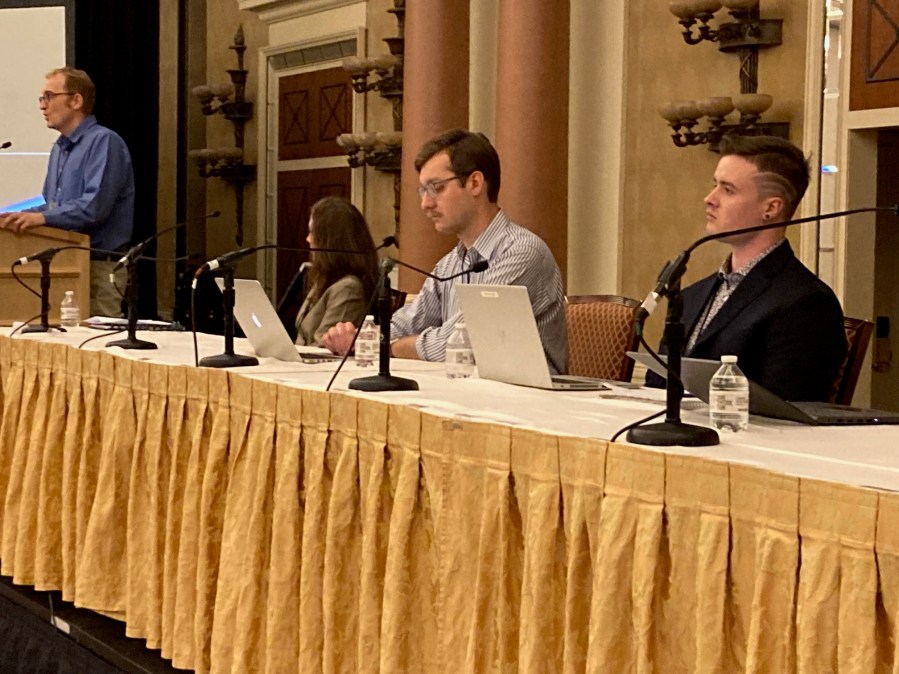
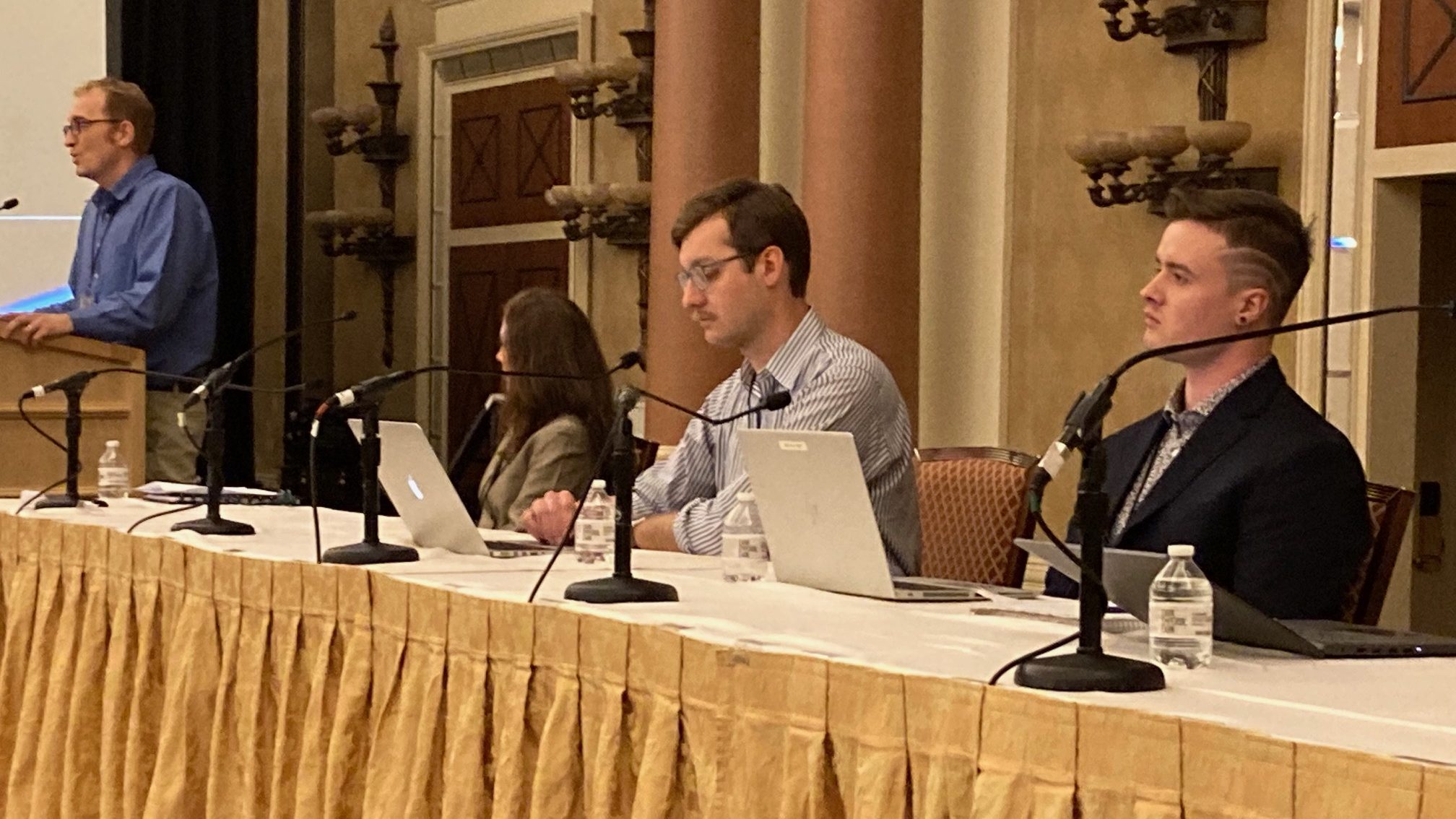
Left to right: Peter Prengaman (AP); Crystal Thompson (CAP); Alex Hager (KUNC); Hunter Bassler (12 News)

Left to right: Peter Prengaman (AP); Crystal Thompson (CAP); Alex Hager (KUNC); Hunter Bassler (12 News)

The 2022 Colorado River Water Users Association meetings are setting records for attendees. It has never before sold out. This time, it has.

It literally has “sold out” of credentials for media, too. The halls of the Caesar’s Palace vast meeting-room levels are swarming with more media than these meetings ever have seen before. This “colloquium” gives attendees a unique window into the news world and how it covers Colorado River water issues.

Peter Prengaman, an environmental news editor at the Associated Press, describes a package of Colorado River stories that AP and other journalists have created for AP subscribers, including Arizona publications such as the Yuma Sun and the Arizona Daily Star.

AP, says Prengaman, previously covered climate-change issues as a science story. In this latest Colorado River series, as well as in other coverage, the news service is attempting to examine climate change more “holistically,” including pursuing stories on water issues around the world.

“A lot of people are only now starting to engage with climate change,” he said. “But the science, really, is 40 or 50 years old.”

Alex Hager, a reporter who produces NPR-style stories for public radio at his home station of KUNC, as well as for numerous other public-radio stations around the US and Canada. In addition, he produces written web features on his subjects, which include a considerable number of stories related to the Colorado River.

His work on the Colorado River is funded by the Walton Family Foundation. Hager observes that there is “a strict firewall” between his reporting and the funding foundation.

Hager notes that a lot of his story subject come from sources “other than PR pitches.” That got a laugh from the audience, which seems to include a fair number of PR people.

Like a great many other people who are attempting to understand the complex issues facing the Colorado River, Hager acknowledges that learning the complex language of water has been a continuous challenge.

Hunter Bassler of KPNX, Channel 12 in Phoenix, is a digital reporter and producer, mainly for the news station’s website.

“Visually showing the effects of climate change is pretty difficult,” said Bassler.

Through his online articles, he said, TV reporters can see whether a story can translate into something they can turn for television. Water stories, he said, need to be interesting, accurate and digestible – a real problem, he acknowledges, given their complexity.

“Water agencies have done a fine job of making water data available online,” he observed.

Jerd Smith of Fresh Water News, a service provided by Water Education Colorado, described how her news service was created to help bolster the dwindling coverage afforded by traditional news media whose newsrooms have been decimated in recent years from layoffs.

“We share our content with media organizations across (Colorado),” said Smith.

Smith noted the importance of including maps with water stories, since “all water stories are local stories.” She pointed out the need for reporters to “get out and build relationships” rather than report from “your closets and basements” – an issue that to many observers became much more serious during the pandemic.

Teal Lehto, who bills herself as “Western Water Girl,” produces water-related videos on Tik Tok, a video-format social media platform that “is the most popular platform” for people under 30, she observed. Lehto has over 50,000 regular viewers.

Like Public Radio’s Alex Hager, she said, “I also use my closet as my studio.”

Lehto noted that she only started her water-news video platform in April. “And, now, here I am up here (on a CRWUA panel) today.”

“My platform is proof that young people are interested and will be engaged, but only if you are speaking their language,” she said.

The most important CRWUA meetings ever begin with a Water 101 primer

Incoming Central Arizona Project GM Brenda Burman is kicking off the formal program for the 2022 meetings of the Colorado River Water Users Association with a primer on the rare language of water that come easily to regular attendees, but can be obscure and confusing to newbies to this conference. And with an overflow audience, there are a lot of newbies here.

A fundamental element of Burman’s lecture is terminology. There are familiar terms: “acre-feet” (the basic measurement of apportionments of water when you’re dealing literally with billions of gallons) and “junior priority,” the notorious status of certain Arizona water users who must stand in line for river water until California’s buckets all are full.

The newest term in Colorado River-ese: “aridification,” the phenomenon that has contributed to dramatically drier soils in the Rocky Mountain watershed, which has been soaking up stunning amounts of snowpack runoff, contributing hugely to the dire conditions at Lake Mead and Lake Powell.

Also: “You will hear people talking about ‘elevations at Lake Mead.’ We talk about that a lot,” said Burman. This is a relatively simple term. It refers to water levels at the biggest reservoir in the U.S., which are descending to near catastrophic levels (which also is the explanation for why the CRWUA annual meetings have sold out). When elevations at Lake Mead start descending toward the most notorious condition of all – dead pool – it attracts a whole lot of attention.

Brenda Burman, Executive Strategy Advisor, Central Arizona Project.

A part of the Burman presentation regards “intake valves” and “bypass tubes” at Glen Canyon Dam. This may be the most under-reported news story regarding threats to the river system’s infrastructure.

Once water levels at Lake Powell descend below the huge intake valves (which drive the generators at the dam and create electricity) the only way to pass water through the dam and down through the Grand Canyon is through a much smaller set of four “bypass tubes.” Burman observes that the Director of the Arizona Department of Water Resources, Tom Buschatzke, often refers to these bypass tubes as “garden hoses.” He’s not wrong. The four much-smaller tubes literally are incapable of handling a typical year’s water flow out of Glen Canyon Dam, which is 7.5 million acre-feet. Relying on those intake tubes is a genuinely serious threat to the system.

“So what does all this mean?” she asks.

“We want to leave this river in a better place than how we found it. Given all we’ve seen here, that’s not an easy job.”

Note: A copy of Burman’s PowerPoint presentation will be posted on the CRWUA website.

Water agencies announce partnership to invest $200 million in conservation efforts to bolster Colorado River’s Lake Mead, under 500+ plan

Las Vegas, Nevada (December 15, 2021) – LAS VEGAS, Nev. – Water agencies across Arizona, California and Nevada, together with the Department of the Interior, today announced a historic effort to invest up to $200 million in projects over the next two years to keep the Colorado River’s largest reservoir, Lake Mead, from dropping to critically low levels.

The agreement, known as the 500+ Plan, aims to add 500,000 acre-feet of additional water to Lake Mead in both 2022 and 2023 by facilitating actions to conserve water across the Lower Colorado River Basin. The additional water – enough water to serve about 1.5 million households a year – would add about 16 feet total to the reservoir’s level, which continues to reach record low levels.

“Two decades of drought on the Colorado River is taking a toll across the Basin and on Lake Mead. By working together we’ve staved off these historic low levels for years, thanks to collaboration and conservation in the Lower Basin. But we need even more action, and we need it now,” said Commissioner Camille Calimlim Touton of the U.S. Bureau of Reclamation.

In addition to Reclamation, the 500+ Plan includes the Arizona Department of Water Resources, Central Arizona Project, The Metropolitan Water District of Southern California, and the Southern Nevada Water Authority.

Under the Memorandum of Understanding signed today during the Colorado River Water Users Association’s annual conference, ADWR commits up to $40 million to the initiative over two years, with CAP, Metropolitan and SNWA each contributing up to $20 million. The federal government plans to match those commitments, for a total funding pool of $200 million.

Some of the specific conservation actions and programs that will be implemented through the 500+ Plan have already begun, while others are still being identified. The MOU includes conservation efforts in both urban and agricultural communities, such as funding crop fallowing on farms to save water, including the recent approval of a short-term agricultural land fallowing program in California, or urban conservation to reduce diversions from Lake Mead.

In 2019, Arizona, Nevada and California signed the Lower Basin Drought Contingency Plan and agreed to contribute water to Lake Mead as it reached certain levels, to keep it from dropping even further and reaching critically low levels. The DCP also included a provision that if modeling indicates a possibility of the reservoir reaching an elevation of 1,030 feet, action would be required.

“Our work on the 2019 DCP took more than five years to complete. This commitment to work together to stabilize Lake Mead came together in a matter of a few months,” said Arizona Department of Water Resources Director Tom Buschatzke. “That alone is a powerful testament to the commitment of the Lower Basin States to work together with our partners at Reclamation to protect this vital river system.”

“These past months have presented tremendous challenges with the additional pressure of the need to work quickly. But rather than drive us apart, this difficult situation has further strengthened our relationships. It’s amazing that work of this magnitude, sensitivity and expense could come together in this amount of time,” said Central Arizona Project General Manager Ted Cooke.

“We had hoped the contributions made under the DCP would be enough to stabilize Lake Mead while we seek longer-term solutions to the challenges on the Colorado River. But they aren’t, which is why we are moving forward with the 500+ Plan,” said Metropolitan General Manager Adel Hagekhalil.

“It is imperative that all users on the Colorado River take action now to preserve this critical resource that we all depend upon,” said SNWA General Manager John Entsminger. “We hope as this initiative is developed, that along with our other many conservation efforts, it will provide strong support for Lake Mead water levels.”

The plan marks the latest collaborative effort by the Lower Basin states in partnership with Reclamation to bring sustainability to the Colorado River, which has been in a historic drought since 2000.

The plan also highlights the Bipartisan Infrastructure Law’s historic $8.3 billion investment in water infrastructure and will help minimize the impacts of drought, and develop a long-term plan to facilitate conservation and economic growth. The BID’s investments will fund water efficiency and recycling programs, rural water projects, WaterSMART grants and dam safety to ensure that irrigators, Tribes and adjoining communities receive adequate assistance and support.

BUREAU OF RECLAMATION
Patti Aaron
paaron@usbr.gov
702-293-8189
ARIZONA DEPARTMENT OF WATER RESOURCES
Shauna Evans
smevans@azwater.gov
602-771-8079
SOUTHERN NEVADA WATER AUTHORITY
Bronson Mack
bronson.mack@lvvwd.com 702-249-5518
CENTRAL ARIZONA PROJECT
DeEtte Person
dperson@cap-az.com
623-869-2597
METROPOLITAN WATER DISTRICT
Rebecca Kimitch
rkimitch@mwdh2o.com
202-821-5253
 

How do we sustain the Colorado River past 2026? Here’s how Arizona intends to find out.

The Opinion piece below was initially published on AZCentral.com on Friday, Sept. 13, 2019.

By Tom Buschatzke, Director, Arizona Department of Water Resources, and Ted Cooke, General Manager, Central Arizona Project


It didn’t take long for the completion of the Drought Contingency Plan to create value to Arizona and the Colorado River Basin.

Its focus on stabilizing Lake Mead and creating incentives to “bank” water in the reservoir already are paying dividends.

We can say with confidence that DCP is already a success.

DCP is providing a safe harbor while we work on important issues leading up to 2026, when the existing guidelines for the operation of the Colorado River system expire.

We now have an opportunity to build on the successful Arizona process that led to the DCP signing. Arizona is Stronger Together. And that will serve us well as we work toward the next step – maintaining a stable, healthy Colorado River system as we face a hotter and drier future.

Lake Mead is 22 feet higher than expected

A year ago, many of us were immersed in the details of Arizona’s Drought Contingency Implementation Plan, which benefited from the cooperative spirit of its participants, including elected leaders and representatives from every sector of the state’s water-using community.

ADWR Director Buschatzke
Tom Buschatzke

In 2020 and likely 2021, we will be operating under DCP’s Tier Zero, a reduction of 192,000 acre-feet to Arizona. The estimated impact of contributing this water is more than $40 million, but the investment is worth it to protect the Colorado River system.

Aerial View of the Colorado River
Ted Cooke

DCP’s incentives allowed for greater storage in Lake Mead this year. That, coupled with a lot of snow from the Rocky Mountains and additional tributary flow, increased storage in Lake Mead by more than 22 feet from what was initially projected.

An excellent winter snowpack in the Rockies helped Lake Mead a lot. But here is the kicker: Almost half of that 22-foot rise in Lake Mead was due to storage and contributions to system conservation.

But DCP won’t hold us forever

The term used for the coming negotiations on the system’s new guidelines is “reconsultation” of the “Colorado River Interim Guidelines for Lower Basin Shortages and the Coordinated Operations for Lake Powell and Lake Mead.”

The emphasis is on “interim.” The 2007 Guidelines expire in 2026. So, when people ask “what’s next?” for Colorado River management, that’s it – the difficult challenge of assessing the effectiveness of the current Guidelines, with the DCP overlay, and exploring new approaches for the next iteration of the Guidelines.

As we learned on January 31 when the State Legislature passed, and Governor Doug Ducey signed Arizona’s DCP, we achieved success because we worked together. We intend to bring the steering committee process back to life, reviving that spirit of cooperation that so infused negotiations.

To that end, we are embarking on a listening and data-collecting effort. It is our plan to meet first with the elected leaders who contributed so much time and effort to the successful steering committee process. Then, we plan to sit down with other delegates, including those representing Arizona tribes, cities, agriculture, mining, development and the nonprofit community.

Our goal: To develop a shared vision

Our new goal? Gather our stakeholders’ thoughts and develop a shared vision as we plan for Arizona’s Colorado River water supply.

This will ensure Arizona is a strong voice among the Colorado River Basin states and the federal government as we hammer out the next set of agreements for management of the Colorado River Basin beyond 2026.

That is our “Next Step.” It’s a big one and we must be prepared. And we will be, because Arizona truly is Stronger Together.


Celebration! Is It So Wrong To Revel In Good Water News For A Change?

Is it so wrong to want to revel in good water news a bit?

After enduring more than 19 years of lingering drought in the Southwest and its implications for the Colorado River system, we think not.

This month, Congress has passed, and the President has signed into law, the Colorado River Drought Contingency Plan Authorization Act, which permits the Secretary of the Interior to sign a DCP agreement with the Seven Basin States.

Considering the very serious potential consequences of Lake Mead water levels falling to critically low levels, that is truly something worthy of celebration. So, too, was the remarkable bipartisanship and leadership on display among the Arizona congressional delegation, which led the DCP effort in in both the House and Senate.

On top of that, hydrology reports both in-state and in the Colorado River system indicate a 2019 winter snowpack that in many cases is well above average.

The implications of the Bureau of Reclamation’s recent April 2019 24-Month Study of projections for the 2020 water year (and, as the name implies, the next 24 months) are especially significant.

The Bureau updates its projections each month, but the April report and the August report are critical in determining how much water will be released from Lake Powell into Lake Mead in the coming year. The elevation levels forecasted to be in each of those reservoirs at the end of each year trigger those releases.

Up until the 2019 snowpack in the Rocky Mountains began seriously building in February, the odds of a first-ever shortage declaration in water deliveries in 2020 were better than even. With every 24-Month Study report from February onward, however, those odds decreased. By the recent April report, the Bureau’s analysts expressed confidence that Lake Mead would likely start 2020 “almost 10 feet above the shortage determination trigger of 1,075 feet.”

As reported by the Bureau, the improved hydrology allows Lake Powell’s operation this year to shift to a “balancing” release of up to 9.0 million acre-feet into Lake Mead.

As Bureau Commissioner Brenda Burman noted, this year’s snowpack “is welcome news.”

Still, she noted, “one good year cannot reverse the effects of nearly two decades of severe drought. Current total Colorado River System storage is approximately 45% of full capacity.”

Arizona Governor puts saving Lake Mead onto center stage on social media platforms

Arizona Governor Doug Ducey is giving over much of his social media platform to  getting a Drought Contingency Plan completed in Arizona.

governor ducey facebook page lake mead 1.23.2019

The art on the Governor’s Twitter feed home page is one of those startling “bathtub ring” photos of Lake Mead, which depict the reservoir’s dramatic decline in recent years.

His official Facebook page includes the same image.

The Governor’s Office has emblazoned the Lake Mead photo with a quote from former Arizona Governor Bruce Babbitt, who observed recently that “this is the moment” to get an Arizona DCP agreement through the State Legislature.

governor ducey twitter feed 1.23.2019

Ducey has asked lawmakers to act quickly to approve proposed legislation that would give the Director of the Arizona Department of Water Resources authority to enter into a drought plan with the other Colorado River states, as well as the federal government.

In December, the Commissioner of the Bureau of Reclamation, Brenda Burman, set a January 31 deadline for states to complete work on their Drought Contingency plans. The Bureau, a division of the Interior Department, is overall manager of the river system.

In addition, the Governor’s Office has published  video on Twitter of a briefing of Ducey’s proposed budget, which includes funding for the DCP. The briefing, held today in Tucson, includes the graphic copied below, which demonstrates why the drought plan is so vital. Discussion of the DCP funding begins after the 59-minute mark.

As depicted in the “Securing Arizona’s Water Future” graphic below, Lake Mead is in jeopardy of falling into a high-risk zone within five years if a system-wide DCP is not in effect. Implementing the DCP, on the other hand, flattens out the curve and gives the Colorado River states time to enact additional drought-fighting measures.

securing arizona water future graphic 1.23.2019