Utah State University analysis of proposal finds water savings would be slight and ecological hazards plentiful
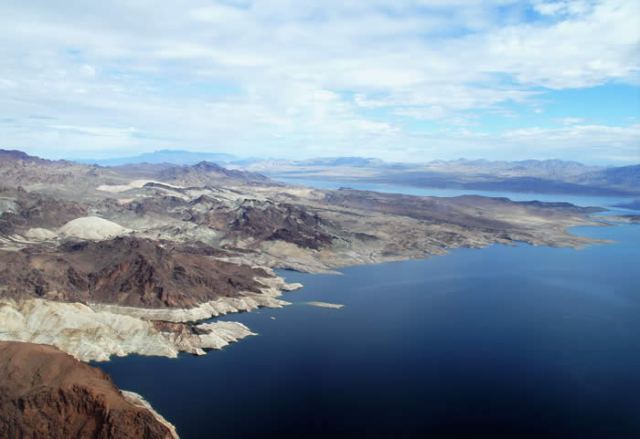
Whether we are talking about draining all of its water or just most of it, reducing Lake Powell to a secondary status behind Lake Mead would fail in two of the plan’s most important goals, according to a technical assessment released last fall by Utah State University researchers.
One of the primary conclusions of the so-called “Fill Mead First” proposal was that water loss, through evaporation and through reservoir bank storage and seepage into the bedrock below Lake Powell, would be greatly diminished by storing water primarily in Lake Mead.
“Fill Mead First” was developed by the Glen Canyon Institute of Salt Lake City, and enjoys strong backing from environmental groups advocating that the Glen Canyon Dam be decommissioned.
The Utah State assessment, however, found that estimates of water saved from evaporation by effectively combining the two great Colorado River reservoirs were too inaccurate – and data too old – to use them for rendering a sound scientific judgment.
The analysis led by Jack Schmidt, director of Utah State’s Center for Colorado River Studies, found considerable “state of the science” data regarding evaporation at Lake Mead. The work had been performed by the U.S. Geological Survey.
But at Powell, no such research has been conducted since the mid-1970s. What’s more, the USU assessment learned that no studies of water seeping into the relatively porous Navajo sandstone bedrock of Lake Powell had been conducted since the mid-1980s.
Conducting their own research, the Utah State analysts concluded while there may be a slight decrease in evaporation loss by combining the two reservoirs in Lake Mead, the uncertainty of those conclusions appeared too high to base such a huge infrastructure choice – draining Lake Powell – on them.
The Fill Mead First study assumed that reservoir bank storage would remain constant for their analysis period. The Utah State researchers, however, estimated the bank storage rates have decreased since Lake Powell was completed and therefore the savings would not be significant. Water in bank storage can return to the reservoir as its elevation drops.
Seepage losses into the Lake Powell bedrock, meanwhile, likely are ten percent of what Fill Mead First advocates claim. The USU study noted that some of the seepage water returns to the Colorado River above Lee’s Ferry.
Schmidt told Phys.org science-news magazine that it would be best to wait for a better system of data collection and analysis before making any major decisions about the future of Lake Powell.
“The Fill Mead First plan has encouraged us to think broadly about how and where we store water in the Colorado River system,” said Schmidt.
“But the magnitude of potential ecosystem changes caused by the FMF plan are so great and the water savings are so uncertain that implementation should await a new program of data collection and analysis designed to reduce uncertainty about the key process of evaporation and bank seepage.”
Utah State’s findings regarding the ecological consequences of lowering or draining Lake Powell appear even more significant than uncertainty about water losses.
The Fill Mead First proposal would have little effect in its initial phases on the amount of fine-grain sediment released into the Colorado River below Glen Canyon Dam. The plan’s final phase, on the other hand, would “cause significant ecosystem adjustments associated with the sudden change from relatively clear water to a very turbid river.”
The assessment concluded that unless Glen Canyon Dam was bypassed completely, it would be impossible to provide the supply of sand needed to reconstitute the eddy sandbars and camping beaches that today are an important part of the river’s ecosystem throughout the Grand Canyon.
The assessment found that impacts to the river’s aquatic and riparian ecosystem – including the existing population of endangered native species such as the humpback chub – could be “potentially significant.”
Editor’s note: Arizona Water News published a two-part series that began September 29 arguing that the effort to decommission Glen Canyon Dam was ill-advised. That series can be found here. And here.