Interior Secretary Jewell signs the Record of Decision implementing the new 20-year management plan for operating Glen Canyon Dam

jewell-ltemp-signing

Negotiators reaffirm commitment to completing a drought contingency plan

CRWUA meetings, Las Vegas — The members of the Colorado River Water Users Association may have parted ways last week disappointed that the Colorado River Basin states and the federal government were unable to finalize negotiations to protect the river system from drought.

But they still managed to finish their meetings on a high note, including encouragement from Secretary of Interior Sally Jewell to continue negotiating.

“We want to get as far as we possibly can, and that’s what we’re going to be urging everybody to do,” Jewell said to reporters at the CRWUA meetings on Thursday.

Many of the negotiators themselves reaffirmed their commitment to getting a drought-contingency plan done soon, if not before the change of administration in Washington, D.C.

“It’s critical that we do this,” said Tom Buschatzke, director of the Arizona Department of Water Resources. “It benefits everyone, up and down the river.”


sally_jewell_official_portrait
Secretary of Interior Sally Jewell

Also on Thursday afternoon, Secretary Jewell officially signed a decision for managing the Glen Canyon Dam over the next 20 years, a deal that significantly updates environmental considerations in the dam’s operation.


Known as the Long-term Experimental and Management Plan (or, LTEMP), the plan is consistent with the federal Grand Canyon Protection Act of 1992 and represents two decades of study of the dam and its impacts on downstream resources.

The Act required the Secretary of Interior to operate Glen Canyon Dam in such a manner as to protect and mitigate adverse effects and improve the values for which Grand Canyon and Glen Canyon were established, which provided the basis for the new management plan signed by Secretary Jewell.

The out-going Interior Secretary signed the Record of Decision approving the management plan shortly before the end of the annual CRWUA meetings in Las Vegas.

Secretary Jewell also expressed optimism that an agreement to protect Lake Mead and the rest of the Colorado River system, as well as a separately negotiated river-system agreement with the Republic of Mexico, should be forthcoming soon.

“We have an agreement that is pending with Mexico that we need to get across the finish line in order to address our water needs between the two countries…  and that has to take first priority,” she said to reporters.

In a letter to Jewell sent in November, representatives of Arizona and the other six Colorado River basin states voiced their qualified approval of the LTEMP.

Arizona and California, together again

resized_20161215_094209

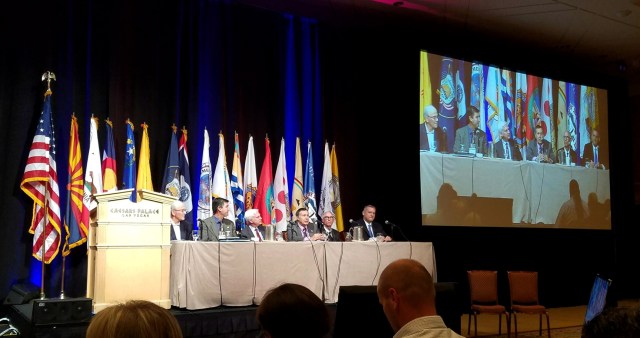
Arizona Water Resources Director Buschatzke joins a panel of California and Nevada water users discussing drought strategies

CRWUA meetings, Las Vegas — Following a welcome from Colorado River Water Users Association President Bart Fisher, Water Resources Director Tom Buschatzke joined a keynote panel, titled “California – Conservation, Transfers and Drought Contingency Planning in the Lower Basin.”

Buschatzke joined John Entsminger, general manager of the Southern Nevada Water Authority; Kevin Kelley, general manager of the Imperial Irrigation District; Jeff Kightlinger, general manager of the Metropolitan Water District of Southern California; and, John Powell, Jr., President of the board of directors of the Coachella Valley Water District. The panel was devoted in large part to an airing of the most pressing drought-related water issues facing the Southwest, with an emphasis on those confronting major southern California water providers.

The panel was devoted in large part to an airing of the most pressing drought-related water issues facing the Southwest, with an emphasis on those confronting major southern California water providers.

Buschatzke told the audience of about 400 attendees at the Colorado River Water Users Association meetings that his State remains well-prepared in the near-term for the effects of the lingering drought. But he emphasized that, going forward, a drought contingency plan would be beneficial to all Colorado River water users, not just those in Arizona.

“The guts of the deal have been incentivizing flexibility,” said Buschatzke.

“At the bottom end, if we do get into trouble despite our best efforts, we do have a backstop.”

Kelley of the Imperial Irrigation District defined for an audience his concerns for the future of the Salton Sea, which has receded dramatically in recent years, exposing an enormous, now-dry expanse of former lake bed contaminated by decades of agricultural run-off.

“For us, it’s an existential threat,” said Kelley, who added that the area of the Salton Sea would be an “incredibly desolate” region if the lake dries up.

Nevertheless, he expressed confidence that a drought contingency plan that includes water for the Salton Sea remains a priority for his district’s users:

“We expect that there will be a solution to the Salton Sea because the situation at Lake Mead demands that there be one,” said Kelley.

On a much lighter note, Kightlinger of the Metropolitan Water District of Southern California, the largest municipal water provider of the Colorado River system, joked that “We’re this agency in southern California, and we want to make our problems your problems.”

The audience representing the entire range of system water users roared in laughter.

Kightlinger noted the vital nature of the Colorado River system to his region’s water supply (observing, for example, that one in every 15 Americans gets water from his district). He also praised the recent U.S. Senate legislation that provides drought relief for the region, especially for California.

Powell of the Coachella Valley district told the audience that water levels in the valley’s enormous aquifer have been going up since 2005, an important conservation signal.

Buschatzke told the audience that Arizona Gov. Doug Ducey is a strong proponent of maintaining the health of the Colorado River system. He recalled that Ducey had been in Las Vegas earlier in the week discussing water issues at a U.S. Chamber of Commerce-sponsored event.

“For Gov. Doug Ducey, DCP is his number one water related priority,” said Buschatzke.

Talking positive about ‘drought’: When was the last time you used the word ‘pluvial?’

CRWUA Meetings, Las Vegas — A water journalist on a panel about ‘communicating the drought’ observed that there’s a problem with the way most water agencies get the word out about drought.

It’s that they use the word ‘drought.’

“I talked recently with some federal officials,” said John Fleck, a former water-news reporter and author of a popular, new book on water in the Southwestern U.S.

“I tried to get them to not to use the word ‘drought.’”

The problem, Fleck explained, is that the word ‘drought’ creates the risk that people may feel powerless in the face of drought.

That, he said, “is problematic,” especially for water officials such as those at these CRWUA meetings.

Fleck, a former journalist is a popular news person at the CRWUA meetings precisely because his views about water in the West are anchored in an optimistic expectation of resolving drought issues.

Even Fleck succumbs to pessimism at times, however.

“I was at Lake Mead this morning,” he said. “I Tweeted out that Lake Mead was ‘kind of empty.’

“I immediately got a response from a water professional: “You could have said, ‘kind of full.’

Unfortunately, speaking positively and avoiding the word ‘drought’ is a challenge for a more complex reason than people may realize, he said:

“We don’t have a word for the opposite of drought. Anyone ever use the word ‘pluvial?’ it’s an extended period of excess precipitation.

“When was the last time you heard someone say that?”


Feds to announce new, environment-friendly management plan for Glen Canyon Dam

glen_canyon_dam_2016_borec_photo

CRWUA Meetings, Las Vegas –The federal Bureau of Reclamation released a statement this morning announcing plans to make official a “Long-Term Experimental Management Plan,” or LTEMP, for the operation of Glen Canyon Dam.

The LTEMP is the culmination of years of research to prepare the Environmental Impact Statement of Glen Canyon Dam. Its “Record of Decision,” or ROD, will provide a framework for adaptively managing the dam operations over the next 20 years.

According to the Bureau statement, the new LTEMP includes operational procedures that “are similar to what we are currently doing, but include some important refinements, tools and approaches that incorporate new science over the past 20 years.

“These tools help us better comply with the Grand Canyon Protection Act and more effectively protect endangered fish in the canyon.”

Interior Secretary Sally Jewell is scheduled to sign the document at a ceremony Thursday afternoon at the CRWUA conferences.

Deputy Interior Secretary Mike Connor and Reclamation Commissioner Estevan López will be in attendance, as will Arizona Department of Water Resources Director Tom Buschatzke.

Director Buschatzke expressed support for the LTEMP in a letter to Secretary Jewell, noting that, among other pluses, the monthly and annual reservoir operations at Glen Canyon Dam continue to deliver and store water as determined by the Law of the River and in addition the new plan better protects the habitat of native fauna like the endangered humpback chub.

“As a lower division state which has the potential to be affected by the (Draft Environmental Impact Statement), Arizona has a particular interest in avoiding potential impacts from the DEIS and ensuring its success,” wrote Buschatzke.

Colorado River water-users gather at annual conference

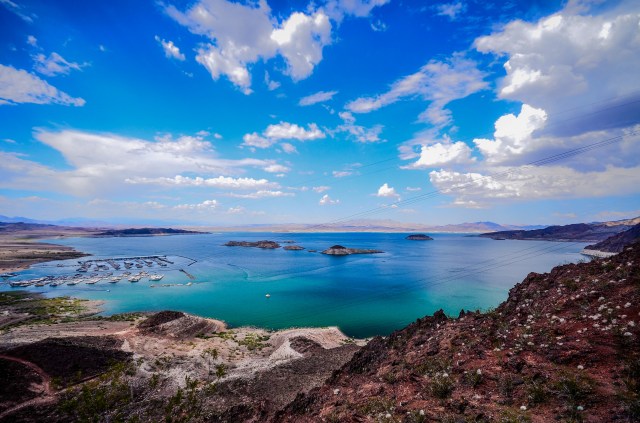
lake-mead-6

Editor’s Note: As a service to our readers, the Arizona Department of Water Resources has created a live blog of events as they occur at the Colorado River Water Users Association conferences in Las Vegas, Dec. 14-16; see our Live Blog)

According to lore, the federal Bureau of Reclamation – the managing agency of the Colorado River system – often takes advantage of the annual gathering of Colorado River states and water-users held each December to make big announcements.

Each year, water leaders from the Colorado River system states and the federal Bureau of Reclamation — as well as the system’s major water users, such as cities and agriculture — gather at CRWUA, sharing ideas about management of the most complex water system in the country, the Colorado River.

This year, the dominant theme is a familiar one: The unprecedented drought that consistently has reduced Rocky Mountain runoff and restricted flows between the system’s two great reservoirs, Lake Powell and Lake Mead.

The first “colloquium” of the meetings – “Communicating the Drought: A Call to Action” – reflects what has become the primary obsession of water managers in the Southwest: Taking action to protect the system, notably Lake Mead, from the debilitating effects of the 16-year on-going drought.

Representatives of the Arizona Water Banking Authority also will be at the CRWUA conferences, focusing on the recovery of Colorado River water stored in Arizona through the novel banking system.

State and federal water agency directors have not been the only public officials discussing water-management in Las Vegas this week, however.

On Monday, Arizona Gov. Doug Ducey joined Colorado Gov. John Hickenlooper in a water-management question-and-answer session sponsored by the U.S. Chamber of Commerce.

Called the “BusinessH2O Summit,” the event promoted best water-management practices employed by both the United States and Israel, one of the world leaders in water conservation and management.

Ducey told the audience that water is an issue that “transcends partisan politics.”

The Arizona governor noted the well-known names from Arizona’s bipartisan hall of water fame – Sens. Carl Hayden, Barry Goldwater and Jon Kyl; Reps. John Rhodes and Mo Udall; and, Gov. Bruce Babbitt – all of them leaders who, he said, “understood the fundamental reality of life in the desert.”

Ducey also noted the on-going efforts to stabilize Lake Mead – efforts led by ADWR Director Buschatzke and others less than a mile from the U.S. Chamber gathering in Las Vegas.

“We work on it together,” said Gov. Ducey. “There’s no other way to do it.”