Public Comment Period for Arizona Water Protection Fund Fiscal Year 2025 Grant Applications Now Open

FOR IMMEDIATE RELEASE

September 16, 2024

Press Release

CONTACT: Doug MacEachern

(602) 771-8507

dmaceachern@azwater.gov

Public Comment Period for Arizona Water Protection Fund Fiscal Year 2025 Grant Applications Now Open

PHOENIX – The Arizona Water Protection Fund* has received grant applications for its fiscal year 2025 funding cycle.

Grant applications are now available for public review at the Arizona Water Protection Fund website at https://www.azwpf.gov/grant-information/fy-2025-grant-cycle or at the Arizona Department of Water Resources physical address described below.

Written comments regarding grant applications may be submitted during the 45-day public comment period, which begins September 17, 2024 and ends November 1, 2024 at 5:00 p.m. Written public comments must be received no later than 5:00 p.m., November 1, 2024. Written comments can be mailed, sent via email, or sent by fax. If mailed, written comments must be postmarked no later than November 1, 2024. Please include application numbers and project titles. For additional information, please contact Reuben Teran, Executive Director at (602) 771-8528.

Mailing AddressPhysical Address           
Arizona Department of Water Resources Arizona Water Protection Fund Attn: Reuben Teran 1802 W Jackson St. Box #79 Phoenix, Arizona 85007Arizona Department of Water Resources Arizona Water Protection Fund 1110 West Washington, Suite 310 Phoenix, Arizona 85007
FaxEmail
(602) 771-8687rteran@azwater.gov

*The Arizona Water Protection Fund supports projects that develop or implement on the ground measures that maintain, enhance and restore Arizona’s river and riparian resources.

Arizona Water Protection Fund Accepting Applications for Fiscal Year 2025 Grant Cycle

FOR IMMEDIATE RELEASE

June 24, 2024

Press Release

CONTACT: Doug MacEachern

(602) 771-8507

dmaceachern@azwater.gov

Arizona Water Protection Fund Accepting Applications for Fiscal Year 2025 Grant Cycle

PHOENIX- The Arizona Water Protection Fund (AWPF) supports projects that develop or implement on- the-ground measures that directly maintain, enhance and restore Arizona’s river and riparian resources.

The AWPF Commission will be accepting applications for the Fiscal Year 2025 grant cycle and will award grants under three categories: capital projects, research, and water conservation. The deadline to submit applications is August 30, 2024, at 11:59 p.m. Arizona time. Applications will only be accepted electronically via the eCivis Grants Management System. The eCivis grant application portal link, grant cycle schedule, grant application manual, and electronic forms are available on the AWPF website at https://www.azwpf.gov/grant-information/fy-2025-grant-cycle

AWPF staff will be hosting one grant application workshop:

LocationDateTime
Online Webinar*Wednesday, July 10, 2024 1:30 p.m. – 2:30 p.m.
Webinar Information
Link: https://adwr.info/3VT5boM
Webinar Number (Access Code): 2530 916 1357
Webinar Password: NgsDFvaU837
Join by Phone: 1-415-655-0001 US Toll (Access Code is same as above)

*Staff will be providing the grant application workshop via online webinar only, but a recording will also be available on the AWPF website at https://www.azwpf.gov/grant-information/fy-2025-grant-cycle.   Please contact the Arizona Water Protection Fund at 602-771-8528 or rteran@azwater.gov with any questions.

The Arizona Legislature established the AWPF in 1994 (A.R.S. § 45-2101, et seq.). The Arizona Department of Water Resources provides administrative, technical, and legal support to the AWPF Commission. The legislation establishing the AWPF provides that it is the declared policy of the Legislature to provide for a coordinated effort between state funding and locally led solutions for the restoration and conservation of the water resources of the state. A.R.S. § 45-2101(A). The primary purpose of the AWPF is to provide monies through a competitive public grant process for implementation of measures to protect water of sufficient quality and quantity to maintain, enhance, and restore rivers and streams and associated riparian resources consistent with existing water law and water rights, and measures to increase water availability. A.R.S. § 45-2101(B).

For additional information, please contact Reuben Teran at rteran@azwater.gov.

Arizona, California and Nevada commit to record-setting conservation to protect the Colorado River

PRESS RELEASE

FOR IMMEDIATE RELEASE OCTOBER 19, 2023

CALIFORNIA
Jessica Neuwerth
Colorado River Board of California
818-254-3202
jneuwerth@crb.ca.gov

NEVADA
Bronson Mack
Southern Nevada Water Authority
702-822-8543
bronson.mack@snwa.com

Arizona, California and Nevada commit to record-setting conservation
to protect the Colorado River

Record-setting volumes of Colorado River water are being saved in Lake Mead

The Bureau of Reclamation is moving the process forward to develop new operating guidelines for the Colorado River that will be in effect after 2026. Simultaneously, states, tribes and water users across the Colorado River Basin continue to collaborate on a long-term sustainable plan for the stability of the river.

To that end, the Lower Colorado River Basin states – water users in Arizona, California and Nevada – are contributing record volumes of water to Lake Mead. By the end of 2023, cumulatively, the Lower Basin will have voluntarily conserved more than 1 million acre-feet  – water that is being held back in Lake Mead for the benefit of the entire system over and above shortage reductions agreed to in 2007 and those of the 2019 Drought Contingency Plan.

In 2023, consumptive use in the Lower Basin States is expected to be around 5.8 million acre-feet, the lowest consumptive use since 1984.

Arizona

Arizona users are conserving nearly 345,000 acre-feet of water in 2023 through the Central Arizona Water Conservation District/Arizona Department of Water Resources ICS Preservation program as well as federally funded CAP subcontractor, tribal contractor and on-river conservation agreements. This is in addition to the 592,000 acre-foot Tier 2a shortage reduction taken by Arizona.

“Arizona is conserving more water than ever to stabilize the Colorado River Basin and protect our collective water future,” said Tom Buschatzke, Director of the Arizona Department of Water Resources.

“The commitment of our state’s tribes, cities, industries and agricultural districts to Colorado River conservation efforts is substantial, and builds upon Arizona’s long history of water conservation in support of a robust economy. I’m confident we will continue this tradition well into the future as we all adapt to a changing Colorado River.”

California

Colorado River water deliveries to California in 2023 are on track to be the lowest since 1949 – 700,000 acre-feet lower than the state’s 4.4 million acre-foot apportionment. In urban Southern California, Colorado River use this year is projected to be the third lowest in 60 years, thanks in part to recent broad efforts to reduce outdoor water use on grass. Last week, Gov. Gavin Newsom signed legislation prohibiting the use of potable water to irrigate grass that serves no functional purpose at businesses and other institutions.

“Twenty years ago this year, California permanently reduced its Colorado River water use by 800,000 acre-feet overnight — enough to serve 2.4 million households every year. This year, in addition to that unparalleled and ongoing effort, we’ve cut our use even further thanks to investments in conservation and partnerships forged between our agricultural, urban, and tribal water users,” said JB Hamby, California’s Colorado River Commissioner and Chairman of the Colorado River Board of California. “California is committed to leading with our water users, Basin States, and Basin Tribes to ensure sustainability on the Colorado River now and into the future.”

Nevada

Nevada implemented a series of new water efficiency measures to further enhance the community’s progressive and comprehensive conservation program, which has reduced Nevada’s consumption of Colorado River by 41 percent since 2002. The new water efficiency measures include pool size limits, state laws requiring decorative grass replacement, prohibitions on new evaporative cooling, and innovative tools to align economic development opportunities with water efficiency.

“With a population of 2.3 million residents, Southern Nevada will use less than 200,000 acre-feet this year – our lowest annual water use since 1993 when our population was about 900,000 people,” said John Entsminger, SNWA General Manager. “As a river community, we can all maintain diverse, robust economies while using less water, and the reductions in municipal and agricultural water use across the Lower Basin demonstrates that.” 

Arizona, California, and Nevada water users continue to conserve and leave roughly 3 million acre-feet of water in Lake Mead by the end of 2026, ensuring Colorado River system stability. Collectively, ongoing commitments may exceed the volumes in the Lower Basin consensus proposal offered to the federal government earlier this year as part of the Supplemental Environmental Impact Statement process to revise the 2007 Interim Guidelines that operate the Colorado River system.

These contributions provide much-needed stability through 2026 while new operating guidelines are being developed for the Colorado River system.

###

Comment Period for Arizona Water Protection Fund Fiscal Year 2024 Grant Applications Now Open

FOR IMMEDIATE RELEASE

September 11, 2023

Press Release

CONTACT: Shauna Evans

(602) 771-8079

smevans@azwater.gov

Comment Period for Arizona Water Protection Fund Fiscal Year 2024 Grant Applications Now Open

PHOENIX – The Arizona Water Protection Fund* has received grant applications for its fiscal year 2024 funding cycle.


Grant applications are now available for public review at the Arizona Water Protection Fund website at https://www.azwpf.gov/grant-information/fy-2024-grant-cycle or at the Arizona Department of Water Resources physical address described below.


Written comments regarding grant applications may be submitted during the 45-day public comment period, which begins September 12, 2023 and ends October 27, 2023 at 5:00 p.m. Written public comments must be received no later than 5:00 p.m., October 27, 2023. Written comments can be mailed, sent via email, or sent by fax. If mailed, written comments must be postmarked no later than October 27, 2023. Please include application numbers and project titles. For additional information, please contact Reuben Teran, Executive Director at (602) 771-8528.

Mailing AddressPhysical Address   
Arizona Department of Water Resources Arizona Water Protection Fund Attn: Reuben Teran 1802 W Jackson St. Box #79 Phoenix, Arizona 85007Arizona Department of Water Resources Arizona Water Protection Fund 1110 West Washington, Suite 310 Phoenix, Arizona 85007
FaxEmail
(602) 771-8687rteran@azwater.gov

_

* The Arizona Water Protection Fund supports projects that develop or implement on the ground measures that directly maintain, enhance and restore Arizona’s river and riparian resources.

###

Arizona Water Protection Fund Accepting Applications for Fiscal Year 2024 Grant Cycle

FOR IMMEDIATE RELEASE

July 5, 2023

Press Release

CONTACT: Doug MacEachern

(602) 771-8507

dmaceachern@azwater.gov

Arizona Water Protection Fund Accepting Applications for Fiscal Year 2024 Grant Cycle

PHOENIX- The Arizona Water Protection Fund (AWPF) supports projects that develop or implement on-the-ground measures that directly maintain, enhance and restore Arizona’s river and riparian resources.

The AWPF Commission will be accepting applications for the Fiscal Year 2024 grant cycle and will award grants under three categories: capital projects, research, and water conservation. The deadline to submit applications is August 25, 2023, at 11:59 p.m. Arizona time. Applications will only be accepted electronically via the eCivis Grants Management System. The eCivis grant application portal link, grant cycle schedule, grant application manual, and electronic forms are available on the AWPF website at https://www.azwpf.gov/grant-information/fy-2024-grant-cycle.

AWPF staff will be hosting one grant application workshop:

LocationDateTime
Online Webinar*Wednesday, July 12, 2023 1:30 p.m. – 2:30 p.m.
Webinar Information
Link: https://adwr.info/AWPF_W
Webinar Number (Access Code): 2595 334 6863
Webinar Password: 3ZKcjn3WW97
Join by Phone: 1-415-655-0001 US Toll (Access Code is same as above)

*Staff will be providing the grant application workshop via online webinar only, but a recording will also be available on the AWPF website at https://www.azwpf.gov/grant-information/fy-2024-grant-cycle.   Please contact the Arizona Water Protection Fund at 602-771-8528 or rteran@azwater.gov with any questions.

The Arizona Legislature established the AWPF in 1994 (A.R.S. § 45-2101, et seq.). The Arizona Department of Water Resources provides administrative, technical, and legal support to the AWPF Commission. The legislation establishing the AWPF provides that it is the declared policy of the Legislature to provide for a coordinated effort between state funding and locally led solutions for the restoration and conservation of the water resources of the state. A.R.S. § 45-2101(A). The primary purpose of the AWPF is to provide monies through a competitive public grant process for implementation of measures to protect water of sufficient quality and quantity to maintain, enhance, and restore rivers and streams and associated riparian resources consistent with existing water law and water rights, and measures to increase water availability. A.R.S. § 45-2101(B).

For additional information, please contact Reuben Teran at rteran@azwater.gov.

Turning the tables: reporters covering the Colorado River explain their challenges to Colorado River water users

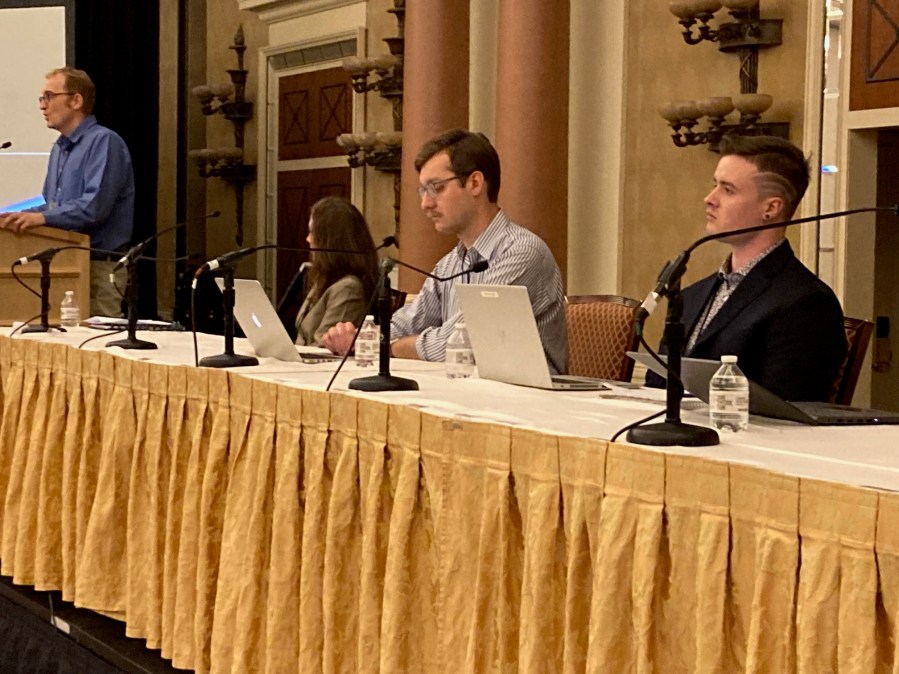
Left to right: Peter Prengaman (AP); Crystal Thompson (CAP); Alex Hager (KUNC); Hunter Bassler (12 News)

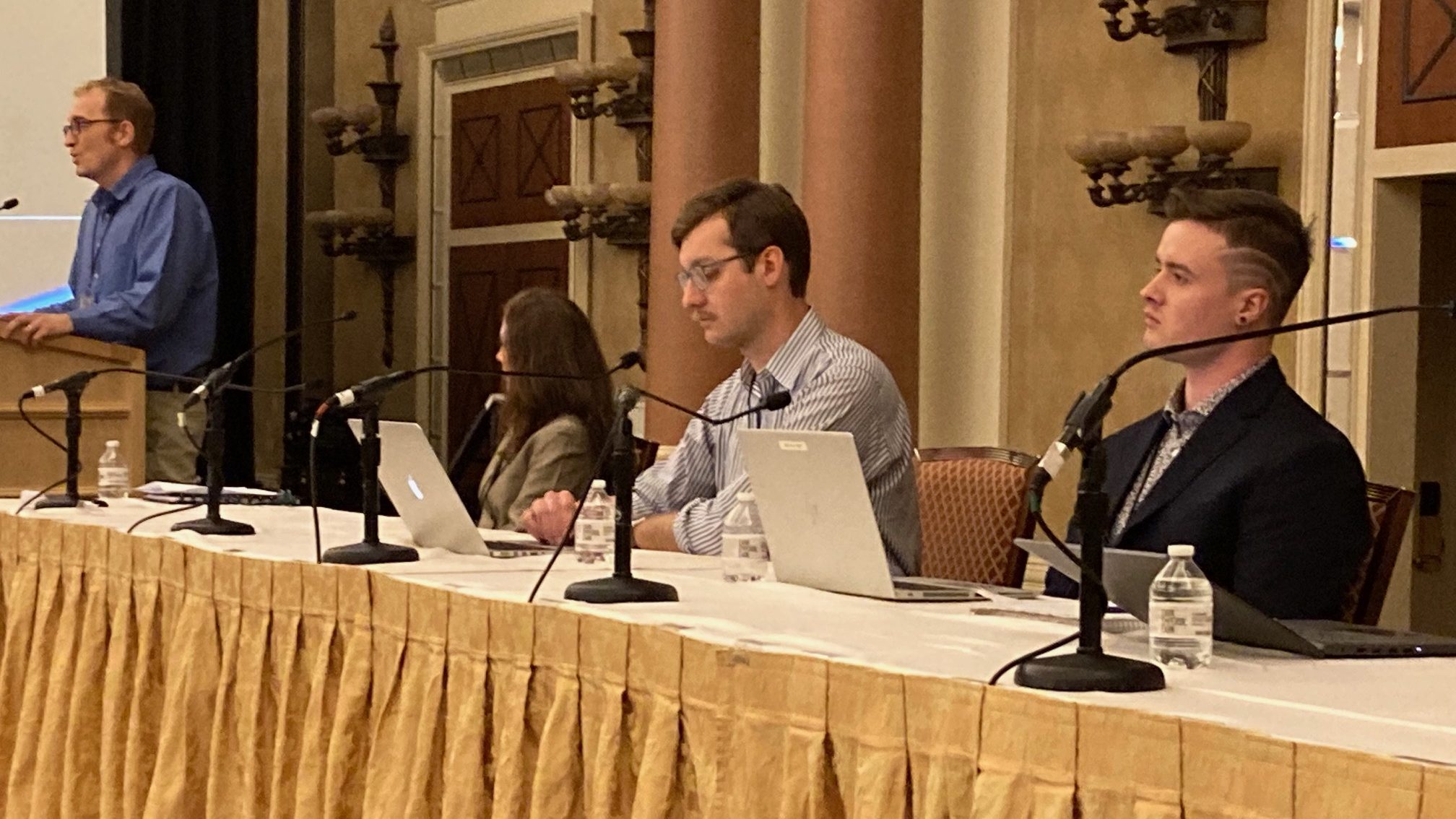
Left to right: Peter Prengaman (AP); Crystal Thompson (CAP); Alex Hager (KUNC); Hunter Bassler (12 News)

The 2022 Colorado River Water Users Association meetings are setting records for attendees. It has never before sold out. This time, it has.

It literally has “sold out” of credentials for media, too. The halls of the Caesar’s Palace vast meeting-room levels are swarming with more media than these meetings ever have seen before. This “colloquium” gives attendees a unique window into the news world and how it covers Colorado River water issues.

Peter Prengaman, an environmental news editor at the Associated Press, describes a package of Colorado River stories that AP and other journalists have created for AP subscribers, including Arizona publications such as the Yuma Sun and the Arizona Daily Star.

AP, says Prengaman, previously covered climate-change issues as a science story. In this latest Colorado River series, as well as in other coverage, the news service is attempting to examine climate change more “holistically,” including pursuing stories on water issues around the world.

“A lot of people are only now starting to engage with climate change,” he said. “But the science, really, is 40 or 50 years old.”

Alex Hager, a reporter who produces NPR-style stories for public radio at his home station of KUNC, as well as for numerous other public-radio stations around the US and Canada. In addition, he produces written web features on his subjects, which include a considerable number of stories related to the Colorado River.

His work on the Colorado River is funded by the Walton Family Foundation. Hager observes that there is “a strict firewall” between his reporting and the funding foundation.

Hager notes that a lot of his story subject come from sources “other than PR pitches.” That got a laugh from the audience, which seems to include a fair number of PR people.

Like a great many other people who are attempting to understand the complex issues facing the Colorado River, Hager acknowledges that learning the complex language of water has been a continuous challenge.

Hunter Bassler of KPNX, Channel 12 in Phoenix, is a digital reporter and producer, mainly for the news station’s website.

“Visually showing the effects of climate change is pretty difficult,” said Bassler.

Through his online articles, he said, TV reporters can see whether a story can translate into something they can turn for television. Water stories, he said, need to be interesting, accurate and digestible – a real problem, he acknowledges, given their complexity.

“Water agencies have done a fine job of making water data available online,” he observed.

Jerd Smith of Fresh Water News, a service provided by Water Education Colorado, described how her news service was created to help bolster the dwindling coverage afforded by traditional news media whose newsrooms have been decimated in recent years from layoffs.

“We share our content with media organizations across (Colorado),” said Smith.

Smith noted the importance of including maps with water stories, since “all water stories are local stories.” She pointed out the need for reporters to “get out and build relationships” rather than report from “your closets and basements” – an issue that to many observers became much more serious during the pandemic.

Teal Lehto, who bills herself as “Western Water Girl,” produces water-related videos on Tik Tok, a video-format social media platform that “is the most popular platform” for people under 30, she observed. Lehto has over 50,000 regular viewers.

Like Public Radio’s Alex Hager, she said, “I also use my closet as my studio.”

Lehto noted that she only started her water-news video platform in April. “And, now, here I am up here (on a CRWUA panel) today.”

“My platform is proof that young people are interested and will be engaged, but only if you are speaking their language,” she said.
Water agencies announce partnership to invest $200 million in conservation efforts to bolster Colorado River’s Lake Mead, under 500+ plan

Las Vegas, Nevada (December 15, 2021) – LAS VEGAS, Nev. – Water agencies across Arizona, California and Nevada, together with the Department of the Interior, today announced a historic effort to invest up to $200 million in projects over the next two years to keep the Colorado River’s largest reservoir, Lake Mead, from dropping to critically low levels.

The agreement, known as the 500+ Plan, aims to add 500,000 acre-feet of additional water to Lake Mead in both 2022 and 2023 by facilitating actions to conserve water across the Lower Colorado River Basin. The additional water – enough water to serve about 1.5 million households a year – would add about 16 feet total to the reservoir’s level, which continues to reach record low levels.

“Two decades of drought on the Colorado River is taking a toll across the Basin and on Lake Mead. By working together we’ve staved off these historic low levels for years, thanks to collaboration and conservation in the Lower Basin. But we need even more action, and we need it now,” said Commissioner Camille Calimlim Touton of the U.S. Bureau of Reclamation.

In addition to Reclamation, the 500+ Plan includes the Arizona Department of Water Resources, Central Arizona Project, The Metropolitan Water District of Southern California, and the Southern Nevada Water Authority.

Under the Memorandum of Understanding signed today during the Colorado River Water Users Association’s annual conference, ADWR commits up to $40 million to the initiative over two years, with CAP, Metropolitan and SNWA each contributing up to $20 million. The federal government plans to match those commitments, for a total funding pool of $200 million.

Some of the specific conservation actions and programs that will be implemented through the 500+ Plan have already begun, while others are still being identified. The MOU includes conservation efforts in both urban and agricultural communities, such as funding crop fallowing on farms to save water, including the recent approval of a short-term agricultural land fallowing program in California, or urban conservation to reduce diversions from Lake Mead.

In 2019, Arizona, Nevada and California signed the Lower Basin Drought Contingency Plan and agreed to contribute water to Lake Mead as it reached certain levels, to keep it from dropping even further and reaching critically low levels. The DCP also included a provision that if modeling indicates a possibility of the reservoir reaching an elevation of 1,030 feet, action would be required.

“Our work on the 2019 DCP took more than five years to complete. This commitment to work together to stabilize Lake Mead came together in a matter of a few months,” said Arizona Department of Water Resources Director Tom Buschatzke. “That alone is a powerful testament to the commitment of the Lower Basin States to work together with our partners at Reclamation to protect this vital river system.”

“These past months have presented tremendous challenges with the additional pressure of the need to work quickly. But rather than drive us apart, this difficult situation has further strengthened our relationships. It’s amazing that work of this magnitude, sensitivity and expense could come together in this amount of time,” said Central Arizona Project General Manager Ted Cooke.

“We had hoped the contributions made under the DCP would be enough to stabilize Lake Mead while we seek longer-term solutions to the challenges on the Colorado River. But they aren’t, which is why we are moving forward with the 500+ Plan,” said Metropolitan General Manager Adel Hagekhalil.

“It is imperative that all users on the Colorado River take action now to preserve this critical resource that we all depend upon,” said SNWA General Manager John Entsminger. “We hope as this initiative is developed, that along with our other many conservation efforts, it will provide strong support for Lake Mead water levels.”

The plan marks the latest collaborative effort by the Lower Basin states in partnership with Reclamation to bring sustainability to the Colorado River, which has been in a historic drought since 2000.

The plan also highlights the Bipartisan Infrastructure Law’s historic $8.3 billion investment in water infrastructure and will help minimize the impacts of drought, and develop a long-term plan to facilitate conservation and economic growth. The BID’s investments will fund water efficiency and recycling programs, rural water projects, WaterSMART grants and dam safety to ensure that irrigators, Tribes and adjoining communities receive adequate assistance and support.

BUREAU OF RECLAMATION
Patti Aaron
paaron@usbr.gov
702-293-8189
ARIZONA DEPARTMENT OF WATER RESOURCES
Shauna Evans
smevans@azwater.gov
602-771-8079
SOUTHERN NEVADA WATER AUTHORITY
Bronson Mack
bronson.mack@lvvwd.com 702-249-5518
CENTRAL ARIZONA PROJECT
DeEtte Person
dperson@cap-az.com
623-869-2597
METROPOLITAN WATER DISTRICT
Rebecca Kimitch
rkimitch@mwdh2o.com
202-821-5253
 

2019 Pinal Groundwater model released

The “2019 Pinal Model and 100-year Assured Water Supply Projection Technical Memorandum” — an analysis of the Pinal County area’s groundwater conditions, performed by the Arizona Department of Water Resources,  is now complete and available for viewing.

The model can be viewed here.


#  #  #

How do we sustain the Colorado River past 2026? Here’s how Arizona intends to find out.

The Opinion piece below was initially published on AZCentral.com on Friday, Sept. 13, 2019.

By Tom Buschatzke, Director, Arizona Department of Water Resources, and Ted Cooke, General Manager, Central Arizona Project


It didn’t take long for the completion of the Drought Contingency Plan to create value to Arizona and the Colorado River Basin.

Its focus on stabilizing Lake Mead and creating incentives to “bank” water in the reservoir already are paying dividends.

We can say with confidence that DCP is already a success.

DCP is providing a safe harbor while we work on important issues leading up to 2026, when the existing guidelines for the operation of the Colorado River system expire.

We now have an opportunity to build on the successful Arizona process that led to the DCP signing. Arizona is Stronger Together. And that will serve us well as we work toward the next step – maintaining a stable, healthy Colorado River system as we face a hotter and drier future.

Lake Mead is 22 feet higher than expected

A year ago, many of us were immersed in the details of Arizona’s Drought Contingency Implementation Plan, which benefited from the cooperative spirit of its participants, including elected leaders and representatives from every sector of the state’s water-using community.

ADWR Director Buschatzke
Tom Buschatzke

In 2020 and likely 2021, we will be operating under DCP’s Tier Zero, a reduction of 192,000 acre-feet to Arizona. The estimated impact of contributing this water is more than $40 million, but the investment is worth it to protect the Colorado River system.

Aerial View of the Colorado River
Ted Cooke

DCP’s incentives allowed for greater storage in Lake Mead this year. That, coupled with a lot of snow from the Rocky Mountains and additional tributary flow, increased storage in Lake Mead by more than 22 feet from what was initially projected.

An excellent winter snowpack in the Rockies helped Lake Mead a lot. But here is the kicker: Almost half of that 22-foot rise in Lake Mead was due to storage and contributions to system conservation.

But DCP won’t hold us forever

The term used for the coming negotiations on the system’s new guidelines is “reconsultation” of the “Colorado River Interim Guidelines for Lower Basin Shortages and the Coordinated Operations for Lake Powell and Lake Mead.”

The emphasis is on “interim.” The 2007 Guidelines expire in 2026. So, when people ask “what’s next?” for Colorado River management, that’s it – the difficult challenge of assessing the effectiveness of the current Guidelines, with the DCP overlay, and exploring new approaches for the next iteration of the Guidelines.

As we learned on January 31 when the State Legislature passed, and Governor Doug Ducey signed Arizona’s DCP, we achieved success because we worked together. We intend to bring the steering committee process back to life, reviving that spirit of cooperation that so infused negotiations.

To that end, we are embarking on a listening and data-collecting effort. It is our plan to meet first with the elected leaders who contributed so much time and effort to the successful steering committee process. Then, we plan to sit down with other delegates, including those representing Arizona tribes, cities, agriculture, mining, development and the nonprofit community.

Our goal: To develop a shared vision

Our new goal? Gather our stakeholders’ thoughts and develop a shared vision as we plan for Arizona’s Colorado River water supply.

This will ensure Arizona is a strong voice among the Colorado River Basin states and the federal government as we hammer out the next set of agreements for management of the Colorado River Basin beyond 2026.

That is our “Next Step.” It’s a big one and we must be prepared. And we will be, because Arizona truly is Stronger Together.


ADWR Director to provide congressional testimony on Wednesday on behalf of tribal settlement

Arizona Department of Water Resources Director Tom Buschatzke on Wednesday will express Arizona’s strong support for an important tribal settlement before a subcommittee of the House Natural Resources Committee.

Director Buschatzke is scheduled to testify before the House Committee on Natural Resources’ Subcommittee on Water, Oceans, and Wildlife on H.R. 2459, the Hualapai Tribe Water Rights Settlement Act of 2019.

The federal legislation approves a settlement agreement involving the tribe and state parties that includes providing the tribe with 4,000 acre-feet per year of Central Arizona Project water from the Colorado River. The settlement also includes the planning, design and construction of the “Hualapai Water Project,” which includes a pipeline capable of delivering 3,414 acre-feet per year to the tribal reservation at Peach Springs and beyond to the tribe’s major tourist attractions at Grand Canyon West.

Approval by Congress would authorize an appropriation of $134.5 million for construction of the Project, $32 million for operation, maintenance and replacement costs by the Tribe, and $7 million for use by the Secretary of the Interior in operating the water project before title is conveyed to the Tribe. The funding also provides technical assistance to prepare the Tribe for the operation of the Project.

For the Hualapai Tribe, the settlement provides a renewable water supply and the infrastructure to convey that water supply from the Colorado River to critical areas on the Tribe’s reservation.

“The State of Arizona strongly supports this legislation,” said Director Buschatzke.

“Half of the 22 federally recognized Indian tribes in Arizona still have unresolved water rights claims. Resolving these claims through settlement is a priority for the State.”

This appearance is the second time this year that Director Buschatzke has testified before the House Subcommittee on Water, Oceans, and Wildlife. On March 28, he joined other representatives of the Colorado River Basin States, as well as Bureau of Reclamation Commissioner Brenda Burman, speaking on behalf the successful effort to pass the Colorado River Drought Contingency Plan.

The Director also testified on Capitol Hill in support of the Hualapai Tribe water-rights settlement on December 6, 2017.

https://naturalresources.house.gov/hearings/legislative-hearing-on-hr-644-hr-2459-and-hr-3292

Who: ADWR Director Tom Buschatzke

What: Testimony on behalf of H.R. 2459, sponsored by Rep. Tom O’Halleran of Arizona

Where: Before the Subcommittee on Water, Oceans, and Wildlife of the House Natural Resources Committee

When: 2 p.m. (EDT); 11 a.m. (MST)