ADWR CELEBRATES NEW, “ALTERNATIVE” ASSURED WATER SUPPLY PATHWAY

PHOENIX – Today Governor Katie Hobbs signed a proclamation celebrating the first implementation of the new “Alternative Designation of Assured Water Supply Program,” commemorating a new pathway for increasing Arizona’s housing supply while at the same time maintaining the vital consumer protections of the State’s landmark Groundwater Management Act.

“This program, dubbed ADAWS, represents the culmination of a challenging public stakeholder process that kept protection of Arizona’s groundwater supplies as a top priority,” said Arizona Department of Water Resources Director Tom Buschatzke.

“I commend Governor Hobbs for her leadership in this effort, and I further commend my hard-working staff for the countless hours they have contributed to making this alternative pathway to an Assured Water Supply a reality for participating providers.”

“The many stakeholders involved in this process have been intensely engaged and determined to find that next adaptation of water policy that allowed incremental, sustainable growth while protecting groundwater. I heartily commend them as well.”

__

See: EPCOR Water Arizona-West Valley System AWS Designation

###

ARIZONA DEPARTMENT OF WATER RESOURCES FIELD HYDROLOGISTS CONDUCTING “BASIN SWEEP” TO COLLECT WATER LEVEL MEASUREMENTS IN TUCSON/SANTA CRUZ AMAS

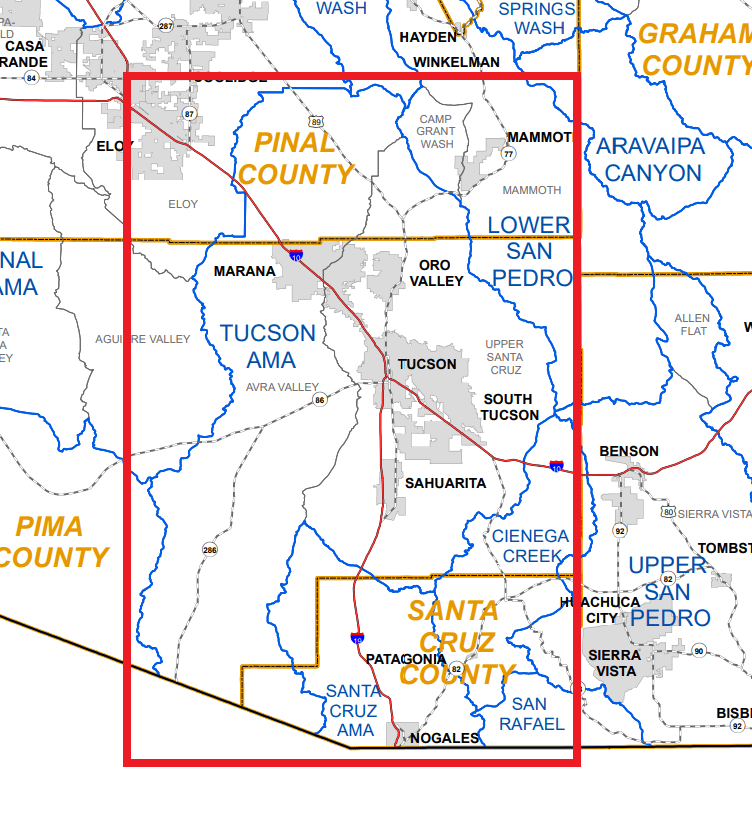
PHOENIX- Beginning the week of March 3, 2025, and continuing through April 2025, Arizona Department of Water Resources (ADWR) field services staff will make an extensive effort to measure water levels in wells within several groundwater basins in Southern Arizona. This survey of wells – or basin “sweep”, as it is known, was last conducted during the Spring of 2020.

The data collected will be analyzed and used to obtain a comprehensive overview of the groundwater conditions and used to support scientific and water management planning efforts. Among others, data uses will include:

  • Analysis of water-level trends
  • Groundwater modeling
  • Water-level change maps
  • Hydrologic reports
  • Water resource planning and management

The groundwater subbasins that will be targeted are as follows; Avra Valley, Cienega Creek, San Rafael, Santa Cruz AMA and Upper Santa Cruz. These subbasins cover several thousand square miles of Tucson Metro, farmland, riparian areas, Santa Cruz River and rugged terrain in Southern Arizona along the border of Mexico. Additional coverage areas include the cities and towns of Green Valley, Tubac, Nogales, Patagonia and Sonoita.

For more information regarding this matter, please contact Public Information Officer Shauna Evans at smevans@azwater.gov or (602) 771-8079.

Details about the nature of basin sweeps and groundwater modeling can be found here. If you would like to volunteer your well for participation in this groundwater survey please contact the Hydrology Division at (602) 771-8535.

###

Arizona Department of Water Resources field hydrologists conducting “basin sweep” to collect water level measurements in Eastern Arizona

PHOENIX- Beginning the week of December 30, 2024, and continuing through February 2025, Arizona Department of Water Resources (ADWR) field services staff will make an extensive effort to measure water levels in wells within several groundwater basins in Eastern Arizona. This survey of wells – or basin “sweep”, as it is known, was last conducted during the winter 1987.

The data collected will be analyzed and used to obtain a comprehensive overview of the groundwater conditions and used to support scientific and water management planning efforts. Among others, data uses will include:

  • Analysis of water-level trends
  • Groundwater modeling
  • Water-level change maps
  • Hydrologic reports
  • Water resource planning and management

The groundwater subbasins that will be targeted are as follows; Bonita Creek, Duncan Valley, Gila Valley, Morenci and San Carlos Valley. These basins cover several thousand square miles of farmland, riparian areas and rugged terrain in East/Central Arizona along the border of New Mexico, through the Gila Mountains and includes the Town of Safford following the path of the Gila River.

For more information regarding this matter, please contact Communications Administrator Doug MacEachern at dmaceachern@azwater.gov or (602) 771-8507.

Details about the nature of basin sweeps and groundwater modeling can be found here. If you would like to volunteer your well for participation in this groundwater survey please contact the Hydrology Division at (602) 771-8535.

###

Arizona Department of Water Resources field hydrologists conducting “basin sweep” to collect water level measurements in the NW Groundwater Basins: Virgin River, Grand Wash, Shivwits Plateau, Kanab Plateau, Paria, and Coconino Plateau Basins (known mostly as the Arizona Strip region, not including Peach Springs Basin)

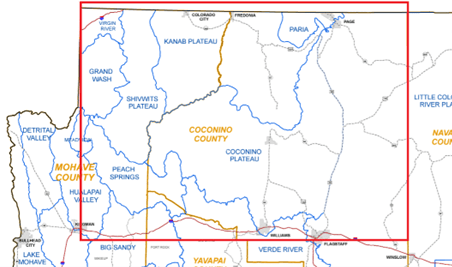
PHOENIX – Beginning the week of March 11, 2024, and scheduled to continue for multiple months, Arizona Department of Water Resources (ADWR) field services staff will be making an extensive effort to measure water levels in wells in the NW Groundwater Basins: Virgin River, Grand Wash, Shivwits Plateau, Kanab Plateau, Paria, and Coconino Plateau Basins.  ADWR’s objective is to measure water levels at hundreds of wells in these groundwater basins. This survey of wells – or basin “sweep,” as it is known – was last conducted by the USGS in 1976 for the Grand Wash, Shivwits Plateau, Kanab Plateau, Paria Basins.  ADWR last conducted a sweep in the Virgin River Basin in 1991 and Coconino Plateau Basin in 2004.

The Arizona Strip area has been identified as a critical area that has not had a basin sweep conducted recently (see ADWR publication, Hydrologic Map Series (HMS), Water Level Change Map Series (WLCMS), and Basin Sweep Assessment Report ADWR Basins and Sub-Basins, (2009)

The data collected will be analyzed and used to obtain a comprehensive overview of the groundwater conditions and used to support scientific and water management planning efforts. Data collected will be used for several purposes, including:

  • Analysis of water-level trends
  • Groundwater modeling
  • Water-level change maps
  • Hydrologic reports
  • Water resource planning and management

This basin sweep covers an area generally in the northwestern portion of the state from the Virgin River and Virgin River Mountains, including the Grand Canyon – Parashant NM, north and south rims of the Grand Canyon NP, extending east to Paria Canyon and southeast to the Colorado River west of Page, south to the San Francisco Mountains just northwest of Flagstaff, including Williams..

For more information regarding this matter, please contact Public Information Officer Shauna Evans at smevans@azwater.gov or (602) 771-8079. Details about the nature of basin sweeps and groundwater modeling can be found here.

###

Arizona Department of Water Resources field hydrologists conducting “basin sweep” to collect water level measurements in the Pinal Active Management Area

PHOENIX- Beginning the week of December 18th, 2023, and continuing through February 2024, Arizona Department of Water Resources (ADWR) field services staff will make an extensive effort to measure water levels in wells in the Pinal Active Management Area (AMA). This survey of wells – or basin “sweep,” as it is known – was last conducted during the Winter of 2018.

The data collected will be analyzed and used to obtain a comprehensive overview of the groundwater conditions and used to support scientific and water management planning efforts. Among others, data uses will include:

  • Analysis of water-level trends
  • Groundwater modeling
  • Water-level change maps
  • Hydrologic reports
  • Water resource planning and management

The Pinal AMA is located in the central part of the State of Arizona. The Pinal AMA covers approximately 4,000 square miles in central Arizona. The topography consists of gently sloping alluvial basins separated by north to northwest trending fault-block mountains. The AMA consists of five sub-basins with unique groundwater underflow, storage, and surface water characteristics. These sub-basins are Maricopa-Stanfield, Eloy, Vekol Valley, Santa Rosa Valley, and Aguirre Valley.

For more information regarding this matter, please contact Public Information Officer Shauna Evans at smevans@azwater.gov or (602) 771-8079. Details about the nature of basin sweeps and groundwater modeling can be found here. If you would like to volunteer your well for participation in this groundwater survey, please contact the Hydrology Division at (602) 771-8535.

###

Press Release: Arizona Department of Water Resources Accepting Applications for the Groundwater Conservation Grant

Color Logo Transparent- For Web

PRESS RELEASE

FOR IMMEDIATE RELEASE                                                   CONTACT: Shauna Evans

Dec. 2, 2019                                                                                          PHONE: 602.771.8079


Arizona Department of Water Resources Accepting Applications for the Groundwater Conservation Grant

PHOENIX- The Arizona Department of Water Resources (ADWR) is now accepting applications for the Water Management Assistance Program (WMAP) Groundwater Conservation Grant. This grant, in the sum of $2,000,000, was appropriated to the WMAP for the purpose of providing additional monies to support conservation of groundwater in Arizona’s five Active Management Areas (AMAs), pursuant to A.R.S. § 45-617 (C). Grants may be allocated to programs and projects that demonstrate the ability to conserve Arizona’s groundwater resources either directly or indirectly and are located within the five AMAs.

The deadline to submit applications is February 14, 2020, by 5 pm.

Application solicitation and the Grant Notice of Funding Opportunity may be found on the Arizona Office of Grants and Federal Resources website: https://grants.az.gov/funding-opportunities-0. Applications must be submitted through this website in order to be considered.

ADWR staff will host a grant application workshop on Tuesday, December 10th at 8:30–10:00 am at ADWR, 1110 W. Washington St., Room 3175, Phoenix, 85007. The workshop will be available via webinar as well as recorded and posted on the WMAP webpage at https://new.azwater.gov/ama/wmap, for those who are not able to attend the workshop.

For additional information, please contact Melissa Sikes, WMAP Coordinator, at (602) 771-8449 or msikes@azwater.gov.

###

2019 Pinal Groundwater model released

The “2019 Pinal Model and 100-year Assured Water Supply Projection Technical Memorandum” — an analysis of the Pinal County area’s groundwater conditions, performed by the Arizona Department of Water Resources,  is now complete and available for viewing.

The model can be viewed here.


#  #  #

Massive earth fissure found near Picacho Peak…and you heard about if first from Arizona Water News!

fissure1

Spectacular drone video shot by Arizona Geological Survey of new fissure sparks wave of media attention

Arizona news media are buzzing suddenly with the release of some spectacular video of a new, expanding earth fissure in the desert near Picacho Peak.

Shot by geoscientist Brian Gootee of the Arizona Geological Survey (AZGS), the drone video depicts a classic aerial shot of the 1.8-mile long fissure before zooming down below the ground-level rim, providing some sensational inside views of the earthly phenomenon.

The video can be viewed here, here, here, here and here. And, notably, here.

The fissure, located about ten miles southwest of Picacho Peak State Park in southern Pinal County, is the latest fissure discovered in an area of the desert where they are becoming plentiful. In places, the nearly two-mile-long fissure is up to ten feet wide and 30 feet deep.


Sending in a drone to examine the earth fissure

Fissures can pose a hazard to hikers and people riding off-road vehicles in the area. Cattle grazing in the area also are in jeopardy of falling into some of the larger fissures.

Fissures also tend to erode quickly, especially during torrential rains, and can act as a conduit for storm runoff into the area’s underground aquifers.

The Arizona Department of Water Resources Land Subsidence Monitoring Report No. 3, which the department featured in the January 12 issue of Arizona Water News, identified numerous fissures in southern Pinal County, including one north of the Picacho Mountains.

The large earth-crack depicted in the video is oriented roughly north and south. It appears to have begun forming between March 2013 and December 2014, according to the AZGS geoscientists who first examined the fissure.

The newer part of the Picacho fissure — much of which the drone traverses at below-the-rim levels — appears to have formed within the last six months, judging by the lack of erosion around its rims, as well as a lack of vegetation.

“The earth fissures are a result of land subsidence which is caused by excessive groundwater use,” said Brian Conway, supervisor for the Water Resources Geophysics/Surveying Unit. Conway worked closely with the AZGS geoscientists in preparing the department’s subsidence report.

An uprooted tree

“This earth fissure was an extension of an earth fissure that was discovered using 2014 imagery by Joe Cook at the AZGS,” said Conway.

“This was Joe Cook’s first chance to visit the earth fissure and discover the newer extension of the earth fissure.”

According to Conway, AZGS researchers never before have used drone-video technology while mapping out an earth fissure.

Water Resources cooperates closely with AZGS in investigating and monitoring earth fissures and land subsidence. Much of their work is mapped out using a revolutionary satellite-based radar technology known as InSAR.

Modern technology clearly changes our understanding of earth-bound phenomena like fissures by giving us perspectives we didn’t have previously.

Camera-carrying drones, for example, allow us to examine the fresh walls of earth fissures as if we were hiking through a Colorado Plateau slot canyon.

“Perspective” works in both directions. Just as a drone can descend below the rim of a new fissure, satellite-based photo technology literally can lift a viewer’s perspective off the planet’s surface. Click on this satellite image

“Perspective” works in both directions. Just as a drone can descend below the rim of a new fissure, satellite-based photo technology literally can lift a viewer’s perspective off the planet’s surface. Click on this satellite image of the Picacho fissure, in an image created circa 2014, and roll your mouse wheel as far back as it will go. Talk about a unique, out-of-this-world perspective!