Arizona Department of Water Resources turns 37!

37th birthday

So what were you up to 37 years ago today?

If you’re a Millennial, the answer is existential: nothing, really.

But if you happened to have been the governor of Arizona at the time, you would have been spending June 12, 1980 at a signing ceremony for legislation that ultimately would be hailed as the most far-sighted set of groundwater-management laws in the country: The Arizona Groundwater Management Act.

As historian Desmond D. Connall, Jr., noted, Arizona Gov. Bruce Babbitt signed the Act establishing “ambitious goals for water conservation and a complex regulatory scheme to achieve them.”

groundwater act signing

Enforcing that “complex regulatory scheme” would be us — the Arizona Department of Water Resources — which came into being with the same stroke of Gov. Babbitt’s pen, since one of the provisions of the Groundwater Management Act was that it should create a division of State government devoted to managing all that complexity.  Babbitt appointed Wes Steiner, at the time the executive director of the Arizona Water Commission, as the department’s first director.

Whether they celebrated with cake or not is a matter lost to history.


Water Resources director exchanges chip shots on water in Arizona on “For Love of the Game” sports radio show

For Love of the Game image

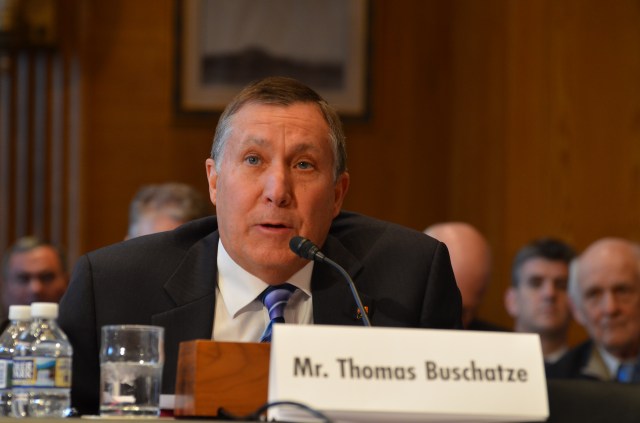
Water Resources Director Tom Buschatzke appeared live Monday with Mike “Uncle Buck” Rafferty on NBC Sports Radio 1060 AM’s “For the Love of the Game” program. Uncle Buck wanted to talk water — specifically, the use of water by golf courses — with the director, who, for some reason, Buck insisted on referring to as “Thomas.”

Clearly a genuine, heartfelt fan of golf and the golf industry, Uncle Buck peppered the director with a lot of well-developed questions about the importance of wise water use and about the history of water management in Arizona. It was a fun interview. And for anyone curious about the extent to which golf courses now go to conserve water, an informative one.

As noted, Uncle Buck came to the 17-minute interview prepared with well-developed questions, especially considering how complicated water as an issue can be. In fact, their interview may represent the first time ever that a sports-radio talk-show host inquired about the complex genesis of groundwater management in Arizona. (Click here to hear the interview)

Science and water: a more potable mix than you may have thought

science and water

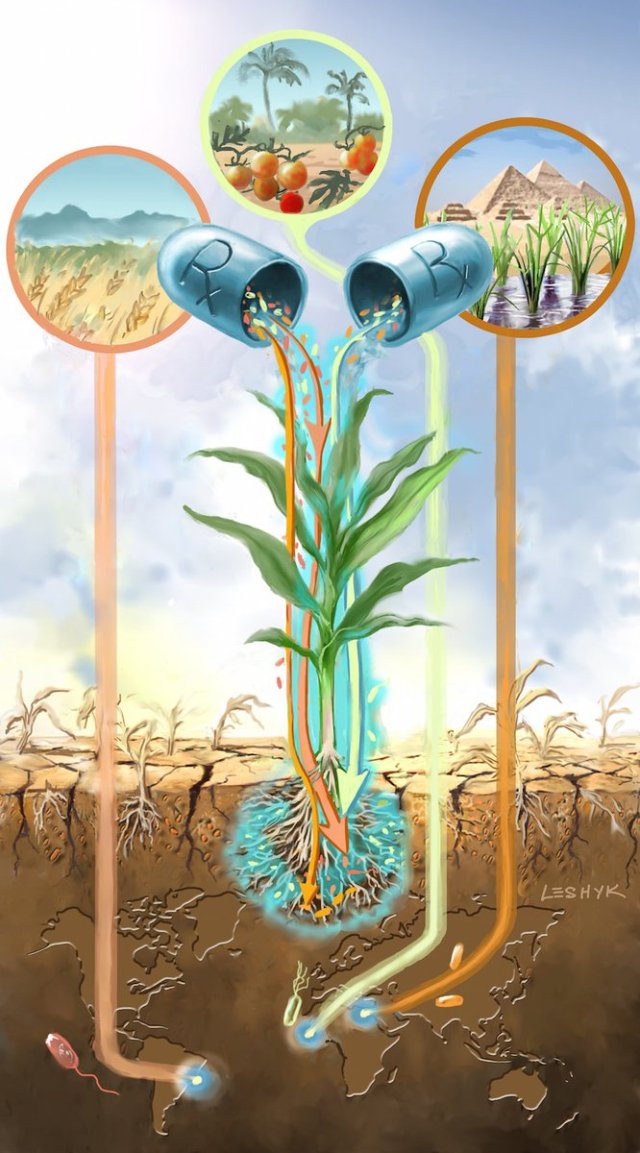
Rhizobacteria illustration courtesy of artist Victor Leshyk and Rachel Rubin of Northern Arizona University’s  Center for Ecosystem Science and Society

Historically, the role of science in combating drought has been limited to relatively back-bench strategies like cloud-seeding, or to mitigating the effects of water scarcity through new and improved farming techniques that wring every drop of value from a drop of water.

That’s changing.

One of the most talked-about consumer items in the water business today is a solar product that pulls water vapor from the air, producing clean, potable water.

An Arizona State University spinoff company, Zero Mass Water of Scottsdale, is developing a consumer version of a wireless, stand-alone “drinking water solar panel” capable of producing two to five liters of drinking water per day.

Some marketing efforts are touting the solar water makers in the same way as energy-producing solar panels – that is, as a self-reliant means of escaping from the “grid.”

Its implications for clean-water-parched and impoverished corners of the world, however, may be even more substantial. Zero Mass Water recently told the Phoenix Business Journal that it sees itself and its customers as “water democratizers” — collaborators in a program to deliver the solar-panel devices to families “with no access to safe water who can’t afford a panel on their own.”

Mass production of the devices – which require little more than an air-filter replacement each year and a new mineral cartridge every five years – could mean that people who have never known dependable sources of clean water now could have it.

Meanwhile, researchers at Northern Arizona University recently published findings that certain bacteria can help mitigate crop loss due to drought.

NAU doctoral candidate Rachel Rubin recently told the Arizona Daily Sun about her work with rhizobacteria, a bacteria that strengthens plants in certain drought-stricken regions around the world. Rubin’s team is finding a 20-40 percent increase in growth in plants introduced to rhizobacteria, according to the Daily Sun.

“This is encouraging because it means that the places most vulnerable to climate change will benefit the most” Rubin told the Daily Sun.

Rubin’s research is finding that rhizobacteria promote plant growth even better under drought conditions than they do in a wetter climate.

Zero Mass Water of Scottsdale, Ariz.

A water drop’s journey: A Las Vegas newspaper produces a splendid, little video on how a desert city’s water gets where it needs to be

screenshot

Just what does it take to quench the thirst of two million people living in the middle of a desert?

Especially in these drought years, news media have become adept at telling us what it takes to deliver water to communities — what it takes to quench the thirst of desert-dwellers and others in the Southwest.

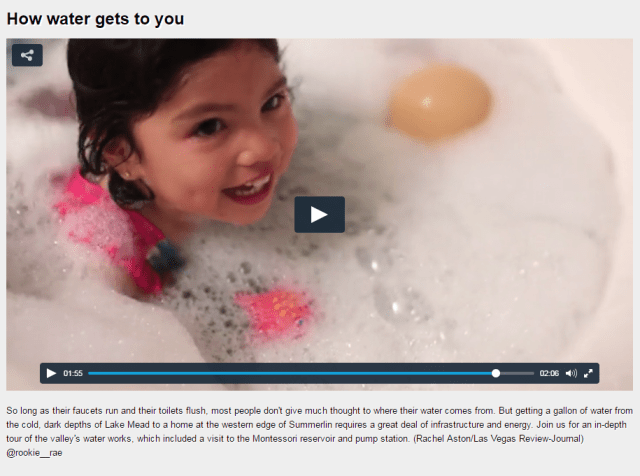
The Las Vegas Review Journal recently did a marvelous job of showing readers — rather than merely telling them — precisely what it takes for a drop of water to exit Lake Mead (Sin City’s primary water resource) and travel to a residential water faucet.

Produced by Rachel Aston of the Review-Journal, the video starts with that basic question — “What does it take to quench the thirst of two million people” living in the middle of a desert? — and escorts viewers on that journey.

(For traditionalists, Review-Journal reporter Henry Brean provided a story about the water-journey, too)

The water-journey video starts in Lake Mead (actually, the video includes a shot or two of the Colorado River, too) and moves with the water through the 20-foot-tall, 3,000- and 4,600-horsepower pumps that draw the water to one of the city’s two treatment facilities. It depicts the cleansing and filtration systems, as well as the various means by which the water is delivered to homes and businesses. And, we assume, casinos.

The video is just a little over two minutes long, but it depicts all of the essential infrastructural elements of water delivery that everyone should understand, but in fact a very few number of us actually do.

Weather and climate in the Southwest: Part Two

This is the second part of a discussion with Arizona’s top weather climatologists about drought, rainy winters and why California gets so much more of those “atmospheric rivers” than we do

storm over monument valley

In this discussion with Arizona’s top weather climatologists about the long (and continuing) drought in the Southwest, we talk about the reasons behind the abundant moisture during the 2016-2017 winter and expectations for the future (cross your fingers!).

Today’s talk features Mark O’Malley, forecaster and Climate Science Program manager for the National Weather Service.

Published on March 8, Part One featured an interview with Arizona State Climatologist Nancy Selover. Dr. Selover is the Julie Ann Wrigley Global Institute of Sustainability Research Professor at Arizona State University’s School of Geographical Sciences and Urban Planning in the College of Liberal Arts & Sciences.

Selover and O’Malley are the co-chairs of the State Drought Monitoring Technical Committee, which is responsible for gathering and analyzing data regarding Arizona drought, climate and weather.

The information they provide is used by the Governor’s Interagency Coordination Group, which makes an annual recommendation to the Arizona Governor about whether the state’s long-running state of drought should be extended. Or… not. Arizona Department of Water Resources Director Tom Buschatzke co-chairs the ICG.

Climate science – a field of study that has evolved rapidly in this century – examines a phenomenon like “drought” from an increasing number of factors.

For one thing, it makes the recommendation to the governor on whether to continue the drought declaration more precise.

Drought impacts can range from a lack of soil moisture, affecting range land and farming, to water levels in the state’s reservoirs. And all of the factors that climatologists weigh when deciding whether drought exists can vary widely in time and scale. But all the drought factors taken together make it more difficult to establish with certainty when a drought may begin or end.

“I think it’s generally accepted that Arizona is in a standing, long-term drought since 1999,” said Mark O’Malley of the National Weather Service.

“But clearly there are years and parts of years in the past 17 years where drought has been less expansive and less intense. There really is no good way to say drought in Arizona started on ‘x’ day in 1999.”

Like State Climatologist Nancy Selover – O’Malley’s co-chair on the State Drought Monitoring Technical Committee – O’Malley sees the effects of the very wet 2016-2017 winter as a real positive for most of Arizona. But the slowly improving drought conditions locally are impacted by the summer monsoons, too, he notes.

“We have experienced three to four excellent summer monsoon seasons where thunderstorms and rainfall across the state have been quite good, but we’ve also had five consecutive winters with below average snow in the mountains,” said O’Malley. And it is that snowpack in the mountains that is important for the state’s water supply.

“This winter has been good — especially around the Flagstaff area — but doesn’t totally compensate for the five previous dry winters.”

In terms of moisture, “good” in Arizona consistently is less good than on the California coast, where unprecedented winter moisture largely has ended that state’s drought. There are a number of reasons for that phenomenon, says O’Malley. Some are atmospheric. Some are geographic.

For one, he notes, central and northern California are at higher latitudes than Arizona, and so more commonly fall under the jet stream – which also explains why even during the sodden 2016-2017 winter, Los Angeles and San Diego are getting less moisture than, say, Sacramento.

Then there is the effect of those mountains separating the coastal cities from Phoenix, which, among other things, tends to wring out moisture from those Pacific storms as they sweep inland.

“Moisture from the Pacific streams unencumbered into the coastal cities with lift provided by air flowing over the mountains providing even more rain and snow,” said O’Malley.

“As the air flows over the mountains into far southeastern California and Arizona, it sinks. And you generally need air rising to produce precipitation.”

Often, he notes, there is “nothing left over for Arizona” in those storms. “This is why the deserts from Yuma through Death Valley, Calif., are the driest places in the United States.”

With California reservoirs literally overflowing and with Los Angeles Mayor Eric Garcetti calling for a state of emergency as a result of the melting snowpack in the eastern Sierra Nevada, California is confident – for now, at least – that it is nearly free of drought.

What about Arizona?

“By both objective measures and impacts, drought in Arizona is certainly better  — which is to say, we have less drought — than last year at this time, and substantially better than two to three years ago,” said O’Malley.

“I wouldn’t go as far as using the term ‘waning’ — that word infers a resolution or termination in the immediate future.”

It doesn’t take much for an arid state to slip back into serious, widespread drought conditions.

“Bottom line, because of our location, growing population, and demand for water, Arizona will always be susceptible to drought.”


Water Resources director hails agreement to expand uses of CAP canal system

“System-use agreement” between Central Arizona Project and the federal Bureau of Reclamation a major milestone for vital water-delivery system

Central Arizona Project photo by Philip A. Fortnam
Central Arizona Project board President Lisa Atkins and board member Sharon Megdal signing the CAP System Use Agreement on Feb. 2


Central Arizona Project and the federal Bureau of Reclamation reached an historic agreement on Thursday that allows for “new and innovative” uses of the CAP’s 336-mile system of canals, including transporting new water supplies, exchanging supplies among users and efficiently accessing water stored underground by the Arizona Water Banking Authority and others.

The agreement creates a legal framework for a variety of water supplies to be moved through the system, including many dedicated to addressing possible future shortfalls in Arizona’s Colorado River water allocations.

“It allows for flexibility in managing our Colorado River water supplies,” said Tom Buschatzke, director of the Arizona Department of Water Resources.

Until now, so-called “non-CAP water” – that is, water controlled by users other than the Central Arizona Project – flowed through the elaborate delivery system only on an ad hoc basis.  In 2014, for example, the cities of Phoenix and Tucson reached an agreement allowing Phoenix to store some of its unused Colorado River allocation in Tucson-area aquifers.

Thursday’s agreement provides a legal framework for such water exchanges, thus opening the door for further innovation, as well as for future agreements on water quality and financial issues.

CAP General Manager Ted Cooke also noted the additional flexibility that the agreement provides his agency. Cooke thanked the agencies involved in helping make it happen for their collaborative efforts:

“This agreement provides us with the flexibility for cost-effective recovery of stored water, including more than four million acre-feet of CAP water stored in the aquifers of central and southern Arizona,” said Cooke.

“I would like to thank the negotiators from the Department of the Interior and the Bureau of Reclamation, along with the significant contributions from the Arizona Department of Water Resources and the Arizona Water Banking Authority.”

Water Resources Director Buschatzke joined Cooke in extending thanks to the Arizona congressional delegation – especially noting the efforts of Arizona Senator Jeff Flake – for helping make the system use agreement happen.

“Our role was to support efforts to complete the system use agreement for the benefit of Arizona water users,” added Buschatzke.

“We sought to support the maximum flexibility of this important asset.”

Gov. Doug Ducey expressed thanks to former Interior Secretary Sally Jewell for her efforts in support of the system-use agreement.

The CAP canal system was built by the federal Bureau of Reclamation for the state of Arizona and is managed and operated by the Central Arizona Project.

The deal is especially valuable to the Water Bank, which pays to bring Colorado River water through the CAP system into central and southern Arizona. The Water Bank stores that water in underground aquifers, or directly recharges it into underground storage facilities. It also arranges for water deliveries to irrigation districts, which use the water in lieu of mined groundwater.

Water Bank officials helped review the agreement.

The deal creates a legal framework allowing the Water Bank to use the CAP system to make recovered water available during potential periods of shortage of Colorado River water deliveries to Arizona. Until now, the Water Bank’s capacity to make use of the water it stores has been extremely limited.

 (A Central Arizona Project statement released Thursday contributed to this blog post)


Ebbing Away: Latest land “subsidence” monitoring report finds lower ground levels and fissures in some regions of Arizona

earth-fissures-pic

The problem of land subsidence in Arizona – the lowering in elevation of land-surface levels, largely the result of groundwater extraction – is a decidedly mixed bag, the Arizona Department of Water Resources is discovering.

Thanks to decreased groundwater pumping in the Phoenix and Tucson Active Management Areas, for example, subsidence rates in many areas of those AMAs have decreased between 25 and 90 percent compared to rates in the 1990s.

That is just one of the major findings of the department’s recent “Land Subsidence Monitoring Report No. 3,” released earlier this month.

And it’s the news from the happy side of the bag.

On the opposite side, land subsidence statewide is proving to be an increasingly serious challenge that is causing problems for infrastructure in some areas. And it is proving to be a headache even in certain parts of active-management areas.


Monitoring for subsidence


As the report describes, Water Resources first began monitoring for subsidence in the eastern areas of the Valley and around Luke Air Force Base in the west after numerous “non-exempt” wells – that is, wells that draw up groundwater at rates faster than 35 gallons per minute – were installed starting in 1997.

Historically, land levels in those areas have dropped at significant rates, the recent report finds.

The problems caused by land subsidence do not go away simply by fixing cracked foundations, reconnecting broken pipelines or repairing roadways.

Subsidence is caused by the collapse of open-pore spaces in subsurface aquifers, an unseen water-storage catastrophe in the making. When the open-pore spaces of aquifers fully collapse, they collapse permanently, in most cases.

“Land subsidence is a regional problem for some groundwater basins in the state and may continue to be an ongoing problem,” said Brian Conway, who prepared the report on behalf of Water Resources.


Arizona Department of Water Resources’s Brian Conway, Supervisor for the Geophysics/Surveying Unit

“Even if sustainable, safe-yield groundwater withdrawal occurred, residual land subsidence would continue until the groundwater levels recover — and/or the open pore-spaces in the sub-surface fully collapse.

As one would expect, the Water Resources report finds that subsidence is most active in regions outside the active-management areas – that is, in areas where groundwater pumping is unregulated.

Land subsidence has resulted in more than 160 miles of earth fissures. The Arizona Geological Survey maps all the earth fissures throughout the state. The Geological Survey analysts provide Water Resources with the data from their research.

The Geological Survey and Water Resources analysts have found that the Willcox Groundwater Basin in southeastern Arizona is the most active area for forming new earth fissures.

Southeastern Arizona is one of the regions most severely impacted by drought. The area also has seen substantial increases in farming operations that rely on mined groundwater.


Earth Fissure


The Willcox Basin is outside the reach of the state’s Groundwater Management Act of 1980, which regulates groundwater extraction in active-management areas. According to the report, new earth fissures in the area are impacting roads, highways, power lines and a pipeline.

The report observes that other non-AMA regions of the state also have seen considerable increases in their rates of earth subsidence, notably parts of the McMullen Valley Basin and the San Simon Valley Sub-basin. Both of those regions have seen increased agriculture activity in recent years that is reliant on mined groundwater

The subsidence mapping process employs the latest radar technology — known as “InSAR,” or satellite-based synthetic aperture radar.

The introduction of the InSAR technology has proved to be a game-changer in terms of the state’s ability to accurately track the development of subsidence over time.

Water Resources was awarded a $1.3 million grant from NASA in 2002 that kicked off a three-year effort to integrate the InSAR system into Arizona’s subsidence-monitoring programs.

The program now has 14 different partners in the effort whose financial support allows the department to fund the InSAR data collection.

The side-looking, self-illuminating, radar-imaging system has helped Water Resources develop an extensive library of scenes, covering an area greater than 150,000 square miles.

With the InSAR data, Water Resources has identified more than 26 individual land subsidence features around the state, collectively covering more than 3,400 square miles.

“The InSAR data is a huge part of our monitoring efforts now,” said Conway.

“We are able to cover large areas with the data and are able to see millimeter changes of deformation at a very high resolution.”

Busy water author explains water “collaboration” in the Southwest

fleck-at-asu

And just who is the busiest water writer out there?

Not much argument that it’s John Fleck, longtime author of an authoritative blog on water in the Southwest ( http://www.inkstain.net/fleck/ ), former water reporter for the Albuquerque Journal, and author of an influential new book on water in the arid West, Water is for Fighting Over and Other Myths about Water in the West.

None of those credentials, however, are evidence of Fleck’s breakneck schedule in recent months.

In August, Fleck was named director of the University of New Mexico’s Water Resources program. He already had served at UNM as a professor of Practice in Water Policy and Governance.

In December, Fleck served on a panel titled “communicating the drought” at the Colorado River Water Users Association meetings in Las Vegas.

Now, he’s in Tempe, where he spoke at an event organized by a trio of Arizona State University-affiliated organizations about the need to nurture collaborative water governance in response to increasing drought-driven scarcity.

“We have this ‘myth’ of water being anchored in conflict, wealth and power (in the West),” said Fleck to an audience of about 35 at the Brickyard Orchid House near ASU’s Tempe campus.

“And that myth just hasn’t played out in the last century.” Rather, he said, regional collaboration, combined with unanticipated adaptations to water scarcity (think: low-flow showerheads and toilets), have effectively “decoupled” growth in regional population from growth in water usage.

“Water use is declining (in the West) overall and on a per-capita basis,” noted Fleck. “This is a phenomenon the economists call ‘decoupling.’”

Fleck spoke at the invitation of ASU’s Future H2O, the Kyl Center at the Morrison Institute and Decision Center for a Desert City.

In the course of a question-and-answer period, Fleck acknowledged in response to an audience-member’s question that there are water-related events that are counter-factual to his thesis about rampant water collaboration.

One of those contradictory issues is the on-going question in California about what to do about the Salton Sea – the ‘accidental’ lake that is fed largely by runoff from the vast Imperial Valley farmlands. With drought and water conservation limiting flows into the Salton Sea, the potential for catastrophic wind-borne chemical pollutants filling the air in the region grows daily.

“The Salton Sea is one of those unsolved problems,” he said.


An end-of-year report: Why Water Resources is putting more resources into informing the public about what we do

graph-6

It is a safe bet that at one time or another nearly every member of the Water Resources team has needed to explain to an acquaintance what we are not.

No, we’re not the people primarily responsible for assuring the quality of the state’s water supply. Those are our valued colleagues over at the Arizona Department of Environmental Quality.

ADEQ is just across the hall. Come on over some day. We’ll introduce you.

Water Resources protects the state’s water supplies. It is our complex duty to help assure the taps keep flowing.

But, no, we’re not your water provider. Not exactly. In most cases, that would be your community’s water department, like the city of Phoenix. Or – in big-picture terms – our friends over at the Central Arizona Project. Or the Salt River Project.

All of them literally deliver water. We help assure the supply. For the entire state.

And we do more. Lots more. At which point, your casual conversation with that acquaintance gets really complicated.

“It is the mission of the Water Resources communications team to express to the public – to those millions of “acquaintances” out there – what it is that this small-but-vital division of Arizona’s government does. As you can see, there’s a lot to it.”

We administer and enforce the most far-sighted groundwater-management laws in the nation. And, not to brag, but we’ve done that job so well that water demand in many of our communities – despite skyrocketing population and economic growth – has remained flat.

In fact, since 1986, we’ve stored over three and a half trillion gallons of water underground for future use.

Other states and localities have been forced to resort to emergency water-saving measures to combat drought conditions that seem to have caught them by surprise. Through Water Resources, Arizona has been vigilantly preparing for drought for decades.

We negotiate with external political entities – including other states and the federal government – over Arizona’s rights to the Colorado River, a mind-bendingly complex mix of salesmanship, diplomacy and a raw determination to protect the vital interests of Arizonans.

We assure the safety of non-federal dams. We collect and analyze data on groundwater levels. We research the complex intersections of weather and climate and create modelling that attempts to accurately assess Arizona’s water future.

“Other states and localities have been forced to resort to emergency water-saving measures to combat drought conditions that seem to have caught them by surprise. Through Water Resources, Arizona has been vigilantly preparing for drought for decades.”

And we are actively – indeed, urgently – working with Governor Ducey to seek out ways to augment Arizona’s water supplies while taking steps to further conserve what we already have.

That’s not the end of it. Not by a long shot. But you get the picture.

It is the mission of the Water Resources communications team to express to the public – to those millions of “acquaintances” out there – what it is that this small-but-vital division of Arizona’s government does. As you can see, there’s a lot to it.

Gov. Ducey has asked each division of state government to report on their efforts to put into practice efficiencies and best-management practices taught by his “Arizona Management System” instructors. It is part of the governor’s commitment to assure the public gets the most bang for its tax-paying buck.

From time to time in the coming months, this Arizona Water News newsletter will report on the progress that our teams here at Water Resources are making at implementing those AMS efficiencies.

We’ll describe how our strategic-planning team is doing. And report on the efficiency efforts of our team coordinating the Assured and Adequate Water Supply program. We’ll describe how the work of our hydrologists, geologists, engineers, modelers and surveyors is progressing.

This week? Well, it’s all about us. The Water Resources communications team. To paraphrase the late, indefatigable mayor of New York, Ed Koch, “How are we doin’?”

Our Arizona Water News newsletter – the “flagship” of the Arizona Department of Water Resources media empire – increased its subscriber listings from 134 in March to over 2,000 by the end of the year.

Since the early months of 2016, the Water Resources communications team has taken steps to accomplish two primary goals: 1) to enhance public awareness of the condition of the state’s water supply during an epochal period of drought; and, 2) to ensure the transparency of the records and data to which the department has been entrusted.

To accomplish that first goal, we have done a simple thing. It is the same thing that communications teams large and small in our fragmented, decentralized, mostly-online media world are attempting to do: We are expanding our viewing audience by providing useful, timely information and by carefully tracking what our analytics tell us interests that audience.

So, how’s that doin’?

In March 2016, the Water Resources news site attracted 158 page-views. We made a commitment to increase website viewers to 11,000 by year’s end. We blew past that figure in mid-summer and re-set our goal at 20,000. In December, we tallied 3,114 page views, and we logged a total of 26,747 page views for the year. Speaking technically, we crushed it.

How? Well, we gave our audience valuable water-related news to consume, of course, including a multi-media supply of written features, audio podcasts and YouTube video, all of which we made more easily accessible.

But we also dramatically diversified how our audience finds us.

Our Arizona Water News newsletter – the “flagship” of the Arizona Department of Water Resources media empire – increased its subscriber listings from 134 in March to over 2,000 by the end of the year.

Our presence on Twitter and Facebook has increased exponentially. In March, we counted 480 profile visits and 4,272 impressions. In December, those figures stood at 3,914 and 77,100, respectively.

“The advancing news cycle, obviously, played the dominant role in the growth of media interest in water issues involving Arizona and the Southwest. There is that matter of descending water levels at Lake Mead, after all. Still…”

Not all those readers are local readers, either. Our analytics show readers coming to our pages from Canada, India, the United Kingdom, Mexico and at least eight other countries.

In mid-December, meanwhile, we launched our Arizona Water News blog, a regularly updated news feature that began as a special “live news” report on Colorado River negotiations among Upper and Lower Basin Colorado River water users. One recent blog post between Christmas and New Year’s Eve attracted over 700 readers.

Small potatoes by New York Times standards? Well… OK. Sure. But the growth curve is up. Not all “media centers” can say that.

Precious few of them, for that matter, can say they have increased their audiences without having spent a penny on promotion or advertising – or on anything outside their own doors. At Water Resources, all the media magic happens here.

What’s more, our effort to problem-solve our way to better public outreach is bearing fruit in another important respect: It appears to be improving the factual awareness about Arizona’s water story among news media in and outside the state.

Our (admittedly subjective) log of accurate news-media reports on water issues in Arizona tracked an average of one or two reports a month in early 2016 that in our judgment related a factually accurate story.

 In November, we recorded 39 such reports, including news accounts published by Politico, International Business Times, the Denver Post, the Los Angeles Times and the Wall Street Journal.

The advancing news cycle, obviously, played the dominant role in the growth of media interest in water issues involving Arizona and the Southwest. There is that whole matter of descending water levels at Lake Mead, after all.

But we’re also confident the steps we have taken to assertively tell Arizona’s water story ourselves have had an impact. Many, if not most, of the media writing about drought in the Southwest now come to the Arizona Department of Water Resources for accurate and timely water data and analysis.

Arizona water podcast: A chat with the head of Arizona’s golf-course supervisors association about results of recent golf-industry study

Rory Van Poucke, president of the Cactus & Pine Golf Course Supervisors Association, recently took time with the Arizona Department of Water Resources to discuss the results of a study of the state’s golf-course industry, including its economic impact and its water use.

An ADWR report on the study, conducted by University of Arizona researchers, as well as a link to the study itself, can be found here.


Click Here!

podcast