Climate vs weather: Is the California drought ending? Not so fast!

desert_electric
Violent electrical storm attacks the California Mojave Desert by Jessie Eastland

In the coming days, the northern Sierra Nevada in California is going to get pounded with a literal rushing “river” of moisture that promises to dump upwards of five feet of snow in some of the mountain range’s higher elevations and as mush as two feet of rain in parts of nothern California.

Within a few days, the mighty system will sweep down into some of the more drought-parched regions of southern California, too.

“This is what we’re supposed to be getting,” Johnnie Powell, a meteorologist at the National Weather Service, told the Los Angeles Times.

“After six years of a drought, I love saying that. This is normal rain and snow that we’re supposed to be getting in December and January.”

So, the end of the five-year California drought is nigh, right? Well, no. It’s not nigh.

The Great California Drought’s end is not nigh for the simple reason that what we are witnessing on the Left Coast is weather. And while an extended “weather” feature like drought is a function of climate, “weather” all by itself is not.

The difference between “weather” and “climate” is a fundamental meteorological distinction.

“Weather is the daily condition of the atmosphere, (including) specifics of temperature, humidity, wind and precipitation,” said Arizona State Climatologist Nancy Selover.

“Climate is the long-term average and extremes of those daily values.”

It is possible, but far from certain, that the enormous “atmospheric river” of precipitation now beginning to batter California is the return to “normal” that Powell of the NWS describes.

That hopeful anticipation is bolstered by other meteorological developments. Northern California also experienced its wettest October in 30 years. And, as reported by the National Weather Service, the same region experienced above-average precipitation in December.

So, is California – and, by extension, the Southwest – out of the drought-woods?

Well, no.

Wet weather is nice, but it would take a long-term trend of similar weather patterns for it to constitute a change in climactic conditions away from the lingering pattern of chronic drought that has left its mark in California for the last five years, as well as in the Southwest for going on 17 years.

And while some parts of the Sierra Nevada range may be getting crazy-deep snow deliveries, the distribution of moisture is far from universal. Despite all that October and December rain and snow, for example, the California-wide snowpack has been measured at just 70 percent of normal, as reported by the California Department of Water Resources.

Of course, that was before that megillah of a storm system began hitting the California northlands – a storm system that, while enormous, still constitutes nothing more than a very encouraging weather pattern.

“We often say, ‘Climate is what we expect, but weather is what we get,’” said Selover.

Arizona water podcast: A chat with the head of Arizona’s golf-course supervisors association about results of recent golf-industry study

Rory Van Poucke, president of the Cactus & Pine Golf Course Supervisors Association, recently took time with the Arizona Department of Water Resources to discuss the results of a study of the state’s golf-course industry, including its economic impact and its water use.

An ADWR report on the study, conducted by University of Arizona researchers, as well as a link to the study itself, can be found here.


Click Here!

podcast

Golf in Arizona: UofA researchers find that industry is reducing golf-course reliance on fresh water

2864127440_7dd12a9f05_b

A University of Arizona study of the golf industry in Arizona has found that golf – with an economic impact of $3.9 billion in 2014 — has re-established its footing as an important driver of the state’s economy following the tumult of the 2009-10 economic downturn.

Just as important, however, are the data the U of A researchers collected regarding the industry’s use of water for course irrigation, which is in a rapid state of transition from a supply that once was largely fresh water to one that increasingly includes effluent.

 The five researchers from the U of A’s Department of Agriculture and Resource Economics concluded their work in December, based on 2014 data.

The study is an update of a 2006 study of the economic impact of golf to the state’s economy. It is largely the product of primary data collected from Arizona golf facilities statewide through a survey.

The University of Arizona team concluded that the golf-course industry is in a more rapid transition to the use of effluent to irrigate greens and fairways than previous research had indicated.

They found that fully 34 percent of water used to irrigate Arizona golf courses statewide is treated effluent.

The most comprehensive water-use data previously had been collected by the U.S. Geological Survey in 2010, which at that time found that effluent accounted for just 28 percent of golf’s total statewide water use. That new data indicates a six percent increase industry-wide in effluent use in just six years.

The Arizona Department of Water Resources also contributed water-use data to the researchers. The department’s data are limited to golf-course irrigation practices in the state’s active-management areas.

Active-management areas, or AMAs, are the areas of the state where water use is regulated by the tenets of the Arizona Groundwater Management Act of 1980.

The department’s data showed that effluent use in 2014 had increased by 27 percent since 2004, and that by 2014 effluent represented 26.3 percent of the water mix of golf courses in AMAs. The U of A researchers contend the actual use of effluent statewide is nearly nine percent higher than that AMA-only figure would indicate.

The study found that, in addition to the increasing use of effluent for irrigation, water-related “best management practices” over the last ten years appear to resulted in the following:

  • An average annual savings per-facility of 19.5 acre-feet of water, in large part due to the extensive use of irrigation audits
  • An average of 10.4 acres of turf grass removed
  • An average of 75.8 acres per facility over-seeded for winter play, down from 89.3 acres in 2009
  • Thirty-nine percent of responding golf facilities report that they have engagement in a partnership with a conservation organization

The data compiled by the U of A researchers also bolstered the conclusion that the Arizona golfing industry is bucking a national trend in terms of the sport’s popularity.

Nationally, the golf industry has struggled to rise out of the effects of the Great Recession. As the study notes, “the national supply of golf courses has been decreasing in what is considered a market correction after significant increases in golf course construction during the 1990s.”

Arizona has seen course closures too, but those have been matched by new construction. Also, numerous courses have undergone substantial renovation, according to the study.

One of the more striking economy-related conclusions of the study is that of the 11.6 million rounds of golf played around the state in 2014, nearly a third of those rounds were played by golfers from out of state.

“Over 32 percent of those rounds were played by out-of-state and foreign visitors accounting for $1.1 billion in total sales,”, said Carmella Ruggiero, executive director of the Cactus & Pine Golf Course Supervisors Association. “The golf industry continues to be one of the primary drivers of tourism to Arizona.”


Arizona loses another valued water warrior

steve_olson-003

Arizona’s water community has lost another dear friend.

Steve Olson, who wore more hats as a defender of Arizona’s water supply than we can count, passed away on Christmas Eve following a lengthy battle with cancer.

As Steve’s son, Nicholas, reported on Facebook, his Dad was surrounded at the end by family, and had taken visits from numerous friends through the day. He even enjoyed a bottle of fine red wine opened by his brother, Jeff Olson.

Steve is the second member of Arizona’s water community to pass away in less than a month. Rick Lavis, an important cotton-industry representative and a member of Governor Ducey’s Water Augmentation Council, died in late November following his own struggle with cancer.

In recent years, Steve had been the principal consultant for his own lobbying group, Olson Policy Services.

Prior to that he had been a senior policy adviser to the Nature Conservancy, executive director of the Arizona Municipal Water Users Association and government relations director for the city of Scottsdale.

He worked with a large group of state-agency volunteers setting up the Water Quality Assurance Revolving Fund, as well as the rules for using it. The WQARF, as the fund was known, constituted the state form of the federal Environmental Protection Agency’s Superfund.

Many of us here at the Arizona Department of Water Resources remember him as legislative liaison for ADWR.

Working under Director Rita Maguire at ADWR, Steve also oversaw the third management plan for the “active management areas” created by the Groundwater Management Act of 1980. He also served as the deputy area director for the Tucson Active Management Area and was a member of the Arizona Water Protection Fund Commission.

Former agency Public Information Officer Jack Lavelle came to Water Resources in 1999 when Steve was legislative liaison:

“In a few years, Steve left for a new job – I can’t remember where – and I claimed his larger office,” remembers Lavelle.

“That also meant I inherited Steve’s collection of massive three-ring binders, plans, reports and law books filling an entire wall. Steve had escaped his paper trail.

“While I pondered this out-of-date mound of paper, the forces of nature settled the issue. I was across the room working at the computer when shelving collapsed as books, binders and thousands of pages crashed to the floor, panicking the entire 5th and most of the lower floors!

“I still recall the noise. I also remember Steve’s hearty laugh when I told him about it. That’s how Steve was. Life was an amusement to Steve, one he shared with those fortunates in his company.”

More than anything else, Steve will be remembered as the kindest of souls. As his friend and former colleague (all Steve’s colleagues remained his fast friends) Karen Peters of the city of Phoenix also observed on Facebook, Steve was “deeply devoted to making things right in this world.”

Our hearts go out to Steve’s family. He spent many years among us at Water Resources doing all he could to make things right in this world. And he did his job well.


Santa’s Snowpack: Christmastime snow accumulation above Lake Powell

snowpack-in-the-colorado-basin-above-lake-powell


The mountains around Prescott were spectacular over Christmas. So were Flagstaff and the surrounding the San Francisco Peaks.

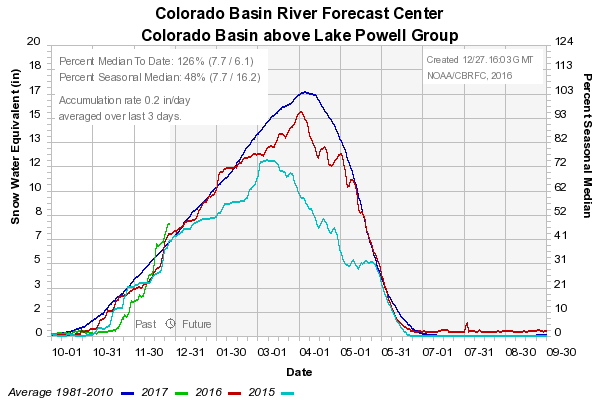
But when all is said and done, it’s the snowpack in the western Rockies that matters most for our water supply. So, if snowflakes joined those sugar-plums dancing in your head over the holidays, the green line in the graph above shows what you were seeing.

The graph depicts what the Colorado Basin River Forecast Center (CBRFC) uses to display the snowpack above Lake Powell, including the average snowpack as measured between 1981 and 2010, and the two most recent full winter measurements. As noted, the green line depicts the current snow-year, so it ends roughly in mid-December.

(The CBRFC uses the term “snow water equivalent” to describe the average or median conditions above various points in the Upper Colorado River Basin.  Snow water equivalent means the amount of actual water in a column of snow.  For example, 10 inches of snow equals one inch of water.)

As the chart depicts, 2015 was way below average snowpack. 2016 was better, but still below average. And the current winter (described as 2017) is just now inching above average.

A holiday gift to one and all in Arizona

cross-country-skier

No one knows better than your Department of Water Resources that “weather” and “climate” are not interchangeable. Still…

As a Holiday gift to the drought-weary, we will note, simply, that the news just now about water in the Southwest — especially from our neighbors to the coastal west — is pleasing. See here, here and here.

It doesn’t mean our tough water times are ending. It certainly doesn’t mean the long-term challenges facing the Lower Basin Colorado River users are resolved. But at this time of year, it is welcome news nonetheless.

It certainly enlivens our Holiday cheer. Happy Holidays, one and all!


5 Questions about DCP for Tom Buschatzke, director of the Arizona Department of Water Resources

tom-b-2

After CRWUA: Colorado River water users departed from their annual meetings without agreeing to a drought contingency plan. Where do they go from here?

The Colorado River Water Users Association held its annual meetings in mid-December without agreeing to a long-term plan to protect the integrity of Lake Mead and the Colorado River system from the effects of drought and allocation imbalances.

The result was disappointing… but widely anticipated. The negotiators, including Arizona Department of Water Resources Director Tom Buschatzke, have been engaged on the issues for many months, and are well-schooled by now in the complexity of the discussions.

On a rainy, stormy Thursday in late December, Buschatzke shared some of his thoughts on where the Lower Basin states and the region’s major water users go from here toward finalizing a DCP…

Click Below!

podcast

Colorado River water users make progress during meetings toward a system-wide drought contingency plan

lake mead


Over the years, the Department of Interior and the Bureau of Reclamation famously use the annual December meetings of Colorado River water-users to announce big policy changes.

That didn’t happen this time at the annual Colorado River Water Users Association meetings in Las Vegas. Despite a yeoman effort to push through an agreement on a drought contingency plan among the Lower Basin states, the many moving parts of the complex “DCP” agreement did not come together before CRWUA members parted ways.

That doesn’t mean the participants did not make progress on the numerous issues on the CRWUA tables, including but not limited to a DCP.

U.S. negotiators of a proposed extension to the U.S.-Republic of Mexico agreement on Colorado River operations – known as Minute 319 – reported progress toward development of a new agreement, tentatively known as “Minute 32x.”

Among the elements of the international-agreement extension are provisions for voluntary water conservation efforts to benefit the Colorado River system and make water available to users in both the U.S. and Mexico.

The extension agreement would also continue efforts to investigate and develop binational water augmentation programs as well as an on-going wetlands project in the Colorado River delta.

“The proposed minute is good for the United States and good for Mexico,” said Edward Drusina, the chief U.S. negotiator on the international agreement to reporters on the final day of the CRWUA meetings. “And we will do what we can to move it forward.”

At CRWUA, participants reported taking advantage of the opportunity to collaborate and brainstorm face-to-face as new concepts took shape.

Also at CRWUA, the Arizona Water Banking Authority announced its recent purchase of credits from water previously stored by Active Resource Management, LLC, a firm now solely managed by the Vidler Water Company.

Throughout the event, the Bank met with public and private interests to discuss other innovative firming concepts as well as water management strategies the Bank can employ in the future to meet its objectives.

The innovative water-banking authority was established in 1996 to increase the state’s utilization of its Colorado River entitlement and to develop long-term storage credits for the state.

The CRWUA meetings also afforded out-going Interior Secretary Sally Jewell an opportunity to complete her time in office on a high note, signing a decision for managing Glen Canyon Dam over the next 20 years.

Jewell authorized the plan – known as the Long-term Experimental and Management Plan (or, LTEMP) in the wake of an exhaustive environmental-impact review.

The Thursday afternoon signing ceremony gave Jewell an opportunity to weigh in on the on-going DCP negotiations. The Interior Secretary said she was optimistic a deal would soon be reached.

“We want to get as far as we possibly can, and that’s what we’re going to be urging everybody to do,” Jewell said to reporters.

Along with Deputy Secretary Michael Connor, Jewell also announced that upon completion, the collaborative “WaterSMART” program was expected to result in the savings of 1.14 million acre-feet of water within several U.S. water systems, including the Colorado River system.

A Thursday morning CRWUA session featuring Arizona Department of Water Resources Director Tom Buschatzke provided the event’s most “cards on the table” moment.

California water officials on the panel raised two still-unresolved issues that they see as impediments to a final drought contingency plan: a detailed plan of action from California elected officials regarding the environmentally sensitive Salton Sea; and, a resolution of water allocations issuing from the Northern California Bay Delta.

Buschtazke, however, said it was imperative that the states resolve intra-state issues and come to an over-arching agreement on protecting Lake Mead and the integrity of the Colorado River system overall.

“Failure is not an option,” said the Arizona Water Resources director.

“The details (of the DCP) are still in flux. Details matter. We have to make all pieces of the puzzle fit together. We have forward momentum.”

Interior Secretary Jewell signs the Record of Decision implementing the new 20-year management plan for operating Glen Canyon Dam

jewell-ltemp-signing

Negotiators reaffirm commitment to completing a drought contingency plan

CRWUA meetings, Las Vegas — The members of the Colorado River Water Users Association may have parted ways last week disappointed that the Colorado River Basin states and the federal government were unable to finalize negotiations to protect the river system from drought.

But they still managed to finish their meetings on a high note, including encouragement from Secretary of Interior Sally Jewell to continue negotiating.

“We want to get as far as we possibly can, and that’s what we’re going to be urging everybody to do,” Jewell said to reporters at the CRWUA meetings on Thursday.

Many of the negotiators themselves reaffirmed their commitment to getting a drought-contingency plan done soon, if not before the change of administration in Washington, D.C.

“It’s critical that we do this,” said Tom Buschatzke, director of the Arizona Department of Water Resources. “It benefits everyone, up and down the river.”


sally_jewell_official_portrait
Secretary of Interior Sally Jewell

Also on Thursday afternoon, Secretary Jewell officially signed a decision for managing the Glen Canyon Dam over the next 20 years, a deal that significantly updates environmental considerations in the dam’s operation.


Known as the Long-term Experimental and Management Plan (or, LTEMP), the plan is consistent with the federal Grand Canyon Protection Act of 1992 and represents two decades of study of the dam and its impacts on downstream resources.

The Act required the Secretary of Interior to operate Glen Canyon Dam in such a manner as to protect and mitigate adverse effects and improve the values for which Grand Canyon and Glen Canyon were established, which provided the basis for the new management plan signed by Secretary Jewell.

The out-going Interior Secretary signed the Record of Decision approving the management plan shortly before the end of the annual CRWUA meetings in Las Vegas.

Secretary Jewell also expressed optimism that an agreement to protect Lake Mead and the rest of the Colorado River system, as well as a separately negotiated river-system agreement with the Republic of Mexico, should be forthcoming soon.

“We have an agreement that is pending with Mexico that we need to get across the finish line in order to address our water needs between the two countries…  and that has to take first priority,” she said to reporters.

In a letter to Jewell sent in November, representatives of Arizona and the other six Colorado River basin states voiced their qualified approval of the LTEMP.

Arizona and California, together again

resized_20161215_094209

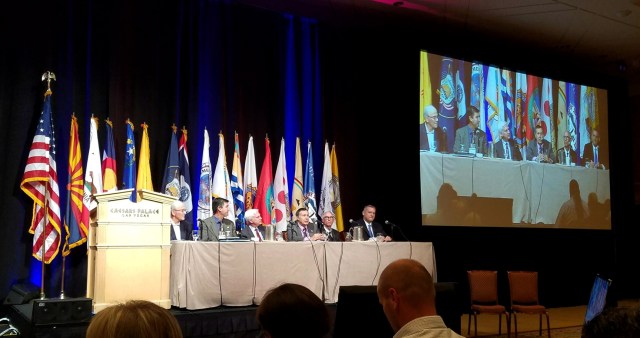
Arizona Water Resources Director Buschatzke joins a panel of California and Nevada water users discussing drought strategies

CRWUA meetings, Las Vegas — Following a welcome from Colorado River Water Users Association President Bart Fisher, Water Resources Director Tom Buschatzke joined a keynote panel, titled “California – Conservation, Transfers and Drought Contingency Planning in the Lower Basin.”

Buschatzke joined John Entsminger, general manager of the Southern Nevada Water Authority; Kevin Kelley, general manager of the Imperial Irrigation District; Jeff Kightlinger, general manager of the Metropolitan Water District of Southern California; and, John Powell, Jr., President of the board of directors of the Coachella Valley Water District. The panel was devoted in large part to an airing of the most pressing drought-related water issues facing the Southwest, with an emphasis on those confronting major southern California water providers.

The panel was devoted in large part to an airing of the most pressing drought-related water issues facing the Southwest, with an emphasis on those confronting major southern California water providers.

Buschatzke told the audience of about 400 attendees at the Colorado River Water Users Association meetings that his State remains well-prepared in the near-term for the effects of the lingering drought. But he emphasized that, going forward, a drought contingency plan would be beneficial to all Colorado River water users, not just those in Arizona.

“The guts of the deal have been incentivizing flexibility,” said Buschatzke.

“At the bottom end, if we do get into trouble despite our best efforts, we do have a backstop.”

Kelley of the Imperial Irrigation District defined for an audience his concerns for the future of the Salton Sea, which has receded dramatically in recent years, exposing an enormous, now-dry expanse of former lake bed contaminated by decades of agricultural run-off.

“For us, it’s an existential threat,” said Kelley, who added that the area of the Salton Sea would be an “incredibly desolate” region if the lake dries up.

Nevertheless, he expressed confidence that a drought contingency plan that includes water for the Salton Sea remains a priority for his district’s users:

“We expect that there will be a solution to the Salton Sea because the situation at Lake Mead demands that there be one,” said Kelley.

On a much lighter note, Kightlinger of the Metropolitan Water District of Southern California, the largest municipal water provider of the Colorado River system, joked that “We’re this agency in southern California, and we want to make our problems your problems.”

The audience representing the entire range of system water users roared in laughter.

Kightlinger noted the vital nature of the Colorado River system to his region’s water supply (observing, for example, that one in every 15 Americans gets water from his district). He also praised the recent U.S. Senate legislation that provides drought relief for the region, especially for California.

Powell of the Coachella Valley district told the audience that water levels in the valley’s enormous aquifer have been going up since 2005, an important conservation signal.

Buschatzke told the audience that Arizona Gov. Doug Ducey is a strong proponent of maintaining the health of the Colorado River system. He recalled that Ducey had been in Las Vegas earlier in the week discussing water issues at a U.S. Chamber of Commerce-sponsored event.

“For Gov. Doug Ducey, DCP is his number one water related priority,” said Buschatzke.