Arizona drought status summary, May 2017

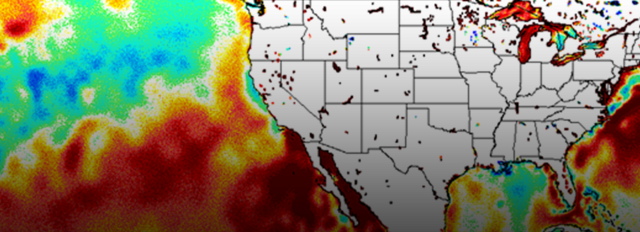
AZ drought image June 2017

Short-term Drought Status Summary for May 2017

While several storm systems passed through the state in May, the precipitation fell primarily across central and northern Arizona, leaving southern Arizona relatively dry.

The dry spring that followed the dry winter in southeastern Arizona led to deterioration in drought conditions in this area. Pima, Cochise, Santa Cruz, southern Maricopa, Pinal, Graham and Greenlee counties are now all in moderate drought (D1).

Until the monsoon activity begins, conditions are not likely to improve, and fire danger continues to be high in central and southern Arizona.

Long-term Drought Status Update: January – March 2017

The winter storms in January and February combined with the earlier storms in November and December brought significant rain and snow to northern and central Arizona.

The relatively heavy winter precipitation has finally improved many watersheds that were bordering an improvement over the past six months or longer.

Long-term drought and water supply conditions in northern Arizona and the Salt River watersheds are much better than they were over the past six to ten years. However, this winter was still not as wet as in late 1980s and early 1990s, before this drought began, and abnormally dry conditions still persist in many parts of the state.

Water Resources director exchanges chip shots on water in Arizona on “For Love of the Game” sports radio show

For Love of the Game image

Water Resources Director Tom Buschatzke appeared live Monday with Mike “Uncle Buck” Rafferty on NBC Sports Radio 1060 AM’s “For the Love of the Game” program. Uncle Buck wanted to talk water — specifically, the use of water by golf courses — with the director, who, for some reason, Buck insisted on referring to as “Thomas.”

Clearly a genuine, heartfelt fan of golf and the golf industry, Uncle Buck peppered the director with a lot of well-developed questions about the importance of wise water use and about the history of water management in Arizona. It was a fun interview. And for anyone curious about the extent to which golf courses now go to conserve water, an informative one.

As noted, Uncle Buck came to the 17-minute interview prepared with well-developed questions, especially considering how complicated water as an issue can be. In fact, their interview may represent the first time ever that a sports-radio talk-show host inquired about the complex genesis of groundwater management in Arizona. (Click here to hear the interview)

Groundwater documentary and discussion in downtown Prescott on Wednesday

Kathy Ferris

Groundwater expert and documentarian Kathleen Ferris, discussing her film on the creation of the 1980 Groundwater Management Act

It is always helpful to have a solid appreciation for the past before making big decisions about the future. Especially when the subject is water.

Prescott and surrounding northern Arizona communities are hard at work right now attempting to accurately analyze their water future. In March, the high country community, along with Salt River Project, agreed to conduct a refined groundwater-flow model for the Big Chino Sub-basin, which Prescott anticipates will be an important future water supply. The plan is to accurately assess the hydrogeologic connection of the Big Chino aquifer with the Upper Verde River.

The analysis is expected to be completed in 2020.

On Wednesday, meanwhile, the producers of a much-acclaimed documentary on the history of Arizona’s landmark groundwater-protection act — the Groundwater Management Act of 1980 — have scheduled a viewing of their film in downtown Prescott this week.

Kathleen Ferris, Senior Research Fellow at the Kyl Center for Water Policy at Arizona State University, and her movie-making partner, film producer Michael Schiffer, will host the presentation at the Elks Theater at 117 E. Gurley Street in Prescott on Wednesday evening.

Immediately following the 26-minute viewing, Ferris will host a panel discussion on the present-day issues facing Arizona’s water supply — including a discussion of what steps, if any, the Arizona Legislature ought to take to update the 37-year-old Groundwater Code.

The six-person panel will include Tom Buschatzke, director of the Arizona Department of Water Resources. Joining Buschatzke will be Greg Kornrumph of SRP, Sarah Porter of the Kyl Center, Yavapai County Supervisor Thomas Thurman, town of Clarkdale Mayor Doug Von Gausig, as well as Schiffer.

Doors open at 6 p.m. More information is available online at https://www.facebook.com/GroundwaterFilmScreeningandDiscussion


Panel recommends Arizona drought declaration continue for umpteenth year

Banner from Slide

It is, indisputably, the best weather show in Arizona all year.

Nothing against the fine work of Arizona’s TV weather forecasters and meteorologists, but the best two hours of weather analysis, climate analysis, near-term predictions, long-term predictions, precipitation, Colorado River flows and the various impacts of all of it is the report of the Governor’s Drought Interagency Coordinating Group.

On Tuesday, the panel of water-weather-climate-watershed experts concluded Arizona remains in a state of drought.

As they have consistently since 1999, the coordinating group’s members voted to make an official recommendation that a letter be sent to the Arizona Governor alerting him to that fact.

The recommendation will serve as the basis for an official drought declaration from Gov. Doug Ducey.

“Our outlook has improved and there have been a lot of proactive efforts to mitigate our (water) risks,” said Wendy Smith-Reeve of the Arizona Division of Emergency Management. Together with Arizona Department of Water Resources Director Tom Buschatzke, Smith-Reeve co-chairs the coordinating group.

“(But) while our short-term outlook is positive, long-term recommends we continue with a drought declaration,” she said. “This is not the time to stop pressing forward.”

Preceding that decision was some of the clearest and most precise weather-climate analysis provided anywhere in the state.

State Climatologist Nancy Selover and Mark O’Malley of the National Weather Service provided a near-term retrospective and near-term prediction, respectively, on the state’s weather.

Arizona State Climatologist Nancy Selover

A thumbnail: weather in the recent past has been a little wetter; weather in the near future, meanwhile, looks at least 50-50 to stay that way.

“Our monsoon picked up a lot of good activity, but for the short-term it still has been a little dry in the southern part of the state,” said Selover, analyzing the 2016 summer storm season.

Regarding the approaching summer monsoon season, O’Malley explained that the intensity of the rainy season will be determined by the “persistence” of a subtropical high-pressure system.

“If the high (pressure system) moves to the north (of Arizona), we get the moisture,” he said.

O’Malley said there is a “50-50” chance that conditions this summer will be ripe for the advent of a so-called “El Nino” weather pattern, which enhances the prospects of moisture in Arizona.

“Same for the (2017-18) winter,” he added.

As for air temperatures this coming summer, stow the sweaters: “It’s very favorable that we’ll be warmer than average,” he said.

Conditions at Lake Mead and on the Colorado River, meanwhile, are moderately improved from last year, continuing the trend of positive effects arising from the strong, early-winter snowstorms in the western Rocky Mountains, said Jeff Inwood of the Department of Water Resources.

Mark O’Malley of the National Weather Service

A warmer, “less wet” spring, however, kept the snowpack from fueling a banner-year runoff into the Colorado River system, said Inwood. Nevertheless, the good (if not quite ‘great’) news is that Lake Mead water levels stand now at about ten feet higher than at this time last year.

Inwood’s report, of course, directly impacts the on-going drama surrounding the chances that Lake Mead may descend to a depth that would trigger a water-delivery shortage declaration for Colorado River water users.

“As a result of the improved hydrologies, we are seeing decreased probabilities of a shortage,” said Inwood.

The report on Colorado River conditions dovetailed with the next presentation, a report on progress toward a drought contingency plan – including both inter- and intra-state agreements – by Water Resources Director Buschatzke.

Buschatzke, too, observed that “we’re in good shape going forward,” but reminded the audience that the chronic structural imbalance in Lake Mead remains. About 1.2 million acre-feet more water is extracted from the reservoir each year than on average flows into it.

Arizona Department of Water Resources Director Tom Buschatzke

Buschatzke updated the coordinating group on the progress of drought contingency planning negotiations.

The Water Resources director also reported that the Fiscal Year 2018 state budget recently passed by the Arizona Legislature included $2 million for each of the next three years for funding conservation efforts in Lake Mead.

Charlie Ester of Salt River Project reported that Arizona’s mountains enjoyed a wetter-than-average winter season, too. But not a record-breaker.

By mid-winter, SRP was crossing its fingers for a snowpack that might fill its premier reservoir, Roosevelt Lake. A dry April and snowfall that “didn’t slide” into the White Mountains — the main watershed for Roosevelt Lake – kept the big reservoir at just 76 percent of capacity, he said.

Still, inflow into Roosevelt wasn’t shabby: Prior to the winter snows, Roosevelt had dropped to just 44 percent of capacity. 

Charlie Ester, Salt River Project

The snowpack in Arizona’s Ponderosa pine country, meanwhile, was good enough to make the state’s approaching fire season “manageable,” said Jeff Whitney of the Arizona Department of Forestry and Fire Management.

In the forests, said Whitney, “we’re looking at a ‘normal’ year.”

“It’s not out of the realm of probability that we could have an upper-elevation fire,” he said. “But I see it being manageable.”

The real challenge, he said, would be in lower-elevation grasslands, which feasted on winter rains and now present a serious fire danger. Whitney noted the southern Arizona Sawmill Fire, which consumed 47,000 acres of mostly grasslands, as well as the smaller Mulberry Fire.

Thanks to the prospects of an earlier-than-average monsoon season, he said, “we are guardedly optimistic – with the caveat that we will have an elevated amount of lightning.”

At that, the co-chairs recommended – and the coordinating group unanimously supported – a recommendation of another drought declaration to be sent to the governor.

Real people, affected by real-world water policy, gather to talk about dealing with it

WFP 2

Western Farm Press, May 7, 2017

The talk about stabilizing Lake Mead and resolving chronic over-allocation of the Colorado River system tends to dwell at the 30,000-foot level.

It’s all about how cutbacks might affect the states. It’s about law and policy. About the consequences of inaction for millions of people and for industries, like agriculture, valued in the billions of dollars.

At some point, though, someone has to think retail. Someone has to contemplate the real-world, on-the-ground impact of what happens at the end of the irrigation canal for the end-user of Colorado River water that may no longer be flowing in quite the volumes that it used to flow.

Unsurprisingly, there are such people contemplating the consequences of the anticipated multi-state “drought contingency plan,” which at some point might result in cuts to Arizona’s allocation by hundreds of thousands of acre-feet of Colorado River water.

About 350 of them – mostly Arizona farmers and ranchers – recently attended the 2017 Irrigated Agriculture Conference, a one-day event in Tucson that this year included 33 speakers analyzing the kind of water-wise management practices that will work best when and/or if a shortfall is declared on the Colorado River system.

Speakers and attendees shared views on water-conservation strategies and water-wise cropping systems. Arnott Duncan of Duncan Family Farms, for example, told attendees how his irrigation system is specifically designed for the organic-vegetable crops he grows.

Speakers weighed the relative importance of balancing lower water-use crops with higher value crops to get the most bang for their farming buck.

The Western Farm Press story on the event can be found here.

A word about Western Farm Press: More than a mere niche publication, WFP has almost 19,000 subscribers and gets annual page-view counts approaching two million. The linked story above is typical of WFP: it reports on and analyzes farming issues from the point of view of the local farmer. It’s not just an “industry” publication. It’s a “how industry issues affect real people” publication.

Drought to continue in Arizona? We’ll find out tomorrow

May 2 2017 drought monitor report

The water-news cycle has drifted east all the way across the continent.

It seems like just yesterday the drought story was all about California. Now, the nation’s eyes have shifted all the way from the Left Coast to the Right Coast as drought worries have ebbed in the Land of Avocadoes, but have intensified in the Land of Grapefruit.

Not to be snowflake-y about it, but what about us and our needs? Arizona has been dealing with this drought phenomenon far longer than California and Florida combined.

The formal process to determine whether Arizona officially will enter its 18th consecutive year of drought is approaching.

The Governor’s Drought Interagency Coordinating Group will meet tomorrow, May 9, here at the Arizona Department of Water Resources (1110 W. Washington St., Phoenix, Suite 310, 10 a.m. – 12 noon). And while the details about Arizona’s climactic conditions no doubt will prove fascinating, the ultimate conclusions of the panel don’t look all that much in doubt.

Although dry conditions have ebbed, particularly through the most recent winter months, Arizona continues to see a substantial portion of its territory in drought. The drought portrait has improved considerably since early 2016 — only a tiny portion of southwestern Arizona remains in a “severe drought” condition, which is the second-highest drought category.

The coordinating group will report on drought conditions, Colorado River water-supply conditions and the weather outlook for the upcoming summer and winter seasons.

Parking is limited, so it helps to RSVP by email to ehenenson@azwater.gov. The meeting also will be available via phone and webinar.

To attend the meeting via phone and webinar: Call-in Number: 1-877-820-7831 / Passcode: 886948#

Web Meeting Link: https://stateofarizona.centurylinkccc.com/CenturylinkWeb/Verdes

At the end, the ICG will be asked to make a recommendation to Gov. Doug Ducey about whether or not he should keep the drought declarations currently in place.

Arizona Department of Water Resources will survey wells in parts of Yavapai and Coconino Counties

Graphic 2

PRESS RELEASE

FOR IMMEDIATE RELEASE                                  CONTACT: Doug MacEachern      

March 10, 2017                                                             PHONE: 602.771.8507

Arizona Department of Water Resources will survey wells in parts of Yavapai and Coconino Counties  

Phoenix- March 10, 2017 – Beginning in early March, the Arizona Department of Water Resources will be making an extensive effort to measure water levels in wells in the Prescott Active Management Area and the Verde Basin (see attached map).

Every year the Department’s field services technicians collect water levels in a statewide network of about 1,600 to 1,800 “index” wells that have typically been measured annually over the last several decades.  There are roughly 250 groundwater index wells measured annually or semi-annually in the Prescott AMA/Verde Basin region.

During the remainder of the 2017 field season Water Resources staff will measure several hundred wells in the Prescott AMA/Verde River basin area in addition to those 250 index wells.

This 2017 survey of area wells – or basin “sweep,” as it is known — will be the first such basin survey of the area since 2009. The data collected will be analyzed and used to obtain a comprehensive overview of the groundwater conditions and used to support scientific and water management planning efforts.

Frequently Asked Questions about basin surveys:

What will the ADWR do with the data?

The department uses the information from the basin survey to develop water level maps to support scientific, planning and management studies of the basin’s aquifer system.

The department produces invaluable “Hydrologic Map Series” reports, and “Water Level Change” reports which show groundwater conditions statewide.

What if well owners don’t want the ADWR measuring their well depth?

Participation and cooperation with the department’s basin survey is entirely voluntary.

The data collected from basin surveys has proved valuable to property owners and lessees just as much as it is to state and municipal water planners.

Why here? And why now?

Historically, the department measures its index wells in the Prescott/Chino Valley/Verde Basin area in the late winter/early spring. During this time, the water levels in the aquifer have typically recovered from the previous summer “pumping” levels and represent a more “static” condition which gives a more representative picture of what’s happening with the aquifers in the area.

Do well owners and lessees get to review the data?

Arizona Department of Water Resources data are all public records. Data collected should be available by early to mid-summer. As maps are completed, the data will be available via the department’s website at azwater.gov. The department’s Groundwater Site Inventory (GWSI) well database is available at: https://gisweb.azwater.gov/waterresourcedata/GWSI.aspx

For more information regarding this matter, please contact Doug MacEachern, Communications Administrator, at dmaceachern@azwater.gov or (602) 771-8507.

###

Seriously? Yes, seriously: Drought-busting moisture levels in parts of the state don’t mean the Arizona drought is done

Record snowfall in the Sierra Nevada…double the average snow in parts of the Rockies… one “atmospheric river” after the next hitting the coast…and enough snowpack in the eastern Arizona mountains to give Lake Roosevelt an outside chance of filling up this spring…yet Arizona remains in drought? Yep


The news is abundant in the West about all the moisture abundance occurring nearly – accent, nearly – everywhere.

Western saturation is the biggest story of the winter in the U.S.

In some areas of northern California, rain totals reached 400 percent of normal in December.  January snowpack in the Sierra Nevada mountains stood at 173 percent of normal, the equivalent of 5.7 trillion gallons of water.

It wasn’t just California experiencing all those remarkably wet atmospheric rivers. As early as mid-January, the Colorado River snowpack stood at 57 percent above the long-term median for that time of year and that was before the big storms of early and late February swept through the Rockies.

Westwide SNOTEL Current Snow Water Equivalent (SWE) Percentage of Normal

The U.S. Department of Agriculture’s latest “Westwide SNOTEL Current Snow Water Equivalent Percentage of Normal” maps of the western mountains are more purple than a ripe eggplant, indicating vast swatches of the region with snowpack deeper than 150 percent of average.

All of which sounds splendid, seemingly alive with drought-busting possibilities… until you have a look at the sobering reality on display in the U.S. Drought Monitor short-term report for February in Arizona.

The February Drought Monitor report may provide the best evidence of the 2016-2017 winter in the Western U.S. for three consistent climate truisms:

  • “Weather” is not the same as “climate,” and
  • Drought is more closely aligned with climate than with weather; and,
  • Drought may come and go in a region, but it comes and goes at different paces in different parts of the same region

The February report concluded: “February was a relatively dry month across parts of the state bringing less than 50 percent of normal precipitation over the eastern third of Arizona and a few spots in northwest Arizona.”

U.S. Drought Monitor – Arizona (February 28, 2017)


Relatively… dry?

This may come as a huge surprise to residents of Maricopa, Yavapai, Coconino, Yuma and La Paz counties, where “much wetter than normal conditions” prevailed. But, then, central Arizona is where most of the residents of the state are too. Most Arizonans were getting wet from the same rainstorm.

It’s a big state. As State Climatologist Nancy Selover notes, the big storms brought plenty of cold air and snow to the northern and western parts of the state, but tended to short-shrift the eastern-mountain watersheds: “They have tended to miss the southeast and many of them have missed the White Mountains as well.”

The headwaters of the Salt and Gila rivers are “below average in snowpack for this time of year,” she said. “Though the Verde is above normal.”

That, Selover observed, is “all short-term drought.”

“We have not had the type of precipitation that will replenish our water resources, so we are not anywhere near being over the drought for long-term water resource concerns.”

Still, said Selover, February overall was “a helpful month” in terms of contributing to the 2017 Water Year profile, which depicts healthy moisture levels since October.

The National Weather Service map of Arizona depicting “Seasonal Precipitation, October 2016 – February 2017” may not  have quite the “ripe eggplant” look as the Western snowpack map, but it’s not far off.

A map of the whole Colorado River Basin rainfall for February and the 2017 Water Year through February map

So where does this mostly-better-than-average winter leave Arizona?

As a part of the Southwestern region? Great: “The Upper Colorado Basin is in great shape this year so far, but we need three or four more consecutive years like this to make up for the deficits,” said the State Climatologist.

But Arizona, specifically? Good, sure. But not great:

“For my money, we are entering the 23rd year (of drought) now,” said Selover.

“I think it started in 1994 after the very wet 1993.”


Ebbing Away: Latest land “subsidence” monitoring report finds lower ground levels and fissures in some regions of Arizona

earth-fissures-pic

The problem of land subsidence in Arizona – the lowering in elevation of land-surface levels, largely the result of groundwater extraction – is a decidedly mixed bag, the Arizona Department of Water Resources is discovering.

Thanks to decreased groundwater pumping in the Phoenix and Tucson Active Management Areas, for example, subsidence rates in many areas of those AMAs have decreased between 25 and 90 percent compared to rates in the 1990s.

That is just one of the major findings of the department’s recent “Land Subsidence Monitoring Report No. 3,” released earlier this month.

And it’s the news from the happy side of the bag.

On the opposite side, land subsidence statewide is proving to be an increasingly serious challenge that is causing problems for infrastructure in some areas. And it is proving to be a headache even in certain parts of active-management areas.


Monitoring for subsidence


As the report describes, Water Resources first began monitoring for subsidence in the eastern areas of the Valley and around Luke Air Force Base in the west after numerous “non-exempt” wells – that is, wells that draw up groundwater at rates faster than 35 gallons per minute – were installed starting in 1997.

Historically, land levels in those areas have dropped at significant rates, the recent report finds.

The problems caused by land subsidence do not go away simply by fixing cracked foundations, reconnecting broken pipelines or repairing roadways.

Subsidence is caused by the collapse of open-pore spaces in subsurface aquifers, an unseen water-storage catastrophe in the making. When the open-pore spaces of aquifers fully collapse, they collapse permanently, in most cases.

“Land subsidence is a regional problem for some groundwater basins in the state and may continue to be an ongoing problem,” said Brian Conway, who prepared the report on behalf of Water Resources.


Arizona Department of Water Resources’s Brian Conway, Supervisor for the Geophysics/Surveying Unit

“Even if sustainable, safe-yield groundwater withdrawal occurred, residual land subsidence would continue until the groundwater levels recover — and/or the open pore-spaces in the sub-surface fully collapse.

As one would expect, the Water Resources report finds that subsidence is most active in regions outside the active-management areas – that is, in areas where groundwater pumping is unregulated.

Land subsidence has resulted in more than 160 miles of earth fissures. The Arizona Geological Survey maps all the earth fissures throughout the state. The Geological Survey analysts provide Water Resources with the data from their research.

The Geological Survey and Water Resources analysts have found that the Willcox Groundwater Basin in southeastern Arizona is the most active area for forming new earth fissures.

Southeastern Arizona is one of the regions most severely impacted by drought. The area also has seen substantial increases in farming operations that rely on mined groundwater.


Earth Fissure


The Willcox Basin is outside the reach of the state’s Groundwater Management Act of 1980, which regulates groundwater extraction in active-management areas. According to the report, new earth fissures in the area are impacting roads, highways, power lines and a pipeline.

The report observes that other non-AMA regions of the state also have seen considerable increases in their rates of earth subsidence, notably parts of the McMullen Valley Basin and the San Simon Valley Sub-basin. Both of those regions have seen increased agriculture activity in recent years that is reliant on mined groundwater

The subsidence mapping process employs the latest radar technology — known as “InSAR,” or satellite-based synthetic aperture radar.

The introduction of the InSAR technology has proved to be a game-changer in terms of the state’s ability to accurately track the development of subsidence over time.

Water Resources was awarded a $1.3 million grant from NASA in 2002 that kicked off a three-year effort to integrate the InSAR system into Arizona’s subsidence-monitoring programs.

The program now has 14 different partners in the effort whose financial support allows the department to fund the InSAR data collection.

The side-looking, self-illuminating, radar-imaging system has helped Water Resources develop an extensive library of scenes, covering an area greater than 150,000 square miles.

With the InSAR data, Water Resources has identified more than 26 individual land subsidence features around the state, collectively covering more than 3,400 square miles.

“The InSAR data is a huge part of our monitoring efforts now,” said Conway.

“We are able to cover large areas with the data and are able to see millimeter changes of deformation at a very high resolution.”

An end-of-year report: Why Water Resources is putting more resources into informing the public about what we do

graph-6

It is a safe bet that at one time or another nearly every member of the Water Resources team has needed to explain to an acquaintance what we are not.

No, we’re not the people primarily responsible for assuring the quality of the state’s water supply. Those are our valued colleagues over at the Arizona Department of Environmental Quality.

ADEQ is just across the hall. Come on over some day. We’ll introduce you.

Water Resources protects the state’s water supplies. It is our complex duty to help assure the taps keep flowing.

But, no, we’re not your water provider. Not exactly. In most cases, that would be your community’s water department, like the city of Phoenix. Or – in big-picture terms – our friends over at the Central Arizona Project. Or the Salt River Project.

All of them literally deliver water. We help assure the supply. For the entire state.

And we do more. Lots more. At which point, your casual conversation with that acquaintance gets really complicated.

“It is the mission of the Water Resources communications team to express to the public – to those millions of “acquaintances” out there – what it is that this small-but-vital division of Arizona’s government does. As you can see, there’s a lot to it.”

We administer and enforce the most far-sighted groundwater-management laws in the nation. And, not to brag, but we’ve done that job so well that water demand in many of our communities – despite skyrocketing population and economic growth – has remained flat.

In fact, since 1986, we’ve stored over three and a half trillion gallons of water underground for future use.

Other states and localities have been forced to resort to emergency water-saving measures to combat drought conditions that seem to have caught them by surprise. Through Water Resources, Arizona has been vigilantly preparing for drought for decades.

We negotiate with external political entities – including other states and the federal government – over Arizona’s rights to the Colorado River, a mind-bendingly complex mix of salesmanship, diplomacy and a raw determination to protect the vital interests of Arizonans.

We assure the safety of non-federal dams. We collect and analyze data on groundwater levels. We research the complex intersections of weather and climate and create modelling that attempts to accurately assess Arizona’s water future.

“Other states and localities have been forced to resort to emergency water-saving measures to combat drought conditions that seem to have caught them by surprise. Through Water Resources, Arizona has been vigilantly preparing for drought for decades.”

And we are actively – indeed, urgently – working with Governor Ducey to seek out ways to augment Arizona’s water supplies while taking steps to further conserve what we already have.

That’s not the end of it. Not by a long shot. But you get the picture.

It is the mission of the Water Resources communications team to express to the public – to those millions of “acquaintances” out there – what it is that this small-but-vital division of Arizona’s government does. As you can see, there’s a lot to it.

Gov. Ducey has asked each division of state government to report on their efforts to put into practice efficiencies and best-management practices taught by his “Arizona Management System” instructors. It is part of the governor’s commitment to assure the public gets the most bang for its tax-paying buck.

From time to time in the coming months, this Arizona Water News newsletter will report on the progress that our teams here at Water Resources are making at implementing those AMS efficiencies.

We’ll describe how our strategic-planning team is doing. And report on the efficiency efforts of our team coordinating the Assured and Adequate Water Supply program. We’ll describe how the work of our hydrologists, geologists, engineers, modelers and surveyors is progressing.

This week? Well, it’s all about us. The Water Resources communications team. To paraphrase the late, indefatigable mayor of New York, Ed Koch, “How are we doin’?”

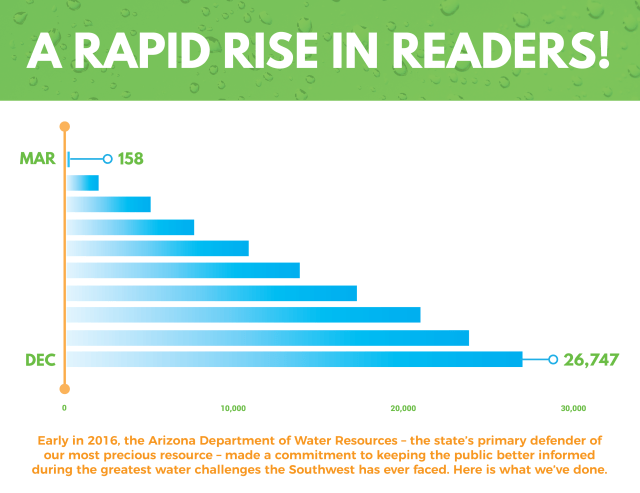
Our Arizona Water News newsletter – the “flagship” of the Arizona Department of Water Resources media empire – increased its subscriber listings from 134 in March to over 2,000 by the end of the year.

Since the early months of 2016, the Water Resources communications team has taken steps to accomplish two primary goals: 1) to enhance public awareness of the condition of the state’s water supply during an epochal period of drought; and, 2) to ensure the transparency of the records and data to which the department has been entrusted.

To accomplish that first goal, we have done a simple thing. It is the same thing that communications teams large and small in our fragmented, decentralized, mostly-online media world are attempting to do: We are expanding our viewing audience by providing useful, timely information and by carefully tracking what our analytics tell us interests that audience.

So, how’s that doin’?

In March 2016, the Water Resources news site attracted 158 page-views. We made a commitment to increase website viewers to 11,000 by year’s end. We blew past that figure in mid-summer and re-set our goal at 20,000. In December, we tallied 3,114 page views, and we logged a total of 26,747 page views for the year. Speaking technically, we crushed it.

How? Well, we gave our audience valuable water-related news to consume, of course, including a multi-media supply of written features, audio podcasts and YouTube video, all of which we made more easily accessible.

But we also dramatically diversified how our audience finds us.

Our Arizona Water News newsletter – the “flagship” of the Arizona Department of Water Resources media empire – increased its subscriber listings from 134 in March to over 2,000 by the end of the year.

Our presence on Twitter and Facebook has increased exponentially. In March, we counted 480 profile visits and 4,272 impressions. In December, those figures stood at 3,914 and 77,100, respectively.

“The advancing news cycle, obviously, played the dominant role in the growth of media interest in water issues involving Arizona and the Southwest. There is that matter of descending water levels at Lake Mead, after all. Still…”

Not all those readers are local readers, either. Our analytics show readers coming to our pages from Canada, India, the United Kingdom, Mexico and at least eight other countries.

In mid-December, meanwhile, we launched our Arizona Water News blog, a regularly updated news feature that began as a special “live news” report on Colorado River negotiations among Upper and Lower Basin Colorado River water users. One recent blog post between Christmas and New Year’s Eve attracted over 700 readers.

Small potatoes by New York Times standards? Well… OK. Sure. But the growth curve is up. Not all “media centers” can say that.

Precious few of them, for that matter, can say they have increased their audiences without having spent a penny on promotion or advertising – or on anything outside their own doors. At Water Resources, all the media magic happens here.

What’s more, our effort to problem-solve our way to better public outreach is bearing fruit in another important respect: It appears to be improving the factual awareness about Arizona’s water story among news media in and outside the state.

Our (admittedly subjective) log of accurate news-media reports on water issues in Arizona tracked an average of one or two reports a month in early 2016 that in our judgment related a factually accurate story.

 In November, we recorded 39 such reports, including news accounts published by Politico, International Business Times, the Denver Post, the Los Angeles Times and the Wall Street Journal.

The advancing news cycle, obviously, played the dominant role in the growth of media interest in water issues involving Arizona and the Southwest. There is that whole matter of descending water levels at Lake Mead, after all.

But we’re also confident the steps we have taken to assertively tell Arizona’s water story ourselves have had an impact. Many, if not most, of the media writing about drought in the Southwest now come to the Arizona Department of Water Resources for accurate and timely water data and analysis.